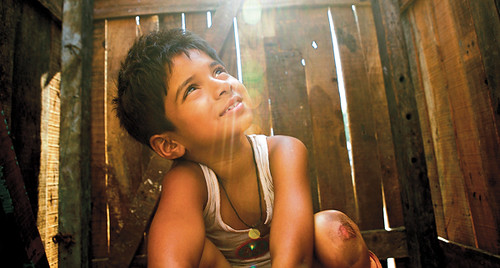
Ebbe the movie by Jane Magnusson and Karin af Klintberg
The nominations for the Swedish Guldbagge, the equivalent of Quebec’s Jutras were very interesting. In the documentary category Ebbe the movie by Jane Magnusson and Karin af Klintberg is a fascinating film about Publisher Ebbe Carlson, a larger-than life character whose social climbing and political manipulations during several were so complex that it’s impossible to distinguish fact from fiction. Wisely, the filmmakers don’t try doing that, opting instead for an exploration of ambiguities and contradictions. And they got the award. Videocracy by Eric Gandini ( who also made Surplus and Sacrificio) takes us behind the scenes of Berlusconi’s media & political power grabs and corrupt schemes in Italy. The Queen and I, which I personally liked less, tells the story of Swedish-Iranian filmmaker Nahid Persson-Sarvestani’s relationship to the former Queen of Iran Farah Diba and the recent history of that country.
It’s interesting to see that two of these films were made by swedes born outside of Sweden. And overall in this years Swedish Jutras, the women had the majority of the important nominations. Not only among the documentarians ( 2 out of three for best documentary), but also in fiction: 2 out or 3 of the directors ( Lisa Siwe got the nod) and 2 out of 3 script writers. According to a film industry agreement, signed in 2006, the women “should” receive at least 40% of the subventions for script, directing and production. So far the goals haven’t been reached (it’s still between 20 to 30%) and the Swedish organization WIFT demands a change into making the 40% obligatory.
For more information, contact: info@wift.se
Ebbe the movie de Jane Magnusson et Karin af Klintberg Plusieurs films intéressants étaient en nomination pour l’équivalent des Jutras en Suède, les Guldbaggar.
Dans la catégorie documentaire, Ebbe the movie de Jane Magnusson et Karin af Klintberg est un portrait fascinant de l’éditeur Ebbe Carlsson qui a monté les échélons de la politiques suédoise grâce à des manoeuvres tellement complexes qu’on ne saurait distinguer la réalité de la fiction. Le film d’ailleurs évite sagement de le faire, et opte pour une exploration des ambiguités et contradictions. Récompense: prix du meilleur documentaire. Videocracy de Eric Gandini ( à qui on doit également Sacrificio – Who Betrayed Che Guevara et Surplus – Terrorized into being consumers) nous amène derrière les coulisses du régime médiatique et politique corrompu de Berlusconi en Italie. La Reine et moi, que j’ai personellement moins aimé, explore la relation de la réalisatrice Nahid Persson-Sarvestani’s avec la Reine déchue de l’Iran Farah Diba et l’histoire récente de ce pays.
Intéressant de voir que deux de ces films sont réalisés par des Suèdois originaires d’autres pays. Mais surtout,cette année, les femmes avaient une majorité des nominations importantes pour les Jutras Suédois. Pas seulement parmi les documentaristes, mais en fiction: 2 sur 3 en réalisation ( Lisa Siwe a eu le prix), et 2 sur 3 en scénarisation, 2 sur 3 pour meilleur documentaire. Selon une entente pour l’Industrie du cinéma signée en 2006 les femmes ‘doivent’ reçevoir au moins 40 % des subventions pour scénarisation, réalisation et production. Cependant l’objectif n’est pas encore atteint (on est encore entre 20 et 30 %) et l’organisation suédoise de WIFT réclame un changement pour rendre le 40 % obligatoire.
Pour plus d’info communiquer avec info@wift.se
We are all of course terribly sad about the tragedy in Haiti – our family not the least since we have a daughter who lived her first years in Port au Prince. I of course encourage everyone to contribute money to the relief and reconstruction efforts.
Among the many film crews now in Port au Prince there is one which has a particularly interesting documentary mandate: Inside Disaster. Conceptually planned and negotiated well ahead of the Haiti earthquake, it will allow for both complexity and follow-up.
“The website that is up now is Phase 1 of the overall web plan for the film – we’re developing a much larger version that will launch alongside the doc at the end of this year. It’s intended to be a community and educational resource for people interested in the world of humanitarian aid – we’ll have debates, data visualization materials and a glossary, all illustrated with photos and video from this website and of course, the film. To encourage redistribution, we’re taking the creative commons, “open” approach to all the current content on the site and using tools like Flickr and YouTube for distribution. Our site is currently funded by TVO, Bell Fund (Development funding), and the CTF Digital Fund.”
Some people have raised questions about the impact of numerous camera crews using precious resources in Haiti presently.
On the DOC Canada discussion forum, Katie had this to say:
“the bigger picture problem is that the huge influx of international media creates an artificially inflated market for everyday supplies – gasoline, fixers, cars, bottled water, etc. The “internationals” will pay whatever it takes, and that pushes prices for essentials out of the reach of everyday people. Yesterday’s NYT is reporting that a bottle of water in the downtown markets is now going for $6 – prices like that force people to be dependent on aid, even if they have the resources to be self-sufficient in a “normal” Haitian economy.
So, that is definitely a legit criticism that can apply to our team and the rest of the media down there.
The flipside, of course, is that the huge media presence is driving a record amount of donations into aid organizations; these donations matter, and their numbers are directly tied to media coverage. Our team is going to be there until February 16th, long after most of the international media has gone home.
They’re also going back in six months to film a follow-up on the recovery. And then when the film is released early next year – likely one year after the event – it will bring Haiti and its reconstruction back into the spotlight in Canada, and hopefully internationally.
So: we’re primarily storytellers, not fundraisers, but we’re glad when the two get tied together (which is why we have a IFRC donation button on our site).”
I just saw the filmThe Informant! labeled a dark comedy, directed by Steven Soderbergh, starring Matt Damon, based on the 2000 non-fiction book by the same name by journalist Kurt Eichenwald. It tells the story of a bumbling whistleblower who takes on the management of the giant agribusiness corporation he works for, but who is too naive and too compromised by his own complicity in the corporate game to succeed. Indeed, at the end of the movie he ends up in jail.
I often find fiction films more inspiring than documentaries when it comes to structure, style and texture, and this is one example. ( Another fairly recent one, which I loved for the style of shooting and editing, was Enemy of the State.) You can learn an awful lot from watching The Informant! about the amount of complexity a film can handle, about character development and ‘narrative economy’ and about a creative and entertaining way to convey the thoughts of the main character.
In addition, I have a long-standing interest in the role and fate of whistleblowers who play a key role in the fight for accountability and democracy. I sometimes discuss these issues with the Executive director of FAIR ( The Federal Accountability Initiative for Reform) David Hutton.
David has this to say about The Informant! :
“Yes I did see the movie, and it was very entertaining. However, although Mark Whitacre helps expose a massive corporate fraud, he turns out to be a delusional fraudster trying to cover his own tracks with layer upon layer of untruths. This makes him completely unlike any whistleblower that I know.
The common characteristic that I have found among whistleblowers is personal integrity. They are ordinary people whose personal values simply would not allow them to collude in wrongdoing that would harm others. So they feel compelled to speak out even though this puts their own careers at risk. Even when their careers have been ruined, they often express no regrets, saying that they felt they had no choice but to do what they did. So in my mind the word ‘whistleblower’ is synonymous with ‘truth-teller’. Thank goodness that there are so many of them: they typically pay dearly for their courage, but the world would be a poorer and more dangerous place without them.”
The personal crises typical of the whistleblower experience are well rendered in another Soderbergh film, Erin Brockowich, one whose strength lies more in the writing and in the performances than in the visual treatment. Brockovich, as played by Julia Roberts, gets so caught up in her inquiry into corporate wrongdoing that she starts neglecting her children and her lover. When she receives a threatening phone call, it leads to increased stress and separation. The personal crisis theme is even more developed in The Insider, where Jeff Wigand (played by Russell Crowe) is subjected to all manner of blackmail,threats, intimidation and violence, with disastrous consequences for his family life. Again, the story line of The Insider stayed very close to the real life story, as told in the Vanity Fair article on which the film was based.
Thanks to Jessica Berglund and David Hutton for help with this post.
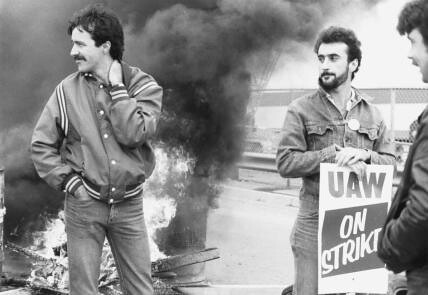
Still from the film ‘Final Offer’ directed by Sturla Gunnarsson
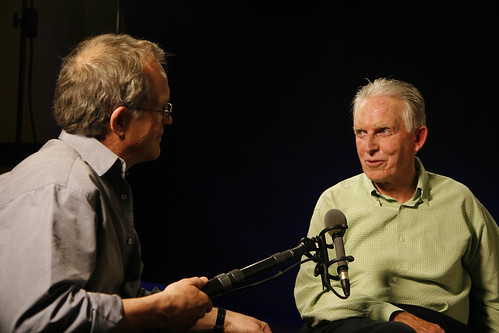
I recently had the opportunity to co-direct a 25-minute video for the Canadian Auto Workers with my wife Jocelyne Clarke. This is one of the very few commissioned pieces I have worked on in my 30 years of doing audiovisual work, but the Auto Workers is one organization I am pleased to work with. Not only does that union have a strong commitment to social justice, but it knows how to use film and video for educational purposes. The leadership of the union has also over the years shown an extraordinary openness to documentary filmmakers, not being afraid of letting them film life as it really was. This is evident in Sturla Gunnarson‘s excellent 1984 film Final Offer (NFB) which documented not just an important strike but the birth of the CAW as a Canadian Union, breaking off from the ‘international’ (US dominated) UAW. Another example is Barry Greenwald‘s terrific film The Negotiator (Barna-Alper 1995) which followed CAW president ‘Buzz’ Hargrove through some very difficult negotiations. And in Quebec, Louise Lemelin and Hélène Pichette made the excellent Troc: Made in Quebec which documented the fight against the closing of the Kenworth plant in Ste-Thérèse for Radio-Canada. I had an opportunity to talk to former CAW president Bob White, the main character of Final Offer, about the union’s attitude towards documentaries. If everyone shared his opinions, we would have an easier time making films !Video below the photo.
Interviewing Bob White, President of the Canadian Auto Workers
An image from Lech Kowalski’s ‘Hey! Is Dee Dee Home?’
Last week I saw the most creatively radical documentary I have ever seen, East of Paradise (2004) by Lech Kowalski. It breaks every convention of story development. The first half of the film is made up of an interview with Kowalski’s mother, about the horrors she experienced as a young girl at the end of the Second World War, in Russian-occupied Poland. Then he cuts to a medley of his own films of junkies on the New York underground scene, filmed over the last couple of decades. And what’s the link? The extreme. That becomes clear in the film, towards the end. Kowalski was here in Montreal for a retrospective of his films at the Cinémathèque Québecoise and had a chance to elaborate. To Kowalski life is real when you’re at the extreme limits of what can be tolerated, and that is what throws light on the rest of our existence. He explained how the horrors his mother had experienced set a sort of standard against which, it seemed, all his own experiences had to be measured. This led him to search out, in his own life and work, some extremely harsh realities. So in a sense, the totally unorthodox structure of his film was totally logical. At the discussion after the film the son of a holocaust victim talked about how he totally identified with this psychological dilemma, and brought up the question of a ‘survival gene.’ Kowalski totally agreed, he had received that also from his parents. After all they had been through to survive, he would not have the right to waste his own life, to become one of those junkies you see dying of overdose or AIDS in his own films.
Lech Kowalski [Photo: Jocelyne Clarke]
Kowalski believes that we are in a ‘post-documentary era’ where reality is too complex to be dealt with in an ordinary film, especially since film production and distribution are largely controlled by vested interests who are set against free creativity and analysis. He has created a web site called Camera War TV to create a new kind of documentary experience. I think this is a great concept, even though I found some of the films on the site less than impressive.
A fascinating encounter. And during the coming month we will have the time to see more of Kowalski’s films. D.O.A.: A Right of Passage (1980), Born to Lose: The Last Rock and Roll Movie (1999), Gringo: The Story of a Junkie (1987), Rock Soup (1991) and two films on Eastern Europe: The Boot Factory (2000) and On Hitler’s Highway (2002).
P.S. I am sure you saw the British clip on YouTube about Susan Boyle, the ‘unattractive’ woman singer whose performance brings down the house in a resounding victory over prejudice (represented by the attitudes of a talent-show jury). A wonderful little film with important issues, suspense, a terrific main character, excellent character development, a surprising turn-around, an uplifting outcome, reminiscent of classical stories like the ugly duckling and Cinderella. What more can you ask of a doc?
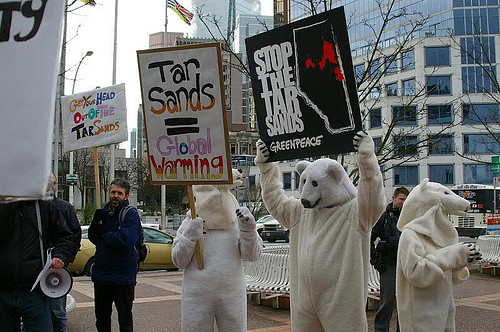
Manifestation en août 2006, réclamant que Exxon nettoie les plages et qu’il paie pour les dommages.
Un des meilleurs films que j’avais vu aux Rencontres Internationales du Documentaire de Montréal au mois de novembre sera aussi présenté cette semaine au Festival des Films sur les Droits, aussi à Montréal, et sera également diffusé à Radio-Canada la semaine prochaine. Le film est le produit d’un travail d’enquête de longue haleine, réalisé par Robert Cornellier dans le cadre de l’excellente maison de production Macumba International – dont je vous reparlerai au cours des prochaines semaines. Black Wave raconte la choquante histoire de l’impact environnemental dévastateur de l’accident du pétrolier Exxon Valdez en Alaska et la lutte des communautés affectés pour des réparations et une compensation adéquate. Je me suis entretenu avec Robert Cornellier.
Cette histoire est choquante. A-t-elle été bien couverte par les médias ? Aux États-Unis notamment ?
Il y a eu une grande couverture médiatique au moment de la catastrophe en 1989. Des journalistes et des caméras du monde entier se sont rendus sur les lieux pendant quelques mois. Puis cette histoire est tombée, peu à peu, dans l’oubli. Il y a eu un regain d’attention, principalement en Alaska, au moment du 10e anniversaire. Quelques bons articles faisant un bilan des conséquences ont été publiés. Puis c’est tombé dans l’oubli. J’ai commencé à couvrir cette histoire en 2004, lors du 15e anniversaire. Riki Ott et un groupe de citoyens de Cordova ont alors organisé une conférence de presse et quelques événements à Washington DC pour attirer l’attention sur leur cause, mais il n’y a pratiquemment pas eu de couverture. À peine quelques lignes provenant d’agences de presse. Finalement il y a eu une petite attention apportée par les médias lorsque la cause a été entendue à la Cour Suprême. Mais aucun papier d’analyse ou reportage de fond sur cette question. Pourtant les conséquences de ce jugement sont très importantes pour l‚avenir. Les citoyens américains viennent, ni plus ni moins, de perdre toute forme recours contre les compagnies pétrolières en cas de déversement pétrolier.
J’ai beaucoup aimé le film, seulement j’avais l’impression qu’on racontait beaucoup des événements du passé plutôt que de les vivre au moment ou les choses se passaient. Les événements se sont déroulés sur quelle période, et tu as tourné sur quelle période ?
J’ai commencé à travailler sur cette histoire en janvier 2004. La catastrophe datait déjà d’il y a 15 ans. À Cordova, le village de pêcheurs où nous avons tourné, les gens ne voulaient plus parler de cette histoire. Ils voulaient simplement reprendre leur vie en main et tourner la page sur le passé. Et la saga judiciaire était rendu au niveau de la Cour d’Appel (9th Circuit Court), et traînait depuis plusieurs années. La difficulté qui s’est posé, c‚est qu’il ne se passait pas grand chose. Le tournage de Black Wave a débuté en août 2006 avec la manifestation de bateaux juste en face du village. Ce fut la seule qu’il y a eu au cours des deux années du tournage. J’ai été constamment à l’affût d’événements. J’ai fait une douzaine de voyages en Alaska. Nous sommes allés pour le carnaval, pour la fête du 4 juillet. À chaque fois que j’apprenais que quelque chose allait se dérouler dans le village ou ailleurs, je m’y rendais. Il faut dire aussi, que du mois d’avril jusqu’au mois de septembre, toute la vie s’articule autour de la pêche. Le village est alors très tranquille. Puis au cours de l’hiver, une grande partie du village se vide, parce que beaucoup de pêcheurs et leur famille vivent ailleurs où ils gagnent leur vie parce qu’à Cordova il n’y a rien. Ce fut donc un réel défi de parler de cette histoire et d’essayer de la rendre vivante, parce qu’il ne se passait pas grand chose.Comme il y a eu beaucoup de déplacements, il fallait aussi faire des choix pour essayer de garder les coûts de production le plus bas possible. Il y a une partie du tournage où j’étais seul, c’est-à-dire que je réalisais, faisait la caméra et le son. Au cours de ce tournage j’ai réalisé à quel point c’est difficile de parler d’événements qui se sont déroulés dans un passé récent mais qui ne sont plus dans l’actualité, tout en essayant de les rendre le plus vivant possible.
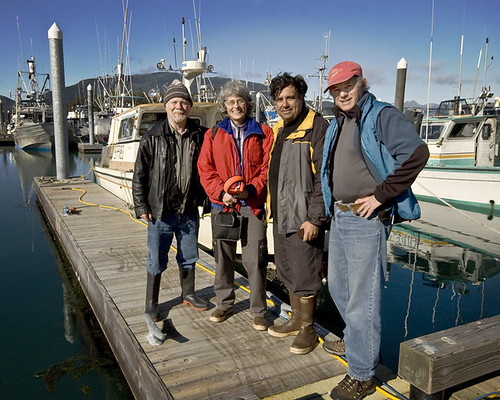
Equipe: Une partie de l’équipe de tournage à Cordova: de la gauche: Robert Vanherweghem, dir. photo; Riki Ott; Paul Carvalho, co-producteur et scénariste; Robert Cornellier, réalisateur et co-producteur.
I am screening a ton of rushes, not much time for writing. But I thought I’d pass on a couple of interesting links.
An image from the documentary ‘The Age of Stupid’
First, about the ‘crowd-funded’ documentaryThe Age of Stupid, by British documentarian Director Franny Armstrong and Producer Lizzie Gillett. Film completed, their aim over the coming months is to “turn 250 million viewers into activists, all focused on the UN Climate Summit in Copenhagen, December 2009
where the successor to the Kyoto Treaty must be finalized.”
I am familiar with Armstrong’s previous work, because she was one of the co-directors of McLibel, about the young activists in the U.K. who sued McDonald’s. During the same period, I made two films about attempts to unionize McDonald’s in Quebec (see my web site) and of course Morgan Spurlock made Super Size Me.
And now for some fiction, both acclaimed and controversial. Slumdog Millionaire is without any question the most successful film of the year, taking home numerous Oscars, including best film, Golden Globe award in the same category. It’s such a household word by now, I won’t describe it. Personally I liked it a lot, for its clever structure and great camerawork and editing. But I have close friends who are documentary filmmakers from Bombay, and they were not so thrilled. The sent me the following articles:
Mitu Sengupta: “Slumdog Millionaire: a Hollow Message of Social Justice” [here]
Following up on my post from last week, here’s part two of my interview with Jean-Daniel Lafond. How has he adapted to his newest role as “His Excellency” and a very active partner to Canada’s Governor General, Michaëlle Jean?
[Video interview clip further down.]
Of his current circumstances, Jean-Daniel says, “The challenge is to remain oneself and to defend the values one has always defended. There is a space for that.” His position is of a volunteer with an official status. He jokes that Canadians are getting “two for the price of one” and professes total solidarity with Michaëlle.
In his official capacity, Jean-Daniel has made culture his bailiwick, and suggests perhaps it is sorely in need of being defended in this country. It is critical to demonstrate the importance of culture, not just complain about lack of support, he says. He has created Point des arts/Art Matters, a forum and network for reflection and debate about artistic matters from all disciplines, bringing together practitioners, theorists and arts administrators of all political stripes. He has initiated the internet site Citizen Voices/Écoute des citoyens in an attempt to make the office of the Governor General more relevant and accessible, particularly to Canadian youth.
About making films, Jean-Daniel says he finds himself constantly in unexpected and extraordinary circumstances, for example in private conversation with heads of state, and in a most privileged position to observe the world, governance, diplomacy, the very highest echelons of power. He finds it simultaneously stimulating and frustrating. Given the opportunity, he would be making films all the time, but contents himself with gathering as much information – and some video material – as possible, building blocks or sources of inspiration for future projects.
The other day, as U.S. President Obama touched down in Ottawa, I asked my students at l’INIS, the Quebec Film school, a question. ‘Which documentary filmmaker will be meeting with Obama today?’ Puzzled looks, no answers. They asked for a lead. ‘OK, I said, he is also a French citizen.’ ‘Oh, of course,’ said Nathalie who used to work at the NFB. ‘I know who it is, but he’s not there because he’s a filmmaker.’
I recently had a chance to meet with and interview Jean-Daniel Lafond, the husband of Governor General Michaëlle Jean, during a visit to Montreal and on the occasion of a retrospective of his works, curated by Tom McSorley at the Canadian Film Institute in Ottawa and running until March 8th. The vast conceptual range of the 15 films he has directed since 1986 defy obvious notions of a continuous oeuvre.
I asked Jean-Daniel two questions, which, given his habitual eloquence, spun into a 30-minute answer, weaving in and through a wide range of topics and philosophical musings about his life’s work. Given how much there is to report from our discussion, I’ll share the first answer with you this week and the second next week.
[Video interview clip further down.]
Marie Tifo playing the role of Marie de l’Incarnation, in the film ‘Folle de Dieu’ (‘The Madwoman of God’)
First question: What impulses and/or issues tie together what initially appears to be a very disparate range of works?
Jean-Daniel begins enigmatically by saying “Nous faisons ce que nous faisons en suivant le chemin qui nous échappe…” by which he means that the documentary impulse for him is always a movement toward the unknown, and stems from a desire to understand. He cites Spinoza at the start of his 2006 film, The Fugitive, “Not laughter, not tears, understanding”, an adage which he says is perhaps most fundamental to his work.
Jean-Daniel says that this retrospective, along with a “perspectives” tribute at La Rochelle documentary festival last year, have enabled him to articulate more clearly the connecting threads. He sees his most recent film, Folle de Dieu (The Madwoman of God), about the ideas and writings of an 18th mystic – Marie de l’Incarnation – who came to Nouvelle France to found a country, as utterly coherent with his first film, Les Traces du rêve(Dream Tracks), a portrait of seminal documentarist Pierre Perrault and of his films in relation to the creation of a country. Both interrogate the act of writing/filmmaking in the context of ideas of place, Otherness, dreams and utopias.
What he calls his fight for “the humanization of humanity” precedes his trajectory as a filmmaker. His first career was as a philosopher, a political thinker and defender of culture against the “absolute evil” of ignorance. He was transformed both by his exile and by his encounter with cinema, which he says is humbling, because it always begins from a place of ignorance. “As a philosopher, I always transmitted what I knew. As a filmmaker, I transmit my experience of the unknown, of the unpredictable, what is beyond me.”
Lafond’s films defy categories and cannot easily be summarized, as they offer an almost seamless extension of his philosophical journey, exploring and confronting the major ideas of the past half-century – exile, négritude, religion, the Other, barbarism.
Next week, the second question: How has Jean-Daniel adapted to his newest role as “His Excellency” and a very active partner to Canada’s Governor General, Michaëlle Jean?