Pioneering coalition-building: L’Observatoire du documentaire.

J-P&Maonon.72250004

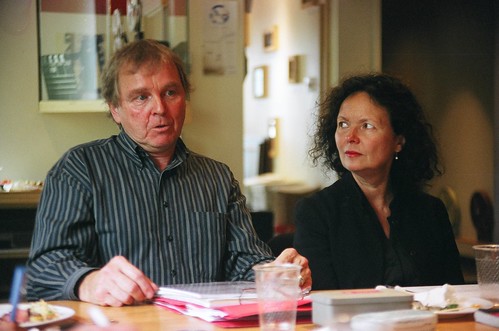
Jean-Pierre Gariépy and Manon Barbeau, respectively Executive Director and President of the Observatoire. My photo.

I’d like to tell you about a pioneering coalition-building experience based here in Montreal, one which could serve as an example for the rest of Canada and even internationally.

Since it was founded ten years ago, I have worked with Montreal’s documentary film festival, the Rencontres. Five years ago, the Rencontres took the initiative for the setting up of the Observatoire du documentaire, which was given the ambiguous english name The Documentary Network. It is actually a coalition, a pressure group which brings together all the main forces producing, broadcasting and distributing documentary film. It brings to the table – for monthly meetings – the professional organizations of producers, directors and technicians, the main television networks producing docs, the National Film Board, distributors, and of course the Rencontres. There is no parallel to this anywhere else in the country. Instead of treating each other as opponents, all these forces come together around common goals: favouring and strengthening documentary filmmaking and its role in society.

Having such disparate organizations working together creates a most interesting dynamic. Everyone has to put some water in their wine and make an effort to come to agreement with the others, but that is only half the story. The representatives of the organizations then have to go back to their respective organizations and fight for what has been agreed on, or what is being prepared for the next meeting. This means that the representatives of the producers or directors have to convince their own colleagues – many of whom produce fiction and television series – to defend the interests of documentary. It means that the broadcasters have to deal with the concerns of the documentary community not just as ‘demands’ from the outside, but as common concerns in which they also have a stake. The Observatoire acts to cement the alliance of all the partners and thereby gives them greater force as a lobby group. During this past year, the Observatoire intervened in numerous ways with the CRTC and other government agencies to favour the interests of documentary production.

Although it’s based in Quebec, the Observatoire has several pan-canadian members. It could serve as an inspiration for English Canada, or it could potentially become a truly representative, bilingual, coast-to-coast organization. It is definitely setting an example.

As a director working in both English and French, I am a member of two organizazations: the Associaction des Réalisateurs et Réalisatrices du Québec (ARRQ) and the Documentary Organization of Canada. Both of these are members of l’Observatoire. I used to be on the executive of DOC, when it was called the Canadian Independent Film Caucus, but these days I attend the meetings of the Observatoire as one of the representatives of the ARRQ.

Cinema Politica faces funding crisis.

BigSellout

Townshop residents in South Africa connect to power grid. From The Big Sellout.

Cinema Politica is the name of a program of screenings which was started at Concordia University in Montreal by Ezra Winton and the Uberculture media arts non-profit five years ago, and which has branched out to a number of other cities on the North American continent and even overseas. Its list of screeings reads like a roll call of the best of recent sociopolitical documentaries: Loose Change, The Corporation, Crude Impact, Seeing is Beleiving, McLibel, The Big Sellout....OK now I can hear my webmestre Kim saying ‘you should have links to these movies.’ But actually, they are all there on the Cinema Politica website, along with many other great films, so check them, out.

The Cinema Politica screenings in Monteal have been a huge success. The two or three screenings I went to last year were attended by about five hundred people. There is a real thirst and enthusiasm out there for political docs, for films that are hard to find on TV. But now, sadly, Cinema Politica’s survival is threatened by a funding crisis. It is really essential for this series of screenings to continue ! I put a few questions to Ezra Winton.
ezra_aeroplane

How did Cinema Politica start and how long has it been running ?
I started it in 2001 at Langara College and it eventually migrated
with me to Concordia where it was renewed in 2003. I started in order
to:
a) address the incredible lack of diversity in Canadian movie theatres
b) help build audiences and support independent Canadian documentary
and fiction
c) use film to inspire audiences (especially students) into actions
around social justice and cultural participation.

How did it expand to other cities ?
People have been to the Concordia events or heard about them and know
how hugely successful we are there. They then contact us and we help
them set up in their communities. They are emboldened by the Concordia
success and want to be part of a network that can hopefully breed that
kind of political cinema energy, and they get a lot of support from us
in the way of licensing costs, website support, etc.

Programming is terrific, how does it work ?
Thanks! I’ve been the programmer for five years at Concordia, and
every year I make suggestions to the 30+ locals in Canada and Europe
on films I think are excellent, but ultimately the other locals do
their own programming. As for how I select, it’s about the quality of
filmmaking, the level of commitment to the politics (ie, films that
take a stand or illustrate a stand), and diversity. I think that our
screenings have resonated with students at Concordia especially,
because every week they know they will experience cinema that is
politically, geographically, and issue-oriented diverse. We even throw
in the odd fiction feature and short to keep things interesting. I
should also mention that my partner, Svetla Turnin, plays a big part
in helping me sort out the gems we will screen from the 100+
acquisitions and submissions I go through every year.

With such an incredibly successful initiative ( when I was there, there were 400-600 people) can you not finance it with ticket sales ?
Part of the mandate of our parent organization (non-profit
überculture) is to promote the media arts to new audiences and to
ensure accessibility. We therefore have asked that none of the locals
charge admission. We do ask for donations, and raise a bit at each
screening that way. The Concordia CP also has its own funding
apparatus – a fee levy that all students pay into, amounting to 2
cents per credit and giving the series almost the budget it needs to
clear great films and bring in speakers. This kind of “collective
payment” method works wonderfully at that one local, our flagship
local, but the funds need to stay there. Funding the rest of the
network is the problem we face. Basically, for $40,000 a year as a
base minimum, we could get a phone and hire a coordinator to keep
things going. With more, we could build the biggest and most active
alternative distribution and exhibition network for documentary and
independent political cinema Canada has seen. For now, we’ve been
running the network on $5,000 per year, thanks to CitizenShift’s
ongoing support and faith in the project.

What happened with Canada Council funding ? Any explanations ?

It’s the second time we’ve been turned down. This time the jury
recommended we get funded and had comments that were all incredibly
positive. They even commented that they couldn’t believe we had
survived so long on volunteer labour!! Unfortunately the jury ranked
us so low the money in the envelope ran out by the time they got to
us. We are actually a bit shocked, as there was even an alternative
video distribution person and a doc filmmaker on the jury….We know
it’s not the Council’s fault, but I am starting to realize how
documentary is discriminated against in the media arts world when it
comes to funding. So many people told us that the jury would love us
(the grant was for organizational funding, exactly what we need) that
we kind of held our breath thinking we’d get it. We are now left with
the option of finding $30,000 to 40,000 over the summer or shutting
down the project. We are discussing a Network membership fee for
locals that would be instituted in the fall and be sliding scale. DOC
has also contacted me to have a meeting later this month, but I know
DOC is not like Toronto International Film Festival – not a lot of money to throw around. So, if
anyone has ideas or access to suitcases of cash, please contact us!
The wind is gone from our sails, but I guess we’re not sunk yet.

Thanks Ezra, keep up the good work !

Ezra also publishes aa news and resources blog and website on Canadian
independent cinema called “Canada Screens” – http://www.canadascreens.ca

Well-deserved award to Serge Giguère (with videos.)

Serge Giguère


If you are a subscriber to this blog and you receive this by e-mail, you need to go to the blog to see all video excerpts.

The other day one of our great Quebec doc makers, Serge Giguère, received one of the Governor General’s awards for creative achievement in media arts. And he deserves it ! Last year Serge and his producers at Les Films du rapide blanc released A Force de Rêve, a fantastic film about elderly people who remain passionately active, for which he received a Jutra award.

Serge has his finger on the pulse of the Quebec population, not the elites but the ‘ordinary people.’ His films look at lives lived and popular culture, but always with a strong creative twist. He is extremely close to the people he films, but at the same time he uses his imagination. In fact, his imagination seems to be triggered by incidents in the lives of his characters, or the locations, and he just takes off from there. Since he does his own camera work, his images express exactly what he saw and imagined, in a very organic whole.

Some time ago my close friend and colleague Simon Bujold and I filmed a presentation by Serge organized by the Quebec chapter of DOC. Here are a couple of excerpts, with a little english summary translation. I’m puttint the translations first for those of you who have some highschool French.

Characters is everything says, Serge in this first clip. You may have a good subject, but without the characters that doesn’t take you very far. He learnt that from the pioneers of cinema direct in Quebec, Pierre Perrault in particular.

[youtube ZBm4rYTlM1c]

In this second clip, Serge talks aboutwhat we often call a ‘mise en situation’ though he doesn’t use the term. Again referring to Perrault, he says brining people together and encouraging thm to interact can be tremendously fruitful. You don’t script what they are going to say, just make some suggestions, perhaps even pushing them a little to engage in an exchange.

[youtube ZppF4ULGKb0]

In the third and last clip, Serge talks about the imagination, and where he gets his ideas. And it’s always from the characters themselves, although he then takes liberties with them and finds ways to amplify them. For example, in his film on country singer Oscar Thiffault, he made use of a huge mock airplane. But the idea came from Oscar, who already had a smaller one around his place.

[youtube L5CzrkqGOwk]

You can find more info about Serge’s films on the web site of Rapide Blanc films which he co-founded with Sylvie van Brabant in 1984. And here’s a little background from the Governor General’s announcement.


Serge Giguère is one of Quebec's leading documentary filmmakers. Over
the course of three decades and in 11 documentaries, he has forged an
identity for documentaries in Quebec that reflects the collective
consciousness. He began his career as a cinematographer, working on
60-odd films, before becoming a critically acclaimed director. He
co-founded Les Films d'aventures sociales du Québec in 1974 and
remained a partner until 1984, when he joined Sylvie Van Brabant to
establish Les Productions du Rapide-Blanc. From 1998 to 2001, he was
filmmaker-in-residence at the National Film Board of Canada. Mr.
Giguère has sat on numerous juries and has been the recipient of many
awards, including the Prix de l'Association québécoise des critiques
de cinéma for best medium-length film of the year (1988, 1991, 1995),
a Prix Gémeaux (1992), and a Prix Jutra (2007). Hot Docs devoted a
retrospective to his work in 2006. Serge Giguère lives in
Saint-Norbert-d'Arthabaska (QC).


Blog thoughts

Siena cathedral 40470019
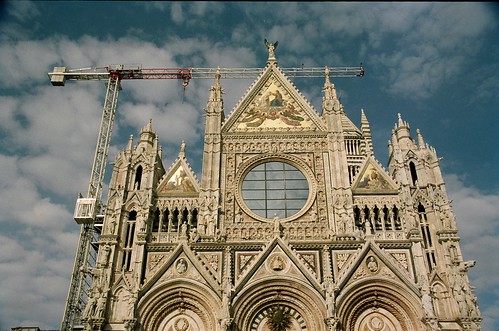
The Cathedeal in Siena, Tuscany, my photo.

If you are a subscriber to this blog, you might have noticed that I have been posting less frequently lately. This was not only because I was on a holiday trip in Tuscany, Italy, for two weeks. It was also because I have been thinking about what direction to take with the blog.

8 months after starting this adventure, with the help of my young friend and webmestre Kim Gjerstad, I was feeling both overextended and a little confused. Publishing twice weekly in both English and French was taking too much time, and I found myself tempted to do too much: review significant new docs, do my best help stir up debate about different issues, report on my own work – all this while maintaining good picture quality and occasionally inserting videos. Some of this activity was the result of good feedback: people seem to appreciate the blog and urge me to cover things. But it was getting out of hand and starting to get in the way of my work.

So I took advantage of my holidays to think about where to go with the blog. By serendipity I picked up a special issue of the progressive French paper Libération on fiction writers. There was an article where several writers talked about how they use their blogs – mainly as ‘carnets de bord,’ a sort of log book, a scrap book on the side, a place to talk about things that don’t necessarily fit into whatever they happen to be writing but need to be said. This brought me back to my original intent with the blog: to share my own experiences and thoughts on documentary filmmaking. So from now on I will write mainly about films I see and people in meet in the course of my regular activities, and of course about my own work. On occasion I will continue to use the blog as a tool to satisfy my own curiosity – I have enjoyed doing that and it has led to some interesting cyber-encounters.

I welcome your comments.