With the Raging Grannies at Bread and Puppets

With the Raging Grannies at Bread and Puppets
Myself and Martin Duckworth filming the Grannies in Vermont.

I am still working on my film about the Raging Grannies, the movement of elderly women fighting for peace, social justice and the environment with satirical songs and the occasional guerrilla action. I have decided to edit some of the Grannies’ songs as music videos, and so I am gathering some special footage in addition to the usual documentary material. The idea is, in my mind, to obtain striking visuals and special effects without having to spend much money. As part of this effort I recently went to the Bread and Puppets Theatre in Vermont with Louise-Édith Hébert, a francophone ‘Mémé déchaînée’ who is an important person in my film. Two other members of our team, Carole Roy and Terre Nash came along for the weekend, along with my wife Jocelyne who has vivid memories from visits to the Bread and Puppets theatre when she was young.

Indeed, Bread and Puppets has been going for several decades now, performing with giant puppets in a natural setting. I thought the images of the theatre could be a way to evoke street theatre as one of the original inspirations for the Raging Grannies, founded in Victoria, B.C., 21 years ago. And thanks to DOP Martin Duckworth, we did get some spectacular images of the Grannies and the puppets. Also, we filmed Louise-Édith making her own puppet and bringing it to the show. In addition, eleven Vermont Grannies responded to our appeal and showed up to sing some songs. A good time was had by all, and a few more tapes were added to my pile. This film is severely under-financed, and it is just the kind of film that will become harder to make with the conservative government’s cutbacks. In fact, if my friends and colleagues didn’t support it, I wouldn’t be able to make it at all.

Louise-Édith Hébert with puppet
Louise-Édith Hébert with the puppet she made. Bread and Puppets actors and staff are meeting in the background.

Thanks to Jorge Bustos-Estefan for help with this blog.

Méta-Morphosis: cinematic still photograpy at its best

Meta-Morphosis
Exposition Méta-Morphosis

My friend the excellent D.O.P. Stefan Nitoslawski, who received the prize for best direction of photography at Hot Docs in 1999, also works with experimental and artistic photography, studying the anatomy and movements of the human body in evocative photographs. The beautifully textured result is reminiscent of Norman McLaren’s ‘Pas de Deux.’ I recommend going to his exhibition at the Cinémathèque Québécoise from September 17 to November 9. I asked Stefan a few questions.

For more info:

http://www.cinematheque.qc.ca/affiche/metamorphoses.html

How did you come to create the photos?

Stefan : Through several years of experimenting. I started by wanting to explore portrait photography but the results didn’t grab me. Through playing around with ways in which to photograph people, I came to shooting with progressively longer exposure times. What fascinated me was that through specific movement I could achieve a new figurative form that radically departed from the form of the model that I was shooting. This kind of transformation now interests me.

What do you mean by transformation?

It is a shorthand term that I use to describe the change I’m trying to achieve within the images. Movement in photography doesn’t interest me per se; I’m not trying to capture a movement blur. What I’m trying to get is a shift in the human form that will jog the viewer into looking at people in a different way. Basically, through these images I want to evoke an interior state of being. I’m interested in what is going on inside a given person. The way in which we see people in our daily live is one way of seeing them. The classic snap shot is great at capturing that outer expression. I am trying to record a different reality and, in a sense, reflect on issues of perception.

It looks like the images have been manipulated by computer.

There is no manipulation. I construct the images though working out a kind of choreography, with the model that creates the various shapes. Lighting is critical as with any film or photo situation; it helps to highlight or hide certain aspects of the form. With exposure I control the layers of movement and it’s degree of deconstruction.

Are you photographing the model or are you using the model to create an image from your own imagination?

I think it’s a bit of both. No one model registers the same way. With certain models there seems to be an interesting transformation but with others it is difficult to get something to occur. No one moves in the same way, with some it’s interesting with others it is less so. So, for the images that I have retained, I feel that there is an important component of the models spirit in the picture. On the other hand, my perception is also important. The ideas for the images come from my imagination and I create a movement sequence to achieve that form. Then, during the exposure, I’ll direct the model to highlight rhythm, energy and amplitude of the action.

Is your exhibit at the Cinémathèque an installation?

Yes, ways in which to represent the transformations have evolved beyond the photos. I have always imagined how I could get these still images to move. The Cinémathèque gave me an opportunity to do just that. So with traditional animation techniques I’m sequencing several hundred images into moving shots. The result will be a projection that will be running in a loop. Chantal Dumas, an electro-acoustic artist, will be creating a soundscape. So, along with the design of the exhibit space, we are trying to create a more immersive environment to explore how we perceive ourselves.

Thanks to Jorge Bustos-Estefan for help with this blog.
Les Femmes de Bruckman

CeliaetIsaac
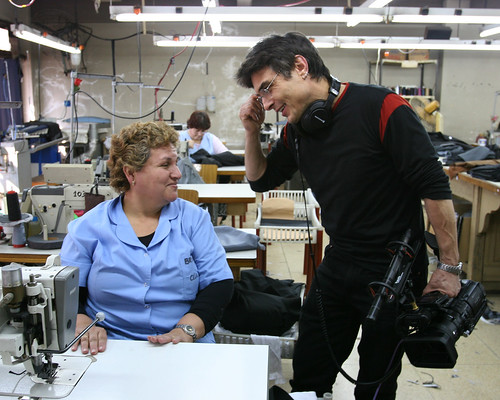
Isaac Isitan avec une des travailleuses, Celia

Je viens de voir un très bon film sur la prise de contrôle d’une usine de vêtements en Argentine par les travailleurs, et surtout travailleuses. Un film réalisé par Isaac Isitan et co-produit avec Carole Poliquin, pour Isca Productions. C’est dans le contexte de la crise économique terrible de 2001 que les employées de la firme Bruckman se sont retrouvés sans patrons et sans leur paye, les propriétaires ayant pris la fuite avec leur argent. Plutôt que de s’en aller chez elle et chômer, elles ont décidé de prendre charge de l’usine et de continuer à travailler. Elles sont devenues leurs propres patronnes. Mais avec l’amélioration de la sitution économique, les patrons ont voulu revenir et reprendre l’usine. Le film documente la lutte qui s’ensuit, sur une période de cinq ans. On a l’impression d’assister à un leçon d’auto-organisation tout à fait exemplaire, selon les principes défendues par la gauche anti-autoritarie dans laquelle j’avais moi-même milité quand j’étais jeune. J’ai bien aimé le film, entre autre parce que le réalisateur n’a pas peur de parler des nombreuses contradictions et conflits internes qui sont inévitables dans de telles luttes. J’ai quand même posé quelques questions critiques à Isaac Isitan.

Il n’y a pas beaucoup de suspense dans le film, on a l’impression de savoir dès le début comment la bataille va se terminer. Commentaire ?

Pour la majorité de spectateurs c’est tout le contraire. C’est juste les gens plus activistes, très informées et préoccupés sur l’actualité qui connaissent la fin de l’usine Brukman.

Tu as très bien couvert la lutte dans l’usine et dans la rue, mais on ne rentre jamais dans l’intimité des femmes, on ne voit pas la conséquence sur leurs vies personnelles. Pourquoi ?

Le focus du film était l’éveil politique des femmes, ainsi que leur découvert de certains tâches qu’elles avaient jamais pensé réaliser, tel que l’administration et gestion d’une usine. Ce qui m’intéressais était montrer les changements soufferts dans leurs vies face à la gestion et control de la manufacture Bruckman, qui sont aussi des changements personnels.

L’action initiale a lieu dans le contexte de la crise de 2001, mais après on n’apprend rien sur l’évolution de la situation politique et économique, si ce n’est que la visite de quelques ministres. Est-ce que le changement de la situation en Argentine n’a pas conditionné ce qui se passait dans l’usine?

Oui, absolutement. L’élection de Kirchner a influencé dans la victoire sur le plan égal, mais c’est grâce aux mouvement sociaux que Kirchner est arrivé au pouvoir et que les femmes ont récupéré l’usine. C’est ça que j’ai voulu montrer dans le film. Je ne voulais pas faire un film comme The Take dans lequel on ne fait que suivre la crise argentine. Mon film raconte l’évolution des femmes, leur éveil, leurs façons de faire. Comme les femmes de Brukman dissent: “C’est la lucha popular (la lutte sociale) qui les a aidé et les a emmené où elles sont présentement” C’est cette lutte que j’ai voulu montrer dans mon film.

Leaving the Fold, Interview with Eric Scott

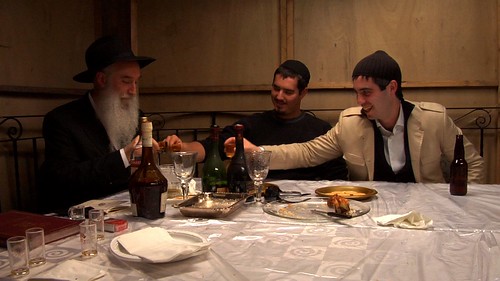
LTF_La_Chaim
Rivens, father and sons

The other day I went to see an excellent documentary directed by Eric Scott and produced by my friend Frederic Bohbot and Evan Beloff of Bunbury Films, here in Montreal. The film is called ‘Leaving the Fold’ and it’s about young people who have left their Orthodox jewish families and culture to live an ordinary life.

It is still playing at the Park Cinema in Montreal, and will be shown on Radio-Canada later in the season. ( It was turned down by the CBC, hard to understand !)

I was very impressed with the choice of characters, and with the access to the normally very closed Hasidic milieu. One of the things you learn is that life among the Hasidim is strictly regulated and controlled, and the rebellion of those who decide to leave the fold seems totally comprehensible. But of course they have grown up with those very strong values and strictures, and will never be able to completely leave them behind.

As a result, they are ‘free’ but still conflicted individuals. The way they open up and share their thoughts and feelings is very touching.

The most fascinating scenes are with a father, Pincus Riven, and his two sons Hudi and Levi who have left the fold. They all speak very honestly and emotionally. We follow the father to prayer sessions and ceremonies where his deep concern and sorrow for his ‘lost’ sons is clearly in evidence. But then, in a surprising twist which ends the film, we find them eating and drinking together and discussing their differences with a considerable amount of compassion and mutual understanding.

I put a few questions to Eric.

Eric_Scott_Head_shot
Eric Scott

How did you get access ? Was it possible because you were dealing with Lubavitch orthodox jews who are known to be relatively more open to the world ?

Although Pinchus Riven is a member of the most “open” Lubavitch Hasidic sect, that alone was not sufficient grounds to give me access. In my mind the more determining factor is that Pinchhus is a ‘baal tshuva’, someone who has repented, in other words become hasidic. He is familiar enough with “outside” culture so as not to be afraid of it. In the course of my research I met other ex-Lubavitch kids who came from “old line” Lubavitch families and the stories were as shocking as those of kids coming from more “closed” Hasidic sects. In those cases there was no question of the parents ever considering participation in a documentary.

The father and sons, in spite of their differences and the father’s sadness, they seem to have a very warm relationship – is this surprising to you, as someone who knows the community ?

The Riven boys do have a surprisingly warm relationship with their father, considering the gravity of their decision and its impact upon the family and its status in the community. Often the arranged marriage negotiations of younger siblings are put into jeopardy because a family would be considered “tainted” if another child has chosen to leave the fold.

The father thinks he did something wrong… is it possible that the reason two of his sons left was instead that he had some special quality, openness, curiosity… that he passed on ?

In the case if the Riven family, the reason that the boys left came more from their personal dissatisfaction with Hasidic life than from their father’s openness or curiosity. After all, they have 6 other siblings who have stayed firmly in the fold. The boys’ two religious brothers (the eldest and youngest of the four) are no less intellectually gifted or curious than Hudi or Levi.

Le contenant le le contenu: Le Moulin à Images

PaulLap
Paul Lapointe

Je vous avais parlé, avant de partir en Europe, de la projection fantastique de Robert Lepage, ‘Le Moulin à Images’, dans le cadre du 400e de Québec. Voici la réaction de mon ami Paul Lapointe. Il a longtemps travaillé pour l’ONF avant de devenir producteur indépendent et de fonder la compagnie Érézi en octobre 1996. Il a produit trois de mes films, et je le connais comme quelqu’un qui soulève toujours des questions de fond. Voici son point de vue sur ‘Le Moulin à Images’. (S’il nous parle de Orwell et Huxley, c’est qu’il sait que j’admire ces deux auteurs de romans d’anticipation et que je travaille sur un projet sur leur oeuvre. )

L’expérience du Moulin à images produit invariablement l’émerveillement. Une projection en extérieur jetée sur un écran de plus de 25 silos créant un rapport horizontal fabuleux, tout ça est effectivement inédit et remarquable d’audace. Le contexte du 400e anniversaire de Québec ajoute à cette expérience parfaitement singulière. Les défis techniques y sont vraiment formidables. Au delà de ces aspects, toutefois, personne ne réfère jamais au contenu, si ce n’est pour mentionner que Lepage y fait un survol historique de la ville de Québec. J’ai, comme tous, été très impressionné par le dispositif et par certains effets d’animation, notamment ces images saisissantes des chutes de Montmorency. Mais j’ai aussi été surpris et déçu de la linéarité du récit, de même que par l’absence complète de point de vue. Lepage est un artiste de grand renom, et mon intervention ne vise nullement à remettre en cause son oeuvre ou son génie. Mais son survol historique de Québec me parait non seulement linéaire et descriptif, il ne produit aucune émotion, et ne commente RIEN.

Mettre en place pareil dispositif pour ne rien dire me scie. Se rendre éloquent à ne rien dire, et dire ce rien au monde entier me stupéfait. Essayons d’imaginer une œuvre de Dominique Blain qui n’aurait pas de point de vue. Impensable, non ? Pourquoi Lepage se donne-t-il autant de mal à ne rien dire? L’attrait de la technologie aurait-il donc l’effet du parfait anesthésiant sur la raison ? Qu’en penseraient George Orwell ou Aldous Huxley?