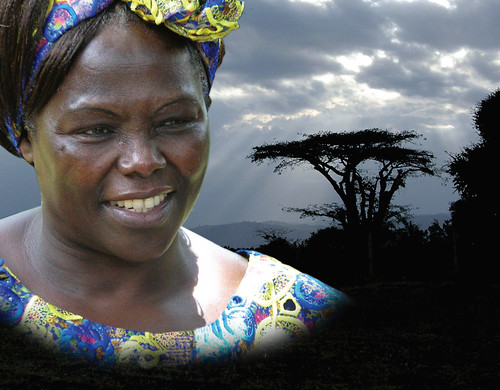
 Wangari Maathai [Photo credit: Lisa Merton]
One of the best films I saw at the Rencontres Internationales du Documentaire de Montréal last November was Taking Root: The Vision of Wangari Maathai, which won both the best documentary award in the ‘Eco-camera’ section and the audience award for the whole festival. The film documents the struggle of Maathai and the Green Belt Movement she started, against authoritarian governments and for the protection of the environment in Kenya. I was particularly impressed by the way archival footage of past actions and repression were interwoven with contextual and current materials, making for a compelling and inspiring story. The filmmakers, Lisa Merton and Alan Dator, told me they were far from the only ones who wanted to make a film about Maathai.

Alan Dater and Lisa Merton, the directors of the film [Photo: Andrei Khabad]
Alan: I think we got to make the film because we got along well with Wangari. And because we started making the film before she won the Nobel Peace Prize, before she had that level of recognition. We weren’t after a “famous” person, we were interested in her life and her work for its own sake. Her story is universal.
We grew up on the land as Wangari did and so we have similar sensibilities in many ways; we understand the rhythms of the natural world, the web of life of which we all are part, and our total dependence on the natural world for our very survival. Something she understood from childhood.
You succeed in portraying the person, the movement and, at least to some extent, the situation in the country. Was that difficult, or did it come naturally?
Lisa: It came naturally. Wangari’s approach to change is holistic so we wanted to show that in the way we made the film. She links sustainable development, democracy and peace in a beautiful, organic way in her life and work. When she had no choice but to become political, she became political. She and the women of the Green Belt Movement could not plant trees without speaking truth to power.
We also felt that we couldn’t make the film without putting it in historical context. The way people survive on the land they live on is an integral part of how their culture is shaped over time. For us the cultural aspect of Wangari’s work is deeply important. Her recognition of the ways in which people lost themselves, their dignity, and their sense of self-worth during colonialism and neo-colonialism is part of what the Green Belt Movement (GBM) addresses in its Civic and Environmental Education Seminars that we show toward the end of the film. It is here that the participants of GBM make the linkages themselves – they learn to know themselves in a new light and therefore are also able to understand what is best for the common good.

[Photo Credit: Ariel Poster]
Merci à Jorge Bustos-Estefan pour l’aide avec ce blogue et à Andrei Khabad pour la photo des cinéastes.

I just saw this film in Halifax last week. It was put on by ACIC (Atlantic Council for International Cooperation) and Cinema Politica. It was really incredible and inspiring. At first I though, pssssssh – a treeplanting woman, tame. But holy moly! What a revolution!