Doc Challenge, Quickie filmmaking !

team_beijing_dreams_from_china
Team Beijing Dreams From China – behind the scenes of award-winning Lao Shan Lao Yin – Jakob makeup


I am amazed how many people are able and willing to make films without funding. A couple of years ago I chaired a competition called Green Camera ( Caméra verte) and we received 135 short films although the deadline was tight. There are also a number of competitions where teams make films in 48 hours of a week. One of the better established ones is The International Documentary Challenge which returns to Hot Docs in April 2008. Registration for the 3rd annual Doc Challenge held from March 6 to 10 2008, is now open. I put a few questions to the producer of the event Doug Whyte.

doug_whyte
Doug Whyte, Doc Challenge Producer.


1. Where did the idea come from?

I work for KDHX Community Media (www.kdhx.org), a non-profit community media organization in St. Louis, MO. (Though I am now based out of Portland, OR.) I produce the St. Louis 48 Hour Film Project (www.48hourfilm.com) for them and after seeing how the fiction filmmaking community has embraced the 48 Hour Film Project, I figured I’d try and launch a similar event for non-fiction filmmakers. Of course, I wasn’t sure how this would work for docs since it often takes years to make a decent one. But the results have been tremendous! The films are so good that Hot Docs Canadian International Documentary Film Festival (www.hotdocs.ca) came on board to be the Presenting Partner and host the premiere of the finalists and the awards ceremony. Other screening partners include SILVERDOCS, the Big Sky Documentary Film Festival, the International Documentary Association, the Documentary Organization of Canada and the 48 Hour Film Project.

2. And how many times have you done this?

This will be the third year of the Doc Challenge and the second year at Hot Docs. This year we will be doing more regional screenings in cities with clusters of participants, including (most likely) Los Angeles, Seattle, Portland, St. Louis, Washington DC, Missoula, and Toronto. These screenings will showcase the locally made films as well as some of the international winners.

3. Is there a theme, or constraints? When do the contestants learn what they are?

On Thursday morning March 6 each team is given the choice of genres for its film, be it Character Study, 1st Person, Music, etc. In addition, all filmmakers will be given a broad theme (such as “Freedom”) that must be addressed at some point in their film. To ensure the films were made within the required time frame, each team must prove the date the film was made by adding a time element to the film or credits (such as the main subject holding a newspaper.)

Then the film must be sent to Doc Challenge headquarters with a postmark no later than Monday, March 10.

4. It seems more and more people are willing to contribute audiovisual pieces for free, to competitions and web sites. Do you think established people with a production company or whatever have an edge here, or that it’s really a pretty equal playing field given how accessible new technologies are?

I would say in a competition like this it is a fairly equal playing field. With such a short time frame, it comes down to engaging characters and story (as it usually does.) That’s not to say that very professional camera work and editing doesn’t give a film an advantage, but it must have the story first. Some of our finalists in the past 2 years have ranged from established filmmakers like Doug Hawes-Davis (Libby, Montana on POV) to first-timers that found extremely engaging and unique subjects. The Doc Challenge is an event that appeals to both novice and professional filmmakers alike: novice filmmakers have the opportunity to go through the whole filmmaking process in less than a week, learning the art of documentary production in a trial by fire situation, and professionals have the opportunity to work on a creative, personal project without having to commit years of their life. One thing I would like to say about this event is that filmmakers are doing much more than just entering a festival. First, we limit the number of entries (250) where festivals do not. (Sundance just had over 8,000!) Second, by registering, they are in the competition, not just “considered” for it. We work toward getting the films screened and distributed, no matter if they are winners or not. At a festival you get one screening (maybe two.) In the last 2 years we worked all year on getting the films screened many times and we actually got more TV distribution for non-winners than winners! And if we find distribution for a film, the split is 75% (filmmaker) to 25% (Doc Challenge.) Also, we are a non-profit organization and all proceeds go back into the event to make it better.

Thanks to Steven Ladouceur for the help with this blog.


doc_challenge_logo

Complete details and entry forms can be found online at http://www.docchallenge.org/
Email info@docchallenge.org with questions.
Check out Hot Docs here: http://www.hotdocs.ca
What are doc filmmakers in ‘third world’ countries working on ?

D. Lacourse 2
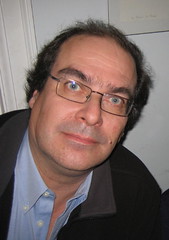
Danièle Lacourse, Director of the Alter-ciné Foundation.

What are documentary filmmakers in ‘third world’ countries working on ? One way to find out is to talk to the Director of the Alter-Ciné Foundation, Danièle Lacourse. The Foundation was established in memory of my friend and colleague Yvan Patry, a pioneering filmmaker and Danièle’s partner, who died ten years ago. It aims to support filmmakers in developing countries whose work promotes human rights and gives out two or three cash awards each year. ( for last years awards see my blog post) Here is my conversation with Danièle:

1. In general, in the projects that you receive from Southern countries, is it the subjects that are pre-eminent or is there also a will to develop an original treatment?

It varies from one country to the other, from one project to the other. I believe that there are more and more filmmakers from the south that are also preoccupied with treatment in order to give more impact to their films. This is seen particularly in countries where there is a strong documentary tradition, like in Argentine for instance.

In terms of our criteria, the main requirement is that the film treats of rights and liberties, understood in its broadest sense, i.e. as much political rights, as economical, social, cultural and other. But if the theme is important, the treatment is also in our view: the foundation supports the documentary of creation, therefore an approach and course of action that is cinematically original and creative, that actually often serves the point better than a didactic documentary, suited or tele formatted.

2. Are there notable differences between the continents? In terms of the nature of the projects and of the filmmakers situations?

First difference: 75% of the projects that we receive are from Latin America, therefore only 25% of the projects that come from Asia and Africa. Difficult to analyse the causes: is it only better access to the internet or better networking, closer ties between documentary filmmakers of Latin America that circulate the information between their associations? Or is there a greater production of documentaries in Latin America compared to Africa and Asia? One thing is certain, filmmakers from Africa and Asia seem more isolated than those in Latin America, but this impression remains to be verified.

With regard to the nature of the projects, it is difficult to see thematic differences between continents, even if certain themes, like the one of disappearances for example, are accosted more in Latin America than elsewhere. With regard to the cinematic approach, it comes from the culture and the history. For example, the African filmmakers often have a montage approach, of time and duration, different from the one found in Latin American filmmakers, as they give particular importance to the “voice” in the narrative.

3. Since the foundation began its activities, what are the changes that you have noticed in the projects submitted?

A greater variety of themes and approaches. In the beginning, we received many more projects strictly about political and economical rights (repression, dictatorship, poverty, etc) with a rather classic cinematic treatment or closer to reportage or the “didactic tool”. Currently, we are receiving more projects dealing with questions of the environment, indigenous peoples, immigration, cultures and the treatment is more often closer to direct cinema, more audacious, more personal, more creative.

4. Here I imagine that the average budget of a one hour documentary is $350,000. How is it for the proposals that you receive?

It varies considerably from one project to the other. The majority of the projects have a budget somewhere between $60,000 et $150,000. But there are also projects that are shot with $30,000 or less: in that case, the director often has access to “borrowed” equipment for shooting and editing. In the case of the documentary “Oscar” by the Argentinean Sergio Morkin for example, the budget was minor. Sergio shot it himself with cameras here and there; he recycled his shooting cassettes; and all of his friends were put to contribution to help direct the film. The small digital cameras also contributed to “democratizing” the documentary by cutting the production costs. In the case of “Raymundo”, the directors had installed their small editing unit in their living room which allowed them to edit during one whole year, which would’ve been unthinkable if they had had to rent an editing suite. What we were also able to notice, is that, when there is an emergency, these filmmakers always find a way to make their films, even without exterior financing.

5. How are these films from the South distributed?

Many of these films are presented in festivals (the film “Raymundo” for example won 15 prizes in various festivals around the world), which allows a certain visibility. But they are mostly distributed in various local and national networks: organisms involved in the defence of rights and liberties, neighbourhood organizations, community organisms, unions, universities, etc. In general, the directors accompany this distribution of their film and get in direct contact with the public that is involved. Sometimes also, certain documentaries (like “Keiskamma une histoire d’amour”) have been presented on a national television channel (SABC in South Africa), which give the possibility to touch another public.

(Thanks to Steven Ladouceur for his help with this post)

Chronicle of everyday life

071111-159
Workshop: Denys Desjardins et Jacques Leduc

During the Rencontres Internationales du Documentaire de Montréal last november, my wife Jocelyne Clarke attended a workshop on a really unique film series called ‘Chronicle of Everyday Life,’ with Jacques Leduc, Denys Desjardins and Richard Brouillette. Jocelyne is a filmmaker ( her most recent film is ‘Edith and Michel’) and she has participated in the programming at the Rencontres since the beginning. Here is her report from the workshop:

Phot Jocelyne Clarke
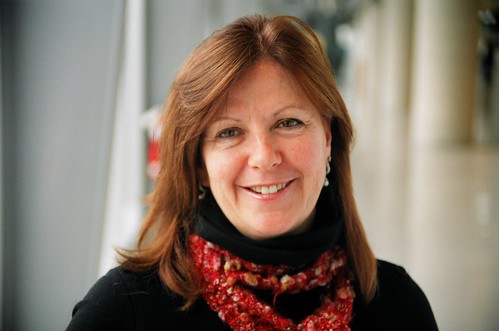
Jocelyne Clarke

I ceased counting the number of times the word “freedom” was uttered when referencing this outstanding work in the annals of Quebec documentary.

Started in the early 70’s, officially produced in 1977 by Jacques Bobet at the NFB, the project was conceived and directed by Jacques Leduc in collaboration with a few dozen other illustrious craftsmen from our cinema. The result was a four and a half hour opus, divided into 8 films of lengths varying from 10 to 82 minutes.

The idea behind the project was to revisit direct cinema at a moment when it was already heavily “contaminated” by mass TV (which Leduc describes as a’ transmission method ‘ and not a ‘cinematographic language ‘), and to reflect on the times through the main axes of life – love, money, food, home, hearth, death. Small filmmaking teams went out in search of serendipitous moments : a parade of men in underwear, houses being built in the suburbs, a group of well-to-do women doing charitable works. Unusual yet essential stereotypes of urban life in those still innocent times. The material was organized as it came in, in an organic back-and-forth between filming and editing, and was divided into themes, which finally became the days of the week.
Footage that was too precious to leave out, but did not fit into the final structure, was edited into an epilogue for the series – Le plan sentimental – remarkable for its visual improvisation as well as its elaborately constructed soundtrack.

The workshop discussion eventually led to the question: could such a work be made today? No categorical answer was forthcoming, but it was generally agreed that today’s televisual requirements – fixed lengths for films, detailed scripts, releases, – definitely limit such freedom, without completely destroying it. Today we have the technological advantages that come with small, inexpensive tools, undreamt-of distribution channels – (all that’s lacking are salaries for filmmakers). Jacques also brought up how film subjects in the 70’s had a much less reflexive relationship with the camera than today, in the wake of reality shows and all manner of idols.

A remarkable series, too little appreciated by the public, which really deserves to be re-issued in a DVD package.

For more information, check out the NFB website, search in the collections under “series”, or search individual titles as follows.

Lundi – Une chaumière, un coeur.
Mardi – Un jour anonyme.
Mercredi – Petits souliers, petits pains.
Jeudi – À cheval sur l’argent
Vendredi – Les chars.
Samedi – Le ventre de la nuit.
Dimanche – Granit
Hors série – Le plan sentimental.

The Invisible People – what happened to the debate ?

Peuple invisible 53540_06
The Minister shaking the hand of a young Algonquin.

During the holidays, I read a collection of articles by the great critic of American cinema Andrew Sarris entitled ‘Confessions of a Cultist.’ One phrase struck me. “Everyone adores a dissident poet – in someone else’s society.” (quoting from memory.)

And I had the opportunity to see the courageous and powerful new film from Richard Desjardins. I will clarify, for those who are not from Quebec, that he is a great poet, composer, and singer-songwriter as well as the author of important documentaries, with Robert Monderie. Almost ten years ago, their film l’Erreur Boréale spurred an enormous debate concerning the state of the boreal forest in Quebec, and it is one of those rare documentary films that one can say led to real change in society. Now, with Le Peuple invisible (The Invisible People), will they manage to provoke a similar debate about the situation of native people in Quebec?

But first, what is this film about? It is the finely spun and well-documented tale of how the Algonquins, the traditional inhabitants of a vast territory north of Ottawa, suffered at the hands of white colonists and governments—not to mention the Jesuits and the Catholic Church. The film does not treat the colonisers tenderly. Here is what my friend and close collaborator Simon Bujold writes:

This film is a great history course. The sort of course that the Quebec school books never dared imagine. Richard Desjardins has again accomplished a brilliant intellectual feat designed to make us think.
The Algonquins, who are they?

“Our brothers,” said Desjardins in an interview. ‘Those whom we have systematically ignored since our ancestors no longer needed them to survive the rigors of the land. They have always been there. They have reasonably accommodated the European and his descendants well before the Bouchard-Taylor commission.’ ( An allusion to the present debate on tolerance toward immigrants and minority cultures in Quebec.)

Nevertheless, as the film by Monderie and Desjardins demonstrates, the Algonquins are an invisible people in the eyes of the Québécois. Criticism has been fired specifically at the sovereignty movement, which asserts a distinct national identity while completely ignoring the First Nations. One victim who shows no solidarity with another even more badly off. “I want us to be able to live together in harmony and peace,” says the conqueror as a testimony to the lost friendship he has just crushed. Why concern oneself with the fate of the weaker when one is the stronger. Many viewers exited the theatre still covered with the shame and guilt that rose up in us when confronted with this reality. Powerlessness in the face of a tragedy of such scope. What disturbs the spectator most is that the accusing finger turns slowly towards us as we discover, one by one, the past and present injustices the Algonquins have sustained. In L’Erreur Boréale, evil was the company, no sweat. In this film there is the cruel reflection of the mirror.”

The film gives no answer to the question everyone has. What to do? What to do today?
Can we overcome hundreds of years of organized contempt to destroy the barrier of cultural ignorance.
Billions for the tsunamis, millions for Haiti. Schools for the young Afghans, Iraq for Iraqis. And for our neighbors? Nothing.

Merci Simon !

And the debate ? What has become of the debate ?
Well, for a while I thought it was going to erupt. The official spokesperson for the Rencontres Internationales du Documentaire de Montréal, the singer Biz of the group Loco Locass, wasn’t ashamed to attack the film. According to Biz, heard on Radio-Canada, Desjardins and Monderie criticize the Québecois without emphasizing that the Americans and the Canadians had done even worse. Some days later, also on Radio-Canada, I heard the writer Dany Lafférière, a Québecer of Haitian origin, assert that Desjardins had taken it upon himself to speak about the oppression of the Algonquins rather than letting them speak for themselves. But aside from that… not a lot. I believe this is a film that makes people very ill at ease. Will the debate eventually take place ? Perhaps after the television broadcast.

Best Docs/meilleurs docs, DOX ( European Documentary Union.)

LasHurdes_Bunuel
Las Hurdes

Here is the list of best documentaries from DOX, the magazine of the European Documentary union. Voici la liste des meilleurs documentaires de DOX, la revue de la Euroepan Documentary Union. C’était dans le numéro 50 publié en janvier 2004. Revue éditée par EDN Ulla Jacobsson & Tue Steen Muller.

1000 MEN de Shinsuke Ogawa
A DECENT LIFE de Stefan Jarl
THE LAST JUDGEMENT de Herz Frank
FREE FALL de Peter Forgacs
LA BATALLA DE CHILE Part I – II – III de Patricio Guzman
BLACK HARVEST de Robin Anderson et Bob Connelly
CALENDAR de Atom Egoyan
LE CHAGRIN ET LA PITIÉ de Marcel Ophuls
THE MAN WITH THE MOVIE CAMERA de Dziga Vertov
CITY OF GOLD de Colin Low
COMIZI D’AMORE de Pier Paolo Pasolini
DEAR AMERICA; LETTERS HOME FROM VIETNAM de Bill Couturier
EL DESENCANTO de Jaime Chavarri
KINDERTGARTEN de Victor Kossakovsky
DRINKING FOR ENGLAND de Brian Hill
FOTOAMATOR de Dariusz Jablonski
GISELLE de Anne Regitze Wivel
LES GLANEURS ET LA GLANEUSE de Agnès Varda
GLAS de Bert Haanstra
THE LONG HOLIDAY de Johan VanderKeuken
HIGH SCHOOL II de Frederick Wiseman
HISTOIRE D’UN SECRET de Marianne Otero
UNE HISTOIRE DE VENT de Joris Ivens
BREAD DAY de Sergey Dvortsevoy
HOME FROM THE HILL de Molly Dineen
TERRE SANS PAIN de Luis Bunuel
IN MY FATHER’S HOUSE de Fatima Jebli Ouazzani
JOKTAOU, CHRONICLE OF A DEAD SEA de Sergey Azimov
KAMLABAI de Reena Mohan
KASHIMA PARADISE de Yann LeMasson
MOANA de Robert J. Flaherty
MOI UN NOIR de Jean Rouch
THE MUSICIANS de Kazimierz Karabasz
CLOSE UP de Abbas Kiarostami
NIGHT MAIL de Basil Wright & Harry Watt
NO PAIZ DAS AMAZONAS de Silvino Santos & Agesilau de Araujo
STATE OF DOGS de Peter Brosens & Dorjkhandyn Turmunkh
NUIT ET BROUILLARD de Alain Resnais
FATHER , SON AND HOLY WAR de Annan Patwardan
PRIMARY de Robert L. Drew
CONFESSION de Aleksander Sokurov
LE SANG DES BÊTES de Georges Franju
SANS SOLEIL de Chris Marker
THE GREAT ADVENTURE de Arne Sucksdorff
STILL LIFE de Sohrab Shahid Saless
TANJUSKA AND THE SEVEN DEVILS de Pirjo Honkasalo
THE THIN BLUE LINE de Errol Morris
VOLCANO : AN INQUIRY INTO THE LIFE AND DEATH OF MALCOLM LOWRY de Donald
Brittain & John Kramer
THE SEASONS de Artavadz Pelechian
WR-MYSTERIES OF THE ORGANISM de Dusan Makavejev
ANYTHING CAN HAPPEN de Marcel Lozinski

(Merci à Adam Shamash et Dijana Lazar pour l’aide avec ce blogue)

Best docs at NFB’s 50th/Meilleurs documentaires au 50e de l’ONF

JohnMarshall-TheHuntersThe Hunters

Here is the list of 52 documentaries programmed by André Paquet for the 50th anniversary of the NFB. Voici la liste des 52 documentaires sélectionnés par André Paquet pour le 50e de L’ONF. Source: catalogue- Documentaire Se Fête / Salute to the Documentary – 16 au 25 juin 1989 – 50e Anniversaire de l’ONF.

87170008.AndréP
André Paquet

79 PRINTEMPS (79 Springs) de/by Santiago Alvarez
À PROPOS DE NICE de/by Jean Vigo
AT THE SPRING SEA CAMP de Asen Balikci
BUCHERONS DE LA MANOUANE (Manouane River) de/by Arthur Lamothe
CHEMIN DE FER de/by Jurgens Bottcher
CHESTER GRIMES de/by Herbert di Gioia & David Hancock
CHRONIQUE D’UN ÉTÉ (Chronicle of a Summer) de/by Jean Rouch
CORRAL de/by Colin Low
CORTILE CASCINO de/by Robert M. Young & Michael Roemer
DRIFTERS de/by John Grierson
FARREBIQUE OU LES QUATRE SAISONS de/by Georges Rouquier
FORTINI CANI de/by Jean-Marie Straub & Daniele Huillet
GOLDEN GLOVES de/by Gilles Groulx
GRASS de/by Merian C. Cooper & Ernest Schoedsack
HARLAN COUNTY, USA de/by Barbara Kopple
HARVEST OF SHAME de/by David Lowe
HUNTERS de/by John Marshall & Robert Gardner
IF YOU LOVE THIS PLANET de/by Terri Nash
KATAK ET KUKTUK SE RACONTENT ET CHANTENT de/by Richard Lavoie
L’HEURE DES BRASIERS (The Hour of the Furnaces) de/by Fernando Solanas et Octavio Getino
L,HOMME À LA CAMERA (The Man with a Movie Camera) de/by Dziga Vertov
LA BATAILLE DU CHILI (The Battle of Chile) de/by Patricio Guzman
LA CHUTE DE LA DYNASTIE DES ROMANOV (The Fall of the Romanov Dynasty) de/by Esther Chub (aka Esfir Shub)
LE MONDE DU SILENCE (The Silent World) de/by Jacques-Yves Cousteau
LE SABOTIER DU VAL DE LOIRE de/by Jacques Demy
LE SANG DES BÊTES (Blood of the Beasts) de/by Georges Franju
LES MAÎTRES FOUS (The Mad Masters) de/by Jean Rouch
LES RAQUETTEURS (The Snowshoers) de/by Michel Brault
LISTEN TO BRITTAIN de/by Humphrey Jennings
MISÈRE AU BORINAGE (aka Borinage) de/by Henri Storck & Joris Ivens
MODERN TIMES de/by Charles Chaplin
NANOOK OF THE NORTH de/by Robert J. Flaherty
NATIVE LAND de/by Paul Strand & Leo Hurwitz
NIGHT MAIL de/by Harry Watt & Basil Wright
NOUS AURONS TOUTE LA MORT POUR DORMIR de/by Med Hondo
NUIT ET BROUILLARD (Night and Fog) de/by Alain Resnais
ON THE BOWERY de/by Lionel Rogosin
POINT OF ORDER de/by Emil de Antonio
POUR LA SUITE DU MONDE (For Those Who Will Follow a.k.a. Of Whales, the Moon, and Men a.k.a. The Moontrap) de/by Michel Brault & Pierre Perrault
PRIMARY de/by Richard Leacock & Robert Drew
RIEN QUE LES HEURES (Nothing But the Hours a.k.a. Nothing But Time) de/by Alberto Cavalcanti
SANRIKUZA: LES PAYSANS DE LA DEUXIÈME FORTERESSE (Nartia: The Peasants of the Second Fortress) de/by Shinsuke Ogawa
TERRE SANS PAIN (Land Without Bread) de/by Luis Bunuel
TERRES NOUVELLES (New Earth) de/by Joris Ivens
THE BATTLE OF SAN PIETRO de/by John Huston
THE TITICUT FOLLIES de/by Frederick Wiseman
THURSDAY’S CHILDREN de/by Lindsay Anderson
TIRE DIE de/by Fernando Birri
TRAINS SPECIAUX de/by Krsto Papic
TURKSIB de/by Victor Turin
UNE ANNÉE DE FRANK W (Franek W.’s Year) de/by Kazimierz Karabasz
VERS LE SUD de/by Johan VanderKeuken

Brault_pourlasuitedumonde
Pour la suite du monde

(Merci à Adam Shamash et Dijana Lazar pour l’aide avec ce blogue)

More on the IDA’s list

BarryG_196screen
Barry Greenwald

I had a lot of reactions to my interview with Diane-Estelle Vicari from the IDA about the list of 25 best documentaries. Here’s one from documentary filmmaker Barry Greenwald (one of my partners on the socialdoc web site):

“I would like to think that a Canadian-created equivalent of the IDA’s ‘Best Documentaries’ would be more reflective of the scope, history, and eclectic quality of international documentary cinema…Perhaps it is time for groups and institutions such as Hot Docs, the Rencontres, DOC, filmmakers in Quebec, POV Magazine, Montage, or an umbrella collective thereof, to develop a truly international ‘Best of List’. Canadian inspired with a global view. Opening such a forum to something along the lines of ‘100 Remarkable International Documentaries’ would be a starter.”

Barry sent out a summary of my interview to the Documentary Organization of Canada discussion group and passed on some of the comments. Sheila Petzold promised to bring the idea of a more inclusive list to the DOC executive. Walter Forsyth commented: “A great subject to fill an edition of POV.” I’ll pass this on to POV editor Mark Glassman.

Well, a little more research turned up some existing lists. This is from veteran programmer André Paquet, Every time this kind of list is established, there is inevitably a bias. Either because the people who are consulted are more or less representative, or because the circumstances are particular. I find that one of the best list is one published by DOX magazine for their 50th issue in 2003. They consulted people from all over the world. And when I organized the 50th anniversary celebrations for the NFB in 1989 I selected 53 films which represented ONE history of the documentary. Among the people I consulted at the time were Santiago Alvarez, Emile de Antonio, Peter Von Bagh, Michel Brault, Haile Gerima, Jill Godmillow, Bernard Gosselin, Joris Ivens, Johan Van der Keuken, Allan King, Bonnie Sherr-Klein, Jean-Claude Labrecque, Arthur Lamothe, Richard Leacock, Colin Low, Mira Nair, Julia Reichert, Helga Reidemeister, Jean Rouch, Henri Storck, Klaus Wildenhan.

Our friends and colleagues in the U.S. have a tendency to limit their vision to their own cinema – this is true both for fiction and documentary,”

And here’s the good news, in a couple of days I will be able to post the two lists mentioned by André.

‘At the Crossroads,’ the last shoots

Y&Yjouent.33

With my friend and colleague Martin Duckworth I am just now doing the last days of shooting for our film ‘At the Crossroads’ ( working title.) For three and a half years we have been following the conflict surrounding the proposed Rabaska liquefied natural gas port in Lévis, Qué. It would be located on the south shore of the St.Lawrence river, opposite l’Île d’Orléans, famous for its natural beauty and historical significance. To the economic élite and the construction workers of the area, this $ 800-million project represents manna from heaven. But many residents of the Beaumont village and the eastern part of Lévis want to protect the agricultural, residential and recreational nature of the area, and for three years put up a strong fight to stop the project. They found allies in several large environmental organizations, but In the end it seems they lost, as the government has given an official go-ahead to the project. Rabaska has yet to negotiate its supplies of natural gas though, and there are two rival LNG projects in Quebec – so perhaps all is not all decided yet.

The film will allow us to throw some light on certain recent social debates in Quebec, notably regarding ‘l’immobilisme,’ – the supposedly unjustified resistance of Quebecers to all major economic projects – and the so-called NIMBY ( not in my back yard) trends.

I am co-directing with Martin – he does camera and I do sound. The film is entirely and NFB ( french program) production, which has many advantages. The film is financed over a four-year period, and we a minimal crew we have been able to follow all the twists and turns of the Rabaska story as well as some related political developments. This long shooting period has allowed us to become very close to our main characters. We have been able to have in-depth discussions with our producers Yves Bisaillon and Johanne Bergeron about the character and story development throughout the process, aided by the fact that we hav done five periods of editing since we started shooting. It’s one of those high-risk projects where you have no idea how the story will end – just my kind – and the NFB is one of the few places where you can still find support for this approach.

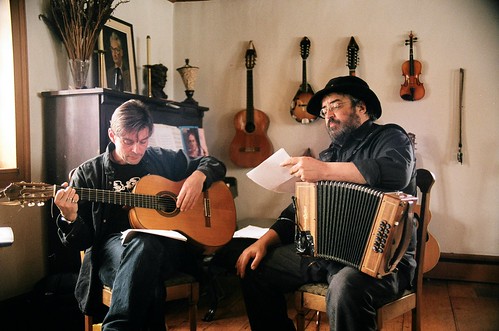
Recently we filmed one of your main characters, Yves St-Laurent, with well-knowf folk musician Yves Lambert. They played ‘Le Tour de l’Isle,’ a song about Île d’Orléans by Quebec’s most popular singer-songwriter Félix Leclerc. ( See photo above.)

When we filmed the last demonstration agains the Rabaska project in front of Quebec’s National Assembly, my friend Simon Bujold shot this little video:

[youtube 6AxfxSEI8rY]

As film projects go, this one is very similar to some of my previous films, following a conflictual situation over a long period of time. But making this one together with Martin has undoubtedly brought other qualities to the film, which will be released later this year.

Questioning the IDA about its list of best documentaries.

DEV-IDA.20
Diane Estelle Vicari

The International Documentary Association, based in Los Angeles, recently released its list of the 25 best documentaries of all times. It was published in the 25th anniversary special edition of the organization’s magazine, as well as on its web site. I was a little shocked to see this list, because almost all of the films mentioned are U.S.-made, English-language films. You have to go all the way down to position 20 to find the first European films, and docs from other continents are nowhere to be seen. Shortly after seeing the list I had the opportunity to meet the president of the IDA, Diane Estelle Vicari. I asked her if the list isn’t distorting the history and reality of doc production ?

“The way we came to this final list is the following. An assigned committee among the board of directors started by establishing a list of more then 600 titles and posted it on our web site, and asked our members to vote. We also asked and provided our members the ability to do the following: “if we’ve missed any of your favorites you may add up to five titles at the end of the list.” which many did. And the list grew. But the vast majority of our members are from the U.S. and Canada. Also, a lot of older and more established film makers who have a better knowledge of the history and scope of documentary making are actually not members of the IDA, while many younger filmmakers are. They are mainly the ones who voted, and that shows in the result.”

How do you personally feel about the result ?

“I do think it’s truly sad that the younger generation of filmmakers is not more aware of the
history and international realities of doc making. This can in some measure
be blamed on the media in the U.S., as it mainly focus on the very narrow field of “commercially” released documentary every year which in the end creates a narrow view for all. I would like to see younger filmmakers as well as audiences discover and learn more so that they may find a balance between old and new, films from here and from abroad.”

But then doesn’t the IDA’s list help aggravate that situation, by creating
the impression that most important docs are recent American ones. This won’t
encourage them to go further afield, will it ?

‘There is certainly no sure way of measuring the direct impact of the 25 Best List in the short term. When debating this process, the board of directors of IDA was clear that no matter what the outcome, it would create heated conversations about documentaries; the titles included as well as the titles off the list. It is only through dialogue and exchange of information that our constituents will learn more. The list has now gone beyond our website, www.documentary.org — it is being discussed with much passion on blogs, among filmmakers and audiences. It is my wish that it crosses the un-limitless borders of the internet and continues to create debate. We, at the IDA are in discussion about a release of all other titles in the near future.”

The socially conscious Christmas doc: Cher Père Noël

ST_NICOLAS

I have already introduced you to my wonderful friend and colleague Martin Duckworth, a veteran of the documentary trade. If you understand French, I recommend his film ‘Cher Père Noël’ – now about 10 years old – for the holiday season. In it, we meet children from New Brunswick who write to Santa Claus about their wishes. Santa appears in animated scenes. And through their letters we learn not about toys and gadgets, but about the social crisis touching so many of them. Poverty, divorce, illness, those are the issues they are really dealing with. What they want more than anything else is for their family members to be happy and healthy.
PETITES_FILLES

Martin has this to say about the origins and the making of the film.

“I got the idea from my handicapped daughter Jacqueline, who loves
Pere Noel and was still writing to him at the age of 25, when the
film was made. It was co-produced by Virage in Montreal, and Phare
Est in Moncton. Caraquet was suggested by Cecile Chévrier of Phare
Est as the place where I was most likely to find real elves. The
animation scenes were developed by Joyce Borenstein as a way of
bringing Pere Noel to life. What I learned from the children is that
we all have a fundamental need for symbols of hope in this world of
increasing despair. There is no English version, unfortunately. ”

Contact for sales:

Mélanie Bhérer
Directrice de la distribution
Films en vue
(514) 276-9556 #242
Info@filmsenvue.ca