Uranium movie makes comeback

003Uranium_BW
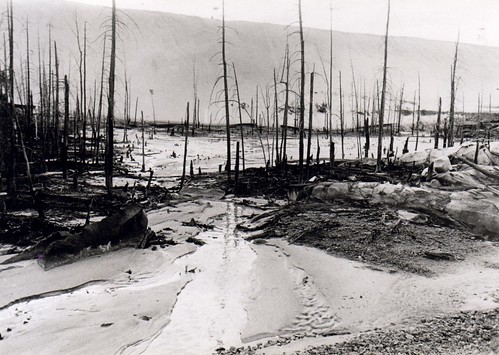
Radioactive uranium tailings at Elliot Lake.

One of my first films, released 18 years ago, was Uranium, about the radioactive wastes from uranium mining on aboriginal lands in Canada. Not a very exciting title, and there was a reason for it. Faced with intense pressure from the uranium mining industry, the NFB sent a letter to the industry promising that the film would not be called ‘Death Rock,’ my preferred title and the literal translation of ‘dada the’, the dene word for uranium. By the time I was told about it, the letter had gone out. I wasn’t happy. But the NFB really supported and promoted the film and organized an exciting cross-county tour with panel discussions. We picked up the award for best documentary at the Yorkton festival.

At the time, Canada was already the world’s leading producer and exporter of Uranium, and huge amounts of radioactive wastes were accumulating on native lands. There is a reason why aboriginal people are much affected by uranium mining, be it in Canada, in Australia or in the ‘four corners’ area in the U.S. Since they were shoved off the best lands but allowed to live on the infertile and rocky hinterlands, they find themselves in the same place as uranium ore.

And now, with oil prices rising, there is a huge upsurge in uranium exploration and mining.

As a result, my film is back in use. It has been shown at numerous conferences in Ontario in particular. According to the organizers, the only thing that has really changed since I made it are the hair cuts.

The man who acted as a consultant to our film back in ’89 was Gordon Edwards, of the Canadian Coalition for Nuclear Responsability. I asked him what he thinks about the present uranium mining boom.

“The soaring price of uranium is something we’ve seen before, in the early
1970’s. In a very short period of time the price went up tenfold. It turned out
to be due to price manipulation; the price then fell steadily for the next
15 years. The result was that uranium mines were welcomed by communtiies,
but the economic benefits never met their expectations. Meanwhile highly toxic long-lived uranium mill residues were left in those areas as a permanent radioactive legacy. Back in 1898, Marie Curie showed that the residues left over after uranium is extracted from the crushed ore are eight times more radioactive than the uranium itself. These residues contain some of the deadliest materials known to science: radium, radon, and especially polonium isotopes, which the industry admits is 250 billion times more toxic than cyanide. These toxic materials are inevitable radioactive byproducts of uranium, produced by the process of radioactive disintegration, and they remain dangerous for hundreds of thousands of years.”

This is from one of the coordinators of the present Ontario campaign, Lynn Daniluk:

The Community Coalition Against Mining Uranium (CCAMU) is a group of concerned citizens from the greater Ottawa Valley and Kingston area, who came together to prevent a uranium mine in Frontenac and Lanark region. A uranium exploration company has staked and claimed 30,000 acres of land at the headwaters of the Mississippi water system, which feeds the Ottawa River. Scientific experts and history tells us that if a uranium mine were developed in this region it would be a serious environmental and public health concern. Our area is renowned for cultural events, tourism, and cottage life.

Our non-native coalition made Canadian history by joining a peaceful protest that had been set up by the Shabot Obaadjiwan First Nation and the Ardoch Algonquin First Nation on June 28th, 2007.

On 15 February 2008, former chief Robert Lovelace, of the Ardoch Algonquin First Nation began serving 6 months in jail for refusing to comply with the court injunction, while following Algonquin law to protect Creation.

The judge in the case handed down this harsh sentence along with heavy fines, saying, “compliance with the orders of this court are not optional”. The underlying issue, however, is that the government of Ontario did not consult with the First Nation community before issuing exploration licenses in Algonquin territory.

To date, fifteen municipalities in eastern Ontario have called for a moratorium on uranium exploration and mining in Eastern Ontario, including the cities of Ottawa and Kingston.

We also have the support of such organizations as Amnesty International, Council of Canadians, Greenpeace Canada, Mining Watch Canada, International Land Coalition, Green Party of Canada and Ontario, United Church of Canada, Physicians for Global Survival, Ontario College of Family Physicians, Lanark Health and Community Services, David Suzuki Foundation, Canadian Association of Physicians for the Environment and many local organizations in the region.

An inquiry was held in four locations (Shabot Lake, Kingston, Peterborough and Ottawa) throughout the month of April 2008. CCAMU now in the process of complying the information and will be writing a report to present the government. For more information go to http://www.ccamu.ca/
The Interactive doc: Bob Lang and Diamond Road

MR_in_SL
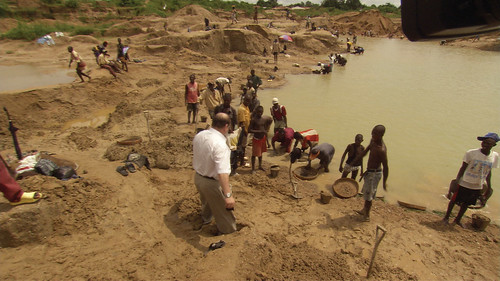
From The Diamond Road

Can you be a documentary filmmaker in the present tough context and still have a life I do my best to have time for family and friends, and to get out in the bush or on a river somewhere regularly. This past weekend I was out paddling with another documentary producer/director, my friend Bob Lang from Port Hope. Bob has made some terrific films and television series, and he is one of the sanest people I know in the ‘business.’ For one thing, he has a great sense of story, only works on things he cares about, and makes very smart decisions. This has allowed him to keep his company, Kensington Comunications, going successfully for some twenty-seven years. Among his many excellent productions are The Sacred Balance, a four-hour series with David Suzuki.

One of Bob’s recent productions is the series Diamond Road, three television hours but also a feature film version which just received the top documentary award at the Houston 41st Annual WorldFest . In addition Bob and his team have created a non-linear interactive version of the film, Diamond Road Online. Here you can dip into the complex story of the world diamond trade at whatever entry point you select on a world map. After viewing the segment you picked, you can select another one, out of a total of more than three hundred, and in that way construct your own story. It’s an ingenious use of Web 2.0 technologies, driven by a new sense of interactive, non-linear storytelling. The underlying architecture is such that it is able to calculate your personal interests by the choices you make and then offer suggestions, Amazon-style, for where to go next. You can even, as a user, contribute stories, edit clips and thus enrich the site for others.

This reminded me of my visit to the World conference of Wikipedia two years ago. I interviewed one of the founders of the movement whose name now escapes me, and asked what he thought would be the next cutting edge, the next frontier. His answer was instantaneous, short, and to the point: ‘collective story-telling.’

Bob Lang
Bob Lang in Frontenac Park.

Bob and I discussed whether we, as documentary filmmakers, used to structuring our stories in ‘auteur’ fashion, should be afraid of these kind of developments. I think we both agreed that yes, there will always be a place for stories in which we fashion and control the dramatic arc and editorial ‘line,’ but we should also welcome the participatory and democratic nature of these new experiences. If we trust the viewers they will make good use of the story material. Have a look at Diamond Road Online, it’s very well made.
http://www.diamondroad.tv/


A beautiful film : ‘My father’s studio’

image
Jennifer Alleyn with her dad Edmund.

Not long ago I had the chance to see ‘My father’s studio’, a beautiful film by Jennifer Alleyn produced by Jeannine Gagné at Amazone Films. The opening screening will be at ExCentris in French and at Cinéma du Parc in English starting May 9th. Excellent editing by Annie Jean. It’s one of those films one should see on a big screen. It won the award for best Canadian production at the Festival des films sur l’art (FIFA) in Montreal.

He was a great artist, Edmund Alleyn: a master colorist, very creative and original. We learn from Jennifer’s movie that her dad made many new departures during his career. Every time he had a real success, he let go of whatever style he’d been working in, and started again in a new uncertain adventure.

Creative, original, but not talkative. Jennifer did one interview with him which is placed right at the top of the film. What he sais is heartfelt and full of meaning, but she had to work really hard to get just a few sentences from him. He died not long after. The movie is a testimony about his life and his art.

Beyond the cinematic qualities of the film, I found myself in familiar territory, because my dad Arne is an artist. He lives in Sweden and he still painting and teaching at age 91. My uncle Torsten, who died one year ago, was a painter and sculptor. My sister Eva paints watercolours and does drawings. Watching Jennifer’s film, I almost could smell the oil paint of the artist studios of my childhood.

I am sure it was not easy for Jennifer to make a film about her dad, and I asked her some questions.

How came up the idea to make a movie about you’re dad?
I’ve been wanting to do a film about my father for a long time. His double identity intrigued me. Born to an English family in Quebec City, he liked to say he was “French to the skin, English to the bone”. I feel connected to that reality. I was born in Paris in May 1968 and we immigrated back to Quebec in 1971. His life span covers recent Quebec history.
But it took me years and his departure, to find the approach that would allow me to plunge into his universe, his imaginings, while remaining respectful of his privacy. Can we ever access the soul of another being? During the research, I discovered he was quite a free thinker, and a philosopher as well as a painter. But the film doesn’t resolve or explain anything. It offers images to the viewer’s own interpretation. One mustn’t forget it is a posthumous dialogue, taking place in the silence of painting..

What are, do you think, the big themes in the movie?
I was very inspired by his work & notes . The fact that I started filming while he was alive and persued the shoot in his absence, gave a particular tonality to the film. In a way, it gave me the opportunity to follow some of his privileged themes: movement and stillness.
Life and death coexist in the film. But it was a celebration of life that I wanted to put on the screen. The title of the film refers to the physical space in which he worked for 40 years, but also to the creator’s mind, constantly processing images, memories, ideas, hopes or unfinished projects.
image2

It’s a really personal film, did you hesitate before starting the process?

I never hesitated, but I went to television to see if the subject could interest others. Surprisingly, the French CBC immediately agreed to the voyage I was proposing. I knew my father was not a celebrity in Quebec, like Jean-Paul Riopelle or Borduas. But his path was very inspiring. He was as free spirit. Now that the film is finished I wonder what will be the next project that will drive me with such strength. It was so dense and deep.

Could you have done the movie while you’re dad was still alive? Do you regret that you didn’t ?

My only regret is that he couln’t be at the premiere of the film!

But had he still been around, it would have been impossible to do this film . He was quite a director himself. He would have called the shots and hired me as his assistant! So I waited for my turn. After his departure, I could revisit his life, question his trajectory, search for the missing fragments. Inheriting his studio gave me a dramatic starting point. The idea of structuring the film according as a stream of consciousness imposed itself very soon. Knowing my father’s love for Virgina Woolf, I would’nt be surprised if she whispered from the darkness…

In the narration,you decided to talk to you’re dad. Is it mainly a choice you made to communicate with the public, or is it because you had things to tell him, to clear up between the two of you ?
During the scriptwriting process, I wrote short texts to my father. Like Haicu’s. Some of them were too personal, but some made their way to the final narration.Through this very intimate dialogue, the father-daughter relationship is offered up. I though people could enter more easily into this intimate space if it was raw. No detour, no mask. Bluntly intimate!. The father figure has always been one of knowledge for me. His absence made me realise I had to turn to other sources to find answers. I guess I had a few unanswered ones I needed to bounce at him. I hope people can interchange characters and address their own parent, in the anonymity of the cinema!

Un trés beau film: L’atelier de mon père

image
Jennifer Alleyn avec son père Edmund.

Il n’y a pas longtemps j’ai eu l’occasion de voir ‘l’Atelier de mon père’, un trés beau film de Jennifer Alleyn produit par Jeannine Gagné à Amazone Films. Le film prend l’affiche à ExCentris en français et au Cinéma du Parc et anglais à partir du 9 Mai. Excellent montage par Annie Jean. C’est un film à voir au grand écran.

Il était tout un artiste, Edmund Alleyn: un grand coloriste, créatif et aussi très original. Il ressort du film de Jennifer que son père a effectué bien des ruptures au cours de sa carrière. Chaque fois qu’il obtenait un grand succès il délaissait le style qu’il avait affectioné pour se lancer dans une nouvelle aventure imprévisible.

Créatif, original, mais pas loquace. Jennifer a faut une entrevue avec lui, qui commence le film. Il livre des vérités lourdes de sens, mais elle a du travailler fort pour lui les arracher. Et il est mort pas longtemps après. Le film témoigne de sa vie et de son art.

En plus des grandes qualités du film en termes cinématographiques je me suis en quelque sorte reconnu dans ce film, puisque mon père Arne est un artiste. Il vit en Suède, il a quatrevingt-onze ans, et il continue à peindre. Mon oncle Torsten, décédé il y a un an, était peintre et sculpteur. Ma soeur Eva peint des aquarelles et fait des dessins. En regardant le film de Jennifer j’ai presque senti l’odeur de la peinture d’huile des studios d’artistes de mon enfance.

J’ai imaginé que ça n’a pas été facile pour Jennifer de faire un film sur son père, et je lui ai posé quelques questions.

Comment t’es venue l’idée de faire un film sur ton père?
Je me suis trouvée devant une pensée, une philosophie que j’ai eu envie d’approfondir, de mieux connaître. Le fait qu’il s’agisse de mon père m’est même d’abord apparu comme un obstacle. J’étais consciente qu’il n’avait ni la reconnaissance de Riopelle, ni le pouvoir d’attraction d’un Borduas. Mais son parcours me fascinait. C’est celui d’un esprit libre.

Quels sont, dirais-tu, les grands thèmes que l’on retrouve dans le film?
Le film s’articule autour de deux thèmes chers à Edmund Alleyn, qui sont la mouvance et la fixité. La mouvance, métaphore de la vie, se retrouve non seulement dans le parcours géographique de cet artiste qui a vécu à Québec, puis à Paris et enfin à Montréal; mais aussi, d’un point de vue iconologique, dans les symboles représentés dans les oeuvres, au premier plan le motif de l’eau qui traverse la peinture d’Edmund Alleyn, du début à la fin. L’idée de fixité, qui apparaît plus tardivement dans l’œuvre, est présente dès le début du film. Cet atelier déserté par l’artiste, ce lieu où le temps est suspendu, suggère la fixité de la mort, un arrêt du mouvement.

image2

C’est un film très personnel, as-tu hésité avant de l’entreprendre ?

Je n’ai pas hésité, mais j’ai attendu longtemps. Je savais qu’il serait impliquant et truffé de risques! J’avais déjà tenté d’approcher mon père avec une caméra, mais il redoutait les entrevues, il était secret. Puis, trois ans avant sa mort par un après-midi d’été, il a ouvert la porte et j’ai pu lui poser quelques questions. Après son décès, ces bandes vidéo ont pris une autre valeur. Et lorsque j’ai hérité de son atelier, le projet s’est imposé de lui-même.

Aurais-tu pu faire le film pendant que ton père était en vie? Regrette-tu de ne pas l’avoir fait?

Le seul regret que j’ai, c’est qu’il n’ait pas pu assister à la première du film!
Mais il aurait été impossible de faire le film de son vivant parce qu’il aurait voulu tout contrôler et j’aurais fait son film! Un peintre, par définition, est un créateur total. Avec son décès, un mur est tombé. Maintenant je le remercie d’avoir mis cette paille, si riche, dans mon berceau. Il a fallu qu’il parte, que le lien émotif ne soit plus là, entre nous, comme une interférence, pour que je puisse entrer dans son monde.

Tu as choisi de parler à ton père. Est-ce avant tout un choix de communication avec le public, ou parce que tu avais des choses à lui dire, ou à mettre au clair entre vous ?
En cours de recherche, il m’arrivait d’écrire à mon père de courts textes. Ils étaient souvent trop intimes, mais ils ont nourri la narration. Et j’ai gardé le Tu qui me semblait à la fois personnel et permettant une implication du spectateur. On a tous un père à qui l’on a dit tu. J’ai fait ce film parce que je crois au dialogue, à l’humain, à la richesse des idées partagées. Mais le dialogue dont je parle à la fin du film est celui que j’entame avec son oeuvre. C’est celui de l’art, qui va de soi à soi et qui ne finit jamais.

Cinema Politica faces funding crisis.

BigSellout

Townshop residents in South Africa connect to power grid. From The Big Sellout.

Cinema Politica is the name of a program of screenings which was started at Concordia University in Montreal by Ezra Winton and the Uberculture media arts non-profit five years ago, and which has branched out to a number of other cities on the North American continent and even overseas. Its list of screeings reads like a roll call of the best of recent sociopolitical documentaries: Loose Change, The Corporation, Crude Impact, Seeing is Beleiving, McLibel, The Big Sellout....OK now I can hear my webmestre Kim saying ‘you should have links to these movies.’ But actually, they are all there on the Cinema Politica website, along with many other great films, so check them, out.

The Cinema Politica screenings in Monteal have been a huge success. The two or three screenings I went to last year were attended by about five hundred people. There is a real thirst and enthusiasm out there for political docs, for films that are hard to find on TV. But now, sadly, Cinema Politica’s survival is threatened by a funding crisis. It is really essential for this series of screenings to continue ! I put a few questions to Ezra Winton.
ezra_aeroplane

How did Cinema Politica start and how long has it been running ?
I started it in 2001 at Langara College and it eventually migrated
with me to Concordia where it was renewed in 2003. I started in order
to:
a) address the incredible lack of diversity in Canadian movie theatres
b) help build audiences and support independent Canadian documentary
and fiction
c) use film to inspire audiences (especially students) into actions
around social justice and cultural participation.

How did it expand to other cities ?
People have been to the Concordia events or heard about them and know
how hugely successful we are there. They then contact us and we help
them set up in their communities. They are emboldened by the Concordia
success and want to be part of a network that can hopefully breed that
kind of political cinema energy, and they get a lot of support from us
in the way of licensing costs, website support, etc.

Programming is terrific, how does it work ?
Thanks! I’ve been the programmer for five years at Concordia, and
every year I make suggestions to the 30+ locals in Canada and Europe
on films I think are excellent, but ultimately the other locals do
their own programming. As for how I select, it’s about the quality of
filmmaking, the level of commitment to the politics (ie, films that
take a stand or illustrate a stand), and diversity. I think that our
screenings have resonated with students at Concordia especially,
because every week they know they will experience cinema that is
politically, geographically, and issue-oriented diverse. We even throw
in the odd fiction feature and short to keep things interesting. I
should also mention that my partner, Svetla Turnin, plays a big part
in helping me sort out the gems we will screen from the 100+
acquisitions and submissions I go through every year.

With such an incredibly successful initiative ( when I was there, there were 400-600 people) can you not finance it with ticket sales ?
Part of the mandate of our parent organization (non-profit
überculture) is to promote the media arts to new audiences and to
ensure accessibility. We therefore have asked that none of the locals
charge admission. We do ask for donations, and raise a bit at each
screening that way. The Concordia CP also has its own funding
apparatus – a fee levy that all students pay into, amounting to 2
cents per credit and giving the series almost the budget it needs to
clear great films and bring in speakers. This kind of “collective
payment” method works wonderfully at that one local, our flagship
local, but the funds need to stay there. Funding the rest of the
network is the problem we face. Basically, for $40,000 a year as a
base minimum, we could get a phone and hire a coordinator to keep
things going. With more, we could build the biggest and most active
alternative distribution and exhibition network for documentary and
independent political cinema Canada has seen. For now, we’ve been
running the network on $5,000 per year, thanks to CitizenShift’s
ongoing support and faith in the project.

What happened with Canada Council funding ? Any explanations ?

It’s the second time we’ve been turned down. This time the jury
recommended we get funded and had comments that were all incredibly
positive. They even commented that they couldn’t believe we had
survived so long on volunteer labour!! Unfortunately the jury ranked
us so low the money in the envelope ran out by the time they got to
us. We are actually a bit shocked, as there was even an alternative
video distribution person and a doc filmmaker on the jury….We know
it’s not the Council’s fault, but I am starting to realize how
documentary is discriminated against in the media arts world when it
comes to funding. So many people told us that the jury would love us
(the grant was for organizational funding, exactly what we need) that
we kind of held our breath thinking we’d get it. We are now left with
the option of finding $30,000 to 40,000 over the summer or shutting
down the project. We are discussing a Network membership fee for
locals that would be instituted in the fall and be sliding scale. DOC
has also contacted me to have a meeting later this month, but I know
DOC is not like Toronto International Film Festival – not a lot of money to throw around. So, if
anyone has ideas or access to suitcases of cash, please contact us!
The wind is gone from our sails, but I guess we’re not sunk yet.

Thanks Ezra, keep up the good work !

Ezra also publishes aa news and resources blog and website on Canadian
independent cinema called “Canada Screens” – http://www.canadascreens.ca

Panel sur le cinéma engagé aux RVCQ

panel RVCQ

Photo Sylvain Légaré.

IL Y A DES EXTRAITS VIDÉO DANS CE POST, CERTAINS USAGERS DOIVENT LES ACTIVER EN BAS DE LA PAGE.

La semaine passée j’ai participé à une discussion de panel sur le cinéma engagé, dans le cadre des Rendez-vous du Cinéma Québecois . J’ai trouvé fort intéressant d’entendre des réalisateurs de fiction parler du documentaire, et j’ai demandé à mon assistante Dijana Lazar de résumer le débat et d’en choisir quelques extraits. Voici ce qu’elle a retenu:

La discussion sur ce sujet percutant et pertinent, autant pour le cinéma que pour la société en générale, a rassemblé cinq réalisateurs, vivant chacun à leur manière la vocation de ‘cinéaste engagé’. Manon Barbeau, Philippe Falardeau, Richard Desjardins, Bernard Émond et Magnus Isacsson ont tous, à travers leurs oeuvres cinématographiques, exprimé leurs préoccupations sociales ou politiques et débusqué des injustices et des inégalités dans le monde qui les entoure.
L’animatrice, Marie-Louise Arsenault a introduit la discussion en posant la même question révélatrice à tous les invités : « Qu’est-ce l’engagement pour vous? »

Bernard Émond a souligné que l’engagement social se trouve au coeur de ses préoccupations en tant que cinéaste, et même s’il ne fait de pas des films politiques en soi, ces notions sont toujours présentes dans ses oeuvres.
Il s’est aussi penché sur la question du cinéma documentaire par rapport au cinéma de fiction, dénonçant la situation très difficile et injuste dans laquelle se trouvent les documentaristes aujourd’hui au Québec et soulignant que les meilleures productions du cinéma québécois sont issues du cinéma documentaire.

[youtube IUJy7iO2gwg]

Pour Philippe Falardeau être engagé : ça veut surtout dire être cohérent et fidèle à ses idées et à ses principes. Il a aussi parlé du sort difficile du film documentaire, accusant les télédiffuseurs de charcuter les films des documentaristes qui travaillent souvent avec moins de moyens mais ayant les mêmes obligations au niveau dramatique que les cinéastes de fiction.

[youtube oITHGBosDNg]

Questionné sur l’ampleur de son engagement et parlant de la controverse qui entoure souvent ses films, dont ‘L’Erreur Boréale’ qui a soulevé un grand débat sur la coupe de bois au Québec, Richard Desjardins a profité de la tribune pour dénoncer la manière discriminatoire dont les amérindiens sont traités dans la société québécoise, et préconiser une démarche sur la scène internationale afin de remédier à leur situation et améliorer leurs conditions de vie.

[youtube 6_hSYEcFuZA]

Manon Barbeau, interrogée sur la facilité de faire les films engagés au Canada et au Québec, a répliqué que c’était beaucoup plus facile de réaliser ce genre de films ici que dans d’autres pays, qui subissent les mêmes problèmes sociaux mais qui ont des systèmes de censure très rigides. Elle a dit que le problème avec le cinéma engagé au Canada, c’est souvent la diffusion des films et non leur réalisation en soi.

[youtube vf6Reo_u29k]

En finissant la discussion, les invités ont tous partagé avec le public les titres de quelques oeuvres cinématographiques qui leur tiennent particulièrement à coeur, et Magnus Isacsson a souligné qu’il aime beaucoup voir des oeuvres de fiction car il en tire une inspiration pour ses propres films surtout par rapport à la construction de la courbe dramatique et l’exploration des personnages. Il a aussi parlé de ce qu’il considère être des ‘conditions gagnantes’ pour réaliser un documentaire qui sera satisfaisant, non seulement par la pertinence du sujet, mais aussi du point de vue dramatique.

[youtube lU35tY4XxtA]

Merci à Michael Julian Berz pour le tournage, à Dijana Lazar pour le résumé et les extraits vidéos, et aux RVCQ pour la photo.

Impressive doc hits big screen: Up the Yangtze

yantze1

I just saw the very successful Canadian-produced documentary ‘Up the Yangze’ and was very impressed. This is a first film, by a young Montreal-based director of Chinese origin, Yung Chang. It tells an epic story, with grand visuals of the transformation of the Three Gorges and the Yangze river valley, but it tells it through a touching and closely filmed story mainly of one family. They are poor uneducated farmers, and they cultivate a small plot of land by the river. As the plans for damming the river move ahead, they know their land will be flooded and they will be displaced along with 2 million other people. Unable to pay for her education, they send their oldest daughter to get a job on a tourist tour boat which travels up the river to the dam, in the final stages of construction. This provides terrific opportunities for showing the encounter of two worlds, and for cutting back and forth between the obsequious tour guides who are prepared to say anything to please the authorities and make a buck, and the struggling farm family for whom this whole development is a disaster. The filmmakers mine this rich vein for all it’s worth, to great effect. The numerous ironies and the poignancy of the situation steers the film away from any kind of simplistic analysis. And far from romanticising the old ways, they contrast the hardships of the age-old poverty with the glitter of a new shamelessly promotional commercialism. Through the story of one family you get a portrait of all of China and its dilemmas, economic, environmental, human. It’s also beautifuly filmed and edited. What an accomplishment ! I encourage you to go and see this film on the big screen, we need to show that there’s a place for theatrical screenings of docs.

My assistant Steven Ladouceur added the following information and links – apologies for the repetition.

This Friday February 22nd opens the Montreal screenings of Yung Chang’s highly acclaimed first feature-length documentary film, Up the Yangtze, at the AMC Forum. The Mirror says viewing this film is “one of those experiences that reinvigorates and restores your faith in the documentary film medium.” Chang graduated from Concordia University’s Film Production programme and his latest achievement stems from a “surreal” journey with his family to China in 2002. One year later, Chang was receiving support from EyeSteelFilm productions through former professor Daniel Cross and then the National Film Board. After developing and refining the project throughout 2004 and 2005, the film was mainly shot in 2006 and post-production ended in July of 2007. From it’s inception Up the Yangtze has been receiving awards and is continuing to do so now more then ever as it is breaking box office records.

Doc impressionnant prend l’affiche: Up the Yangtze

yantze1

Je viens de voir le succès documentaire Up the Yangtze, production canadienne qui m’a vraiment impressionné. C’est un premier film de Yung Chang, jeune réalisateur d’origine chinoise, basé a Montréal. Il raconte l’épopée de la transformation du Three Gorges et de la vallée de la rivière Yangtze avec des éléments visuels grandioses, mais la raconte principalement à travers l’histoire touchante et intimement filmé d’une famille. Ils sont des fermiers pauvres et sans éducation et ils cultivent un petit lot de terre près de la rivière. Alors que les plans pour créer un barrage avancent, ils savent que leur terre sera inondée et ils seront déplacés ainsi que 2 millions d’autres personnes. Incapable de payer pour son éducation, ils envoient leur fille aînée pour obtenir un emploi sur un bateau de croisière pour touriste qui voyage le long de la rivière jusqu’au barrage, qui en est a ses dernières étapes de construction. Ce qui permet une opportunité formidable de montrer la rencontre de deux mondes et couper entre les guides de tournée obséquieux qui sont prêts à dire n’importe quoi pour plaire aux autorités et faire de l’argent, et la lutte de famille de fermier pour qui ce développement est un désastre. Les documentaristes minent cette veine riche à fond avec brio. Les nombreuses ironies et le caractère poignant de la situation dirige le film loin d’une analyse simpliste. Et loin d’idéaliser les anciennes façons, ils créent un contraste entre les vieilles difficultés de la pauvreté et le scintillement effronté d’un nouveau commercialisme promotionnel. À travers l’histoire d’une famille, vous avez le portrait de toute la Chine avec ses dilemmes économiques, environnementaux, humains. Il est aussi magnifiquement filmé et monté. Quel accomplissement!

Mon assistant Steven Ladouceur ajoute ceci: ( pardonnez quelques répétitions.)

Ce vendredi 22 février a Montréal débutera les projections de Up the Yangtze, le premier long-métrage documentaire extrêmement acclamé de Yung Chang au Forum AMC. La version française du film prendra l’affiche le 7 mars au cinéma Quartier Latin. Le Mirror dit que voir ce film est « une de ces expériences qui revigore et restaure la foi en medium du film documentaire. » Chang est un diplômé du programme de Production Cinéma de l’Université Concordia et son dernier accomplissement trouve ses origines d’un voyage «surréaliste » avec sa famille en Chine en 2002. Un an plus tard, Chang recevait du support des productions EyeSteelFilm à travers un ancien professeur Daniel Cross et puis par l’Office National du Film. Après avoir développé le projet en 2004 et 2005, le film a principalement été tourné en 2006 et la post-production a terminé en juillet 2007. Dès ses débuts, Up the Yangtze reçoit des prix et continue à le faire maintenant plus que jamais alors qu’il établit de nouveaux records au guichet.

Doc Challenge, Quickie filmmaking !

team_beijing_dreams_from_china
Team Beijing Dreams From China – behind the scenes of award-winning Lao Shan Lao Yin – Jakob makeup


I am amazed how many people are able and willing to make films without funding. A couple of years ago I chaired a competition called Green Camera ( Caméra verte) and we received 135 short films although the deadline was tight. There are also a number of competitions where teams make films in 48 hours of a week. One of the better established ones is The International Documentary Challenge which returns to Hot Docs in April 2008. Registration for the 3rd annual Doc Challenge held from March 6 to 10 2008, is now open. I put a few questions to the producer of the event Doug Whyte.

doug_whyte
Doug Whyte, Doc Challenge Producer.


1. Where did the idea come from?

I work for KDHX Community Media (www.kdhx.org), a non-profit community media organization in St. Louis, MO. (Though I am now based out of Portland, OR.) I produce the St. Louis 48 Hour Film Project (www.48hourfilm.com) for them and after seeing how the fiction filmmaking community has embraced the 48 Hour Film Project, I figured I’d try and launch a similar event for non-fiction filmmakers. Of course, I wasn’t sure how this would work for docs since it often takes years to make a decent one. But the results have been tremendous! The films are so good that Hot Docs Canadian International Documentary Film Festival (www.hotdocs.ca) came on board to be the Presenting Partner and host the premiere of the finalists and the awards ceremony. Other screening partners include SILVERDOCS, the Big Sky Documentary Film Festival, the International Documentary Association, the Documentary Organization of Canada and the 48 Hour Film Project.

2. And how many times have you done this?

This will be the third year of the Doc Challenge and the second year at Hot Docs. This year we will be doing more regional screenings in cities with clusters of participants, including (most likely) Los Angeles, Seattle, Portland, St. Louis, Washington DC, Missoula, and Toronto. These screenings will showcase the locally made films as well as some of the international winners.

3. Is there a theme, or constraints? When do the contestants learn what they are?

On Thursday morning March 6 each team is given the choice of genres for its film, be it Character Study, 1st Person, Music, etc. In addition, all filmmakers will be given a broad theme (such as “Freedom”) that must be addressed at some point in their film. To ensure the films were made within the required time frame, each team must prove the date the film was made by adding a time element to the film or credits (such as the main subject holding a newspaper.)

Then the film must be sent to Doc Challenge headquarters with a postmark no later than Monday, March 10.

4. It seems more and more people are willing to contribute audiovisual pieces for free, to competitions and web sites. Do you think established people with a production company or whatever have an edge here, or that it’s really a pretty equal playing field given how accessible new technologies are?

I would say in a competition like this it is a fairly equal playing field. With such a short time frame, it comes down to engaging characters and story (as it usually does.) That’s not to say that very professional camera work and editing doesn’t give a film an advantage, but it must have the story first. Some of our finalists in the past 2 years have ranged from established filmmakers like Doug Hawes-Davis (Libby, Montana on POV) to first-timers that found extremely engaging and unique subjects. The Doc Challenge is an event that appeals to both novice and professional filmmakers alike: novice filmmakers have the opportunity to go through the whole filmmaking process in less than a week, learning the art of documentary production in a trial by fire situation, and professionals have the opportunity to work on a creative, personal project without having to commit years of their life. One thing I would like to say about this event is that filmmakers are doing much more than just entering a festival. First, we limit the number of entries (250) where festivals do not. (Sundance just had over 8,000!) Second, by registering, they are in the competition, not just “considered” for it. We work toward getting the films screened and distributed, no matter if they are winners or not. At a festival you get one screening (maybe two.) In the last 2 years we worked all year on getting the films screened many times and we actually got more TV distribution for non-winners than winners! And if we find distribution for a film, the split is 75% (filmmaker) to 25% (Doc Challenge.) Also, we are a non-profit organization and all proceeds go back into the event to make it better.

Thanks to Steven Ladouceur for the help with this blog.


doc_challenge_logo

Complete details and entry forms can be found online at http://www.docchallenge.org/
Email info@docchallenge.org with questions.
Check out Hot Docs here: http://www.hotdocs.ca

Chronicle of everyday life

071111-159
Workshop: Denys Desjardins et Jacques Leduc

During the Rencontres Internationales du Documentaire de Montréal last november, my wife Jocelyne Clarke attended a workshop on a really unique film series called ‘Chronicle of Everyday Life,’ with Jacques Leduc, Denys Desjardins and Richard Brouillette. Jocelyne is a filmmaker ( her most recent film is ‘Edith and Michel’) and she has participated in the programming at the Rencontres since the beginning. Here is her report from the workshop:

Phot Jocelyne Clarke
Jocelyne Clarke

I ceased counting the number of times the word “freedom” was uttered when referencing this outstanding work in the annals of Quebec documentary.

Started in the early 70’s, officially produced in 1977 by Jacques Bobet at the NFB, the project was conceived and directed by Jacques Leduc in collaboration with a few dozen other illustrious craftsmen from our cinema. The result was a four and a half hour opus, divided into 8 films of lengths varying from 10 to 82 minutes.

The idea behind the project was to revisit direct cinema at a moment when it was already heavily “contaminated” by mass TV (which Leduc describes as a’ transmission method ‘ and not a ‘cinematographic language ‘), and to reflect on the times through the main axes of life – love, money, food, home, hearth, death. Small filmmaking teams went out in search of serendipitous moments : a parade of men in underwear, houses being built in the suburbs, a group of well-to-do women doing charitable works. Unusual yet essential stereotypes of urban life in those still innocent times. The material was organized as it came in, in an organic back-and-forth between filming and editing, and was divided into themes, which finally became the days of the week.
Footage that was too precious to leave out, but did not fit into the final structure, was edited into an epilogue for the series – Le plan sentimental – remarkable for its visual improvisation as well as its elaborately constructed soundtrack.

The workshop discussion eventually led to the question: could such a work be made today? No categorical answer was forthcoming, but it was generally agreed that today’s televisual requirements – fixed lengths for films, detailed scripts, releases, – definitely limit such freedom, without completely destroying it. Today we have the technological advantages that come with small, inexpensive tools, undreamt-of distribution channels – (all that’s lacking are salaries for filmmakers). Jacques also brought up how film subjects in the 70’s had a much less reflexive relationship with the camera than today, in the wake of reality shows and all manner of idols.

A remarkable series, too little appreciated by the public, which really deserves to be re-issued in a DVD package.

For more information, check out the NFB website, search in the collections under “series”, or search individual titles as follows.

Lundi – Une chaumière, un coeur.
Mardi – Un jour anonyme.
Mercredi – Petits souliers, petits pains.
Jeudi – À cheval sur l’argent
Vendredi – Les chars.
Samedi – Le ventre de la nuit.
Dimanche – Granit
Hors série – Le plan sentimental.