A year in class, fiction meets documentary.

Entre_les_murs
A still from Laurent Catnet’s film The Class [original French title: Entre les murs]

Have you noticed how many and how many recent fiction films look like documentaries, or are inspired by documentaries? I recently wrote about Milk – up for several Oscars – which borrows many scenes from the documentary The Times of Harvey Milk. Last fall I saw a marvellous fiction film which had many scenes with a purely documentary quality, Tulpan, a story from the life of sheep herders on the Kazakh steppes, by Sergei Dvortsevoy. And one of my favourite films this year, nominated for best foreign film at the Oscars, is the French film The Class, by Laurent Cantet (Entre les murs is the French title). The director came upon a reality-inspired novel by François Begaudeau, a teacher in a ‘difficult’ multiracial school in the suburbs of Paris, describing some of the challenges he was up against. Cantet then organized improvisation groups with actual college students and did a combination of casting and training, until he was able to put together his own fictional class. The students drew upon their own experiences to develop their characters. The result is surprisingly convincing, subtle but dramatic, and very documentary-like. It got the ‘Golden Palm’ award at Cannes.

Etre_et_avoir
A frame from Nicolas Philibert’s documentary Être et avoir [‘To Be and to Have‘]

Seeing this film reminded me of two other excellent documentaries which also did nothing more than spend a year in class, but did it well. There was the touching Être et avoir (To Be and to Have) by Nicolas Philibert, shot in a small class in a primary school in France, which had a long run in theatres there and in many other countries. The film got additional press coverage as the main character, the marvelously attentive school teacher Georges Lopez who showed another side of his personality and claimed large sums of money from the producers after the film was successful. And there was La Classe de Madame Lise, a film shot in the multicultural neighborhood of Mile-End in Montreal, nearby where I live. Directed by Sylvie Groulx and produced by Galafilm, the film got a Genie for best doumentary in 2006.

(Another Oscar-nominee for best foreign film this year is Waltz with Bashir, a hybrid, combining documentary and animation.)

La_classe_de_Mme_Lise
An image from La Classe de Madame Lise – a movie by Sylvie Groulx

Thanks to Jorge Bustos-Estefan for help with this blog.

‘Islam Québec’ à Canal Vie: les défis de la production

Hafsi_72dpi

Lorsque la série Manifestes en série de Hugo Latulippe a été télédiffusée l’année passée, j’étais trop occupé pour regarder plus que quelques bribes, mais j’ai pris bonne note du fait qu’un réseau spécialisé (Canal D) diffusait une série intéressante et progressiste. Maintenant, une autre chaîne spécialisée, Canal Vie – aussi propriété d’Astral Média – vient aussi de commencer la diffusion d’une série fort intéressante, Islam Québec. Sous-titré ‘un accès privilégié chez de nouveaux arrivants’ cette série de 13 épisodes nous fait entrer dans le quotidien de trois familles du Maghreb vivant au Québec depuis quelques années seulement. Le premier épisode nous a fait rencontrer des gens hautement scolarisés, très articulés et sympathiques, qui sont dans un impasse: malgré tous les beaux discours sur l’ouverture et l’intégration, trouver un emploi s’avère presque impossible. On sent le découragement et la désillusion. Du point de vue production, on sent que la série n’avait pas des moyens illimités, loin de là, mais les auteurs ont certainement pris le temps de construire une relation de confiance avec les sujets.

Ma collègue Louise Lemelin a développé le projet et en a assuré la production déléguée avec les deux réalisateurs Charles Gervais et Sophie Lambert, dans le cadre de la maison d’une production Trinôme. Je lui ai posé deux questions.

LouiseL.1642
Louise Lemelin

VERSION COURTE

Magnus Isacsson : Tu as déjà travaillé pour Radio-Canada en tant que contractuelle et en faisant des films avec des producteurs privés mais pour la télévision publique. Faire une série pour la télévision spécialisée, est-ce bien différent ? Comment il faut adapter ses méthodes de travail ?

Louise Lemelin : Les télévisions spécialisées sont parmi celles qui diffusent le plus de séries documentaires. Ces diffusions répétées permettent d’avoir un impact intéressant sur le débat public. Aussi, Canal Vie, avec des émissions de déco et de mode atteint un auditoire de femmes modernes, allumées, auquel elle présente aussi une programmation documentaire costaude : pensons au Voyage d’une vie, à Bouffe Malbouffe, aux Dessous de l’assiette, à Trisomie 21 / Défi Pérou. On peut donc atteindre par ce diffuseur un auditoire qui n’est pas celui des télévisions généralistes et qui pourrait être plus influencé que d’autres par la mauvaise presse dont sont victimes les musulmans installés au Québec. Va sans dire qu’il faut tenir compte des habitudes de ces téléspectatrices et du style du diffuseur auquel elles sont attachées.

Évidemment, les moyens de production disponibles ne sont pas les mêmes. Le nombre de jours de tournage et de montage sont même plus restreints que c’est le cas pour les reportages d’actualités produits pour les télévisions généralistes. J’ai passé 8 mois à faire la recherche et à scénariser avant d’entrer en production pour savoir où l’on allait et pouvoir s’ajuster rapidement devant l’imprévu. Ça m’a aidé en production à gérer le projet en fonction des objectifs visés. La production s’est adjoint des réalisateurs imaginatifs, sensibles et inventifs. Vous remarquerez à la diffusion qu’en fixant certains patterns de tournage, ils ont facilité le montage et diminué les besoins en narrations. Les réalisateurs ont combiné plusieurs approches pour filmer les épisodes: la manière du cinéma vérité, des plans plus cadrés et des séquences suscitées. Ces façons de procéder permettent plus de contractions et donnent à la série sa signature particulière, deux avantages dans un environnement télé. Toutefois, la durée de 22 minutes entrecoupée de pauses publicitaires rendait inévitable l’usage de narrations. D’autant plus qu’une télévision qui présente beaucoup de magazines crée des attentes en ce sens. Faire une série avec un financement de télévision spécialisé, cela exige une production hyper ficelée et beaucoup beaucoup de talent et d’énergie.

MI : Le sujet que vous avez abordé n’est pas facile, on sait qu’il y a des perceptions négatives pour ne pas dire des préjugés. Par quelles réflexions êtes-vous passés avant d’arriver à la formule, le style, le contenu que vous avez choisi ?

LL : Au départ, j’étais très intéressée à me pencher sur ce qui était, dans la foulée des débats sur les accommodements raisonnables, l’un des grands enjeux de notre société. À l’origine, la série devait être une série documentaire où nous filmerions le quotidien d’une famille musulmane s’installant au Québec. Rien de tel qu’une démarche documentaire dans la durée. Nous nous sommes rendus compte qu’en percevant les musulmans installés au Québec comme une communauté d’abord préoccupée d’obtenir des accommodements religieux, et risquant de faire revenir le Québec à l’époque de la grande noirceur, nous, les Québécois nés ici, étions vraiment très loin de la réalité! Les statistiques effarantes sur le chômage des Maghrébins nous ont particulièrement ébranlés.

La question de l’égalité des femmes préoccupait toute l’équipe. Au départ, plusieurs d’entre nous étaient plutôt réfractaires à l’idée du voile et le considéraient comme un signe de soumission. La recherche et la production dans la durée nous ont amenés à voir les choses de façon beaucoup plus nuancée. L’immigration demande beaucoup de courage et exige des couples énormément de complicité. Les femmes, voilées ou non, en mènent large, à la fois dans ce projet et dans la vie de famille. Plusieurs sont des professionnelles de haut niveau. Le drame, c’est que ces couples sont venus sans se rendre compte de la difficulté d’accès aux métiers et aux professions régis par des ordres professionnels. Ils se retrouvent en situations très précaires. Le vrai danger pour le Québec c’est la formation d’une communauté humiliée, vilipendée, où la dépression se répand de façon insidieuse.

Pour tout le monde, et indépendamment de la sympathie que nous pouvions ressentir pour l’un ou l’autre des participants, le tournage a été très ardu. La série doit beaucoup aux familles participantes et aux autres personnes qui ont témoigné. Pour les Maghrébins, l’expérience documentaire et télé est complètement exotique. Il n’existe ni au Maroc, ni en Algérie l’équivalent de l’émission que nous étions en train de faire. Alors que nous filmions avec grande parcimonie, nos participants trouvaient le tournage épuisant. Tous les musulmans interviewés craignaient de se voir dénigrer à nouveau comme c’est trop souvent le cas depuis 2001, particulièrement avec l’incident d’Hérouxville et les débordements devant la Commission Bouchard-Taylor

C’est ainsi que la série est devenu ce documentaire réalité qui combine l’enquête sur des enjeux fondamentaux et la découverte d’êtres humains touchants, à la fois semblables et différents de nous. Nous croyons que les Québécois qui verront la série s’attacheront aux personnages et s’attaqueront, dans la mesure de leurs moyens, aux obstacles qui bloquent leur intégration, au premier chef, l’intégration en emploi. Au nom de l’équipe, j’émets un vœu : que des employeurs qui auront vent de la série offrent enfin aux parents des trois familles suivies pendant près d’un an, des emplois à hauteur de leurs compétences et de leur expérience!

Pour lire la VERSION LONGUE cliquez ici.

A Violinist in the Metro

bell

As a New Year’s greeting I sent all my friends a touching, revealing and thought-provoking story which I had received from Carole Roy who is working with me on the film about the Raging Grannies. It says a lot about how we live and it certainly made me think, because on most days I would have behaved just like the people in the story.

I got a lot of responses to my message. At the end, a comment from filmmaker (‘His Excellency’) Jean-Daniel Lafond. Jennifer Alleyn – one of those people who would have stopped and listened, I’m sure – sent me the whole original story from the Washington Post. As usual, Jorge Bustos-Estefan helped with the blog.

A Violinist in the Metro

A man sat at a metro station in Washington DC and started to play the violin; it was a cold January morning. He played six Bach pieces for about 45 minutes. During that time, since it was rush hour, it was calculated that thousand of people went through the station, most of them on their way to work.

Three minutes went by and a middle aged man noticed there was musician playing. He slowed his pace and stopped for a few seconds and then hurried up to meet his schedule.

A minute later, the violinist received his first dollar tip: a woman threw the money in the till and without stopping continued to walk.

A few minutes later, someone leaned against the wall to listen to him, but the man looked at his watch and started to walk again. Clearly he was late for work.

The one who paid the most attention was a 3 year old boy. His mother tagged him along, hurried but the kid stopped to look at the violinist. Finally the mother pushed hard and the child continued to walk turning his head all the time. This action was repeated by several other children. All the parents, without exception, forced them to move on.

In the 45 minutes the musician played, only 6 people stopped and stayed for a while. About 20 gave him money but continued to walk their normal pace. He collected $32. When he finished playing and silence took over, no one noticed it. No one applauded, nor was there any recognition.

No one knew this but the violinist was Joshua Bell, one of the best musicians in the world. He played one of the most intricate pieces ever written with a violin worth 3.5 million dollars.

Two days before his playing in the subway, Joshua Bell sold out at a theater in Boston and the seats average $100.

This is a real story. Joshua Bell playing incognito in the metro station was organized by the Washington Post as part of an social experiment about perception, taste and priorities of people. The outlines were: in a commonplace environment at an inappropriate hour: Do we perceive beauty? Do we stop to appreciate it? Do we recognize the talent in an unexpected context?

One of the possible conclusions from this experience could be: If we do not have a moment to stop and listen to one of the best musicians in the world playing the best music ever written, how many other things are we missing?

Joshua_Bell_DC_metro
A frame from the surveillance camera in the D.C. metro.

A Comment from Jean-Daniel Lafond (my translation):

‘When beauty and culture become merchandise, it is no longer a matter of life but of property. Things are valued for their price and their wrapping. It becomes a matter of ownership. When, on the other hand, beauty is given as a gift, it becomes a shared resource, as essential as the air we breathe. This, I imagine, is what a three-year old child responds to. ‘

‘Quand la beauté comme la culture est une marchandise, elle relève de l’avoir et non plus de l’être. On la reconnaît à son prix et à l’emballage. C’est une valeur de possession. Alors que la beauté se donne en partage, elle est une valeur commune, aussi essentielle que l’air que l’on respire. Ce qu’un enfant de trois ans peut sans doute ressentir.’
Bonne année.
JD

Listen to Bell’s full metro performance here.
Read the full story from the Washington Post here.

Thanks to Jorge Bustos-Estefan for help with this blog.

A passionate pursuit, but can you make a living?

ATSA_making_of_1
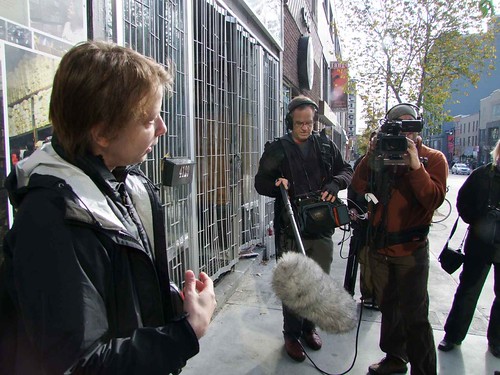
Myself and Simon Bujold (on camera) wearing our techincian hats, filming Annie Roy on St. Lawrence Avenue in Montreal. Photo by Michel Gélinas.

Fellow filmmaker Manfred Becker, director and editor based in Toronto (director of Fatherland, co-director of Diamond Road) recently wrote to me with a question. He was preparing for a workshop he was giving with Barry Stevens (Offspring, The Great Atlantic Air Race) as part of the Documentary Organization of Canada workshop series. He wanted a little input on the following question: ‘We all know that a lot of people feel passionate about making documentaries, but… can you actually make a living doing this?

Well, a few people can. With budgets in the millions of dollars, Michael Moore is certainly one of them. But for most documentary filmmakers survival is a real struggle. There used to actually be staff jobs for documentary filmmakers at the National Film Board but those positions were mostly abolished about ten years ago. Just a few months ago, the three last remaining NFB staff directors here in Montreal were let go. There are fewer and fewer jobs directing current affairs documentaries at the CBC – that’s where I did my early work. And funding for independent documentaries is more and more precarious, a situation aggravated by the recent Harper government cutbacks in the arts sector. The cuts that affect us filmmakers are the elimination of the Canadian Independent Film and Video Fund and the reduced subsidies for film schools.

Producing a documentary, especially one with a personal style or a socio-political edge, has become extremely difficult. This is why I feel that producers and directors committed to documentary filmmaking are in the same boat, fighting the same battle, and have to be each other’s strongest allies. DOC reflects this essential alliance well, with its membership made up of both directors and producers.

So, back to the question. How do you make a living? My feeling is that the great majority of documentary filmmakers have to either have another job or source of income on the side, or have to wear several hats on their projects. One filmmaker friend in Cape Breton has a small hydroelectric power station on his land, providing basic income. Another one comes from a wealthy family, in addition to being extremely talented. I recommend all of these avenues! But for most of us it is probably more realistic to make money from skills that are related to filmmaking. My friend Martin Duckworth has been teaching film production at Concordia University for years, and so have Daniel Cross and Mary Ellen Davis. Martin of course is a leading DOP, shooting films for other people. Other people do script editing, sound recording or editing. Ironically, you usually make more money working for others (because there is an actual daily rate) than on your own work (unlimited hours, very little pay).

In my own case, I think I only survive because I work in both English and French. If a project doesn’t find takers in one language universe, I can usually finance it in the other. I look for the special producers and commissioning editors who will take on a challenging project. I often invest a lot of money and especially time to get a project to the stage where I can convince producers and investors to get involved. On the side, I teach regularly but not a lot of hours at l’INIS (the Quebec film school) and occasionally elsewhere. I sometimes read scripts for the funding agencies or the National Film Board. But most of all, I wear several hats on my own productions: researcher, writer, production manager, sound recordist, and of course director. I also generally use my own equipment which I rent out to the producer (you noticed, producer is not one of my hats) and which I also rent out to other people when I’m not shooting. My projects generally take about five years from start to finish, so the income is spread pretty thin over those years. I spend far too much money paying interest on my credit line.

This brings us back to the question you asked, about the passion. I don’t think anyone who is not passionate and determined to make documentaries would accept to live with the prevailing, precarious, financial conditions. But of course it’s wonderful work, and it needs to be done.

Thanks to Jorge Bustos-Estefan for help with this blog.

Harvey Milk, documentary and fiction

Harvey_Milk_Sean_Penn
Harvey Milk (left); Sean Penn playing Harvey Milk (right)

Last week, I saw both the 1984 documentary The Times of Harvey Milk, directed by Rob Epstein, and the recently released fiction film Milk, directed by Gus van Sant. Both tell the story of the rise to prominence and assassination of the first openly gay man to be elected to public office in the U.S. Milk was elected San Francisco supervisor in 1977 but then gunned down along with Mayor George Moscone by a bitter rival. Comparing the two films is a fascinating exercise, as they cover pretty much the same territory and the documentary clearly inspired the fictional treatment. I am sure many students will be doing just that for their term papers. To me, the Oscar-winning documentary is worthy and competently made, definitely worth seeing (now available from Amazon) but more interesting as a historical record than as a piece of filmmaking: it’s pretty traditional and sometimes a bit plodding. But the fictional Milk is a true cinematic accomplishment, one of van Sant’s best films, which is saying a lot. It brilliantly establishes the homophobic context of the times, and the many struggles for gay rights not just in San Francisco but across the U.S. While many scenes are inspired by the documentary, other dimensions are added, particularly involving the assassin-to-be Dan White (Josh Brolin) and his relationship with Milk – played by Sean Penn in one of his best performances. Somewhat ironically I find that the fictional film is the greater inspiration for a documentary filmmaker, from the standpoint of dramatic structure, character development and contextualization. As you can tell, I recommend both of these films. Milk is still in theatres, and will surely be up for some Oscars. Epstein collaborated with van Sant on the treatment for Milk. For an interview with him rest here.

Thanks to Jorge Bustos-Estefan for help with this blog.

Grannies rage against war toys

GranssingEatonCtr
Mémés and Grannies sing in front of Eaton Center

Continuing to shoot our film abut the Raging Grannies and their French-speaking sisters, the Mémés Déchaïnées. Last week we joined Louise-Édith Hébert and Anna-Louise Fontaine as they picked up several other Mémés and brought them down to a rehearsal with the Raging Grannies. They then went over to the Eaton Center to sing, first outside and then inside, in front of a video games store. Their message: there are certain kinds of presents our kids don’t need ! Here is one of the songs they sang together:

Vive le vent – War toys

Couplet :
Pendant l’temps / pendant l’ temps /
Des grandes ventes d’hiver / /
Faudrait pas vendre / les jouets de guerre / /
Qui enragent les grand-mères / /Non / / /

Pour Noël / pour Noël /
Voici l’ vœu d’ ces grand-mères / /
Assez / assez / de violence //
Les jouets de guerre / à la poubelle / Ouiiiiiiiii !

(CHORUS)
When we go to shop / To buy a gift or two /
Let’s think of books and paints / and fun things kids can do / /
With skates / a bike / a ball / Our message will be clear /
Peace on Earth / goodwill to all /
Today and through the year / / / Oh !

Jingle bells / Jingle bells /
Jingle of dismay
It’s no fun to shop today /
With war toys on display / / /

Praise for ‘The Battle of Rabaska’

Journaux_RABASKA

This film which I co-directed with Martin Duckworth, has been playing in three theatres in Montreal and Quebec City over the last few weeks. Martin and myself attended many of the screenings and stayed for Q’s & A’s, sometimes in the company of some of the film’s main characters. We have received many messages stating that the film has given the opposition to the LNG port project a real boost. One newspaper, La Vie rurale, which had previously supported the port project went as far as saying the film has completely changed its perception of the opposition, from naive and selfish to credible citizens whose concerns are to be taken seriously. Newspaper reviews have been excellent. Here are some excerpts:
« In case there aren’t enough reasons to spike your blood pressure at this time of year, watch The Battle of Rabaska. »
John Griffin, The Gazette

“Tells us far more about citizen engagement and human nature than a whole pile of sociological studies. Very edifying.”
Mario Cloutier, La Presse
“A shocking film!”
Catherine Lachaussée, Radio-Canada

« Not afraid of taking sides, this film portrays the situation convincingly, with many strong arguments but also with a strong human dimension. »
Kevin Laforest, voir

La Bataille de Rabaska – Critiques des journaux

Journaux_RABASKA

Depuis deux semaines, les journaux et médias électroniques ont beaucoup parlé du film LA BATAILLE DE RABASKA que j’ai co-réalisé avec Martin Duckworth. (Production ONF, Yves Bisaillon et Johanne Bergeron.) Toute cette attention est due en partie à l’excellent travail de notre relationniste Marie-Claude Lamoureux. Je vous reviendrai sur l’impact que toute cette couverture médiatique a eu sur le mouvement d’opposition, mais voici d’abord les critiques des journaux. Le film est encore projeté dans trois salles, au Cinéma ONF à Montréal, au Cinéma du Parc ( avec sous-titres anglais) et au Cinéma Cartier à Québec. Voir www.onf.ca/labataillederabaska

«Comme dans une fiction, le spectateur s’identifie aux protagonistes selon ses propres opinions. …nous en apprend plus sur l’engagement citoyen et la nature humaine que bien des précis de sociologie. Édifiant. »
Mario Cloutier, La Presse

« D’habitude, c’est pas ma tasse de thé ce genre de film, mais ça, c’est vraiment du cinéma! »
Franco Nuovo, Radio-Canada

« …un document fascinant (…) qui pose des questions pertinentes sur l’état de la démocratie québécoise. »
Médiafilm

« …prouve, de façon éloquente, que le vieil adage demeure d’une cruelle actualité : « Si tu ne t’occupes pas de la politique… » »
André Lavoir, Le Devoir

« In case there aren’t enough reasons to spike your blood pressure at this time of year, watch La bataille de Rabaska. »
John Griffin, The Gazette

« Clairement engagé, le film résume la situation de façon concise et convaincante, avec nombre d’arguments probants, mais aussi une forte dimension humaine. »
Kevin Laforest, Voir

« En évaluant le poids de la mobilisation citoyenne contre celui des ténors de l’industrie, les cinéastes tracent un portrait touchant du visage des militants et des enjeux environnementaux québécois. »
Frédéric Towner-Sarault, Alternatives

« …un film marquant, dont on sort en colère contre le système qui a permis à un groupe industriel de faire changer le zonage agricole pour répondre à des besoins en énergie complètement artificiels. »
Sophie Bernard, www.lienmultimédia.com <http://www.lienmultimédia.com>

Qui enquêtera sur Rabaska ?

porc_methanier

Martin Duckworth et moi préparons actuellement avec l’ONF la sortie en salle de notre film LA BATAILLE DE RABASKA. Martin et moi serons présents à plusieurs des visionnements en salle (Cinéma de l’ONF à Montréal et Cinéma Cartier à Québec, à partir du 5 décembre). Aussi, nous aurons l’occasion d’accorder plusieurs entrevues aux médias. Il nous fera évidemment plaisir de parler du film, des personnages, etc. Mais j’ai aussi l’intention de poser la question suivante : n’y aurait-il pas lieu de faire une enquête sur le processus décisionnel qui a mené à l’approbation de ce projet ?

On voit dans le film que Rabaska produira des quantités énormes de gaz à effet de serre, que le projet représente un danger sérieux pour la population locale et qu’il menace une région à forte valeur patrimoniale. Pourquoi, alors, les institutions et agences qui auraient dû protéger les intérêts de la population n’ont-elles pas soulevé des objections ? Il faut dire que la Commission de protection du territoire agricole du Québec (CPTAQ) en a soulevé – et le gouvernement lui a enlevé tout pouvoir par rapport au projet Rabaska. Mais où était la Commission des biens culturels ? Pourquoi la ministre de la culture n’a pas demandé l’avis de la commission, et pourquoi celle-ci ne s’est-elle pas manifestée ? Pourquoi les gens au Ministère de la santé et dans les conseils régionaux de la santé qui étaient en désaccord avec le projet ont dû se taire ? Pourquoi le rapport d’évaluation environnementale conjointe du fédéral et du provincial (souvent appelé BAPE) a simplement mentionné des problèmes sans s’objecter au projet ? La liste est longue, les questions nombreuses.

Nous avons fait un film, pas une enquête journalistique. Mais nous avons quand même ramassé des éléments fort troublants en cours de route. Dans le film, on voit que le Ministre de l’Environnement de l’époque, Thomas Mulcair, se retrouve simple député en bonne partie à cause de ses désaccords avec le premier ministre Charest et son entourage au sujet de Rabaska. Il explique qu’il avait défendu le principe que tout projet soit traité de manière égale, indépendemment de sa taille, et que cela avait soulevé des dissensions au sein du parti. Autrement dit – c’est mon interprétation – Rabaska a bénéficié d’un traitement de faveur. Au lancement de notre film à Montréal, M. Mulcair a affirmé – sans révéler ce qui s’était passé au Conseil des ministres – qu’il y avait eu « de l’ingérence » de la part du cabinet du Premier ministre pour l’empêcher d’annoncer qu’il avait décidé de ne pas envoyer Rabaska au BAPE. En privé, il m’a expliqué qu’il considérait ce projet trop dangereux pour même le soumettre au BAPE. Et, pour sa part, l’ancien ministre de l’agriculture Jean Garon – qu’on voit dans le film comme Maire de Lévis, favorisant le projet à un moment crucial- a déclaré au Soleil lors de notre lancement à Québec, dans sonlangage direct et coloré, que le débat n’a jamais eu lieu parce que ‘le gouvernement a fermé la gueule à tout le monde.’

Mulcair
Thomas Mulcair : ancien Ministre de l’Environnement; actuellement, Député du NPD pour Outremont

Est-ce que le fait que le Chef de cabinet du prmier ministre Charest, Stéphane Betrand, était un ancien vice-président de Gaz Métro a pu jouer un rôle dans ce dossier ? Plusieurs des personnes impliquées dans l’histoire le pensent. (Gaz Métro est un des partenaires du consortium Rabaska.)

LA BATAILLE DE RABASKA a été produit par Yves Bisaillon et Johanne Bergeron au Programme Français de l’ONF.

Merci à Jorge Bustos-Estefan pour l’aide avec ce blogue.

Launching ‘The Battle of Rabaska’

rabaska_affiche_haut

Last week Martin Duckworth and I launched the original French-language version of our feature doc LA BATAILLE DE RABASKA – THE BATTLE OF RABASKA, in the framework of the Rencontres internationales du documentaire de Montréal. The film tells the story of the four-year fight by groups of citizens against a projected LNG (liquefied natural gas) import facility on the south shore of the St. Lawrence, opposite the famous Île d’Orléans. The project makes no sense because of its impact on climate change, health and safety for the population in the immediate area, and the protection of the cultural heritage of the region. But business interests and construction unions in the area backed it, and a powerful lobby intervened to push for it on all levels of government. Last October, the provincial government gave the project a green light.

The first screening of our film took place at the Museum of Civilization in Quebec City. It was an emotional event, as many of the people who participated in the struggle were there. They have felt quite abandoned both by politicians and government agencies, and really appreciated having their experience documented and shown on the big screen. Former Quebec Agriculture minister and Mayor of Lévis, Jean Garon, who is seen supporting the project in the film, surprised everyone by stating that ‘the debate never really happened,’ and that ‘the government shut everyone up.’ Other revelations followed at the Montreal premiere a few days later, with former Environment minister Thomas Mulcair (now NDP MP for my riding) stating that there had been undue government interference in the assessment process.

Although the project has received a green light, it doesn’t seem certain that it will actually be built. Rabaska has signed an agreement in principle with the Russian energy giant Gazprom, but there is no final agreement and the gas field which is supposed to supply the project is not in operation. With the economic crisis and reduced energy needs it seems even more absurd than it already was, in a province which has a huge potential for renewable energy sources.

The film, shot over four years, was produced by Yves Bisaillon and Johanne Bergeron at the ONF (National Film Board, French program). It will be in theatres in Quebec City and Montreal starting on December 5th.

Thanks to Jorge Bustos-Estefan for help with this blog.