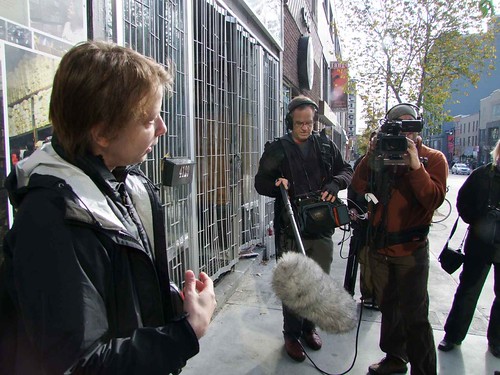
The philosopher-filmmaker at Rideau Hall – part 1

Jean-Daniel Lafond
Jean-Daniel Lafond

The other day, as U.S. President Obama touched down in Ottawa, I asked my students at l’INIS, the Quebec Film school, a question. ‘Which documentary filmmaker will be meeting with Obama today?’ Puzzled looks, no answers. They asked for a lead. ‘OK, I said, he is also a French citizen.’ ‘Oh, of course,’ said Nathalie who used to work at the NFB. ‘I know who it is, but he’s not there because he’s a filmmaker.’

I recently had a chance to meet with and interview Jean-Daniel Lafond, the husband of Governor General Michaëlle Jean, during a visit to Montreal and on the occasion of a retrospective of his works, curated by Tom McSorley at the Canadian Film Institute in Ottawa and running until March 8th. The vast conceptual range of the 15 films he has directed since 1986 defy obvious notions of a continuous oeuvre.

I asked Jean-Daniel two questions, which, given his habitual eloquence, spun into a 30-minute answer, weaving in and through a wide range of topics and philosophical musings about his life’s work. Given how much there is to report from our discussion, I’ll share the first answer with you this week and the second next week.
[Video interview clip further down.]

Folle_de_dieu
Marie Tifo playing the role of Marie de l’Incarnation, in the film ‘Folle de Dieu’ (‘The Madwoman of God’)

First question: What impulses and/or issues tie together what initially appears to be a very disparate range of works?

Jean-Daniel begins enigmatically by saying “Nous faisons ce que nous faisons en suivant le chemin qui nous échappe…” by which he means that the documentary impulse for him is always a movement toward the unknown, and stems from a desire to understand. He cites Spinoza at the start of his 2006 film, The Fugitive, “Not laughter, not tears, understanding”, an adage which he says is perhaps most fundamental to his work.

Jean-Daniel says that this retrospective, along with a “perspectives” tribute at La Rochelle documentary festival last year, have enabled him to articulate more clearly the connecting threads. He sees his most recent film, Folle de Dieu (The Madwoman of God), about the ideas and writings of an 18th mystic – Marie de l’Incarnation – who came to Nouvelle France to found a country, as utterly coherent with his first film, Les Traces du rêve (Dream Tracks), a portrait of seminal documentarist Pierre Perrault and of his films in relation to the creation of a country. Both interrogate the act of writing/filmmaking in the context of ideas of place, Otherness, dreams and utopias.

What he calls his fight for “the humanization of humanity” precedes his trajectory as a filmmaker. His first career was as a philosopher, a political thinker and defender of culture against the “absolute evil” of ignorance. He was transformed both by his exile and by his encounter with cinema, which he says is humbling, because it always begins from a place of ignorance. “As a philosopher, I always transmitted what I knew. As a filmmaker, I transmit my experience of the unknown, of the unpredictable, what is beyond me.”

Lafond’s films defy categories and cannot easily be summarized, as they offer an almost seamless extension of his philosophical journey, exploring and confronting the major ideas of the past half-century – exile, négritude, religion, the Other, barbarism.

Next week, the second question: How has Jean-Daniel adapted to his newest role as “His Excellency” and a very active partner to Canada’s Governor General, Michaëlle Jean?

Thanks to Jocelyne Clarke and Jorge Bustos-Estefan for help with this blog.

Interesting structure, interesting texture: ¿¡Revolución!?

Revolucion
Venezuela’s President Hugo Chavez

Hugo Chavez, the President of Venezuela, has won his most recent referendum, modifying the constitution so that elected officials – notably including himself – can be reelected for several terms. Is this good or bad ? Only the future will tell, but at least he submitted the change to a popular vote, in stark contrast to the may military coups in Latin America, supported by – if not orchestrated by – some of the countries who like to suggest Chavez is a dictator-in-the making.

I recently organized a screening of a film I really like, ¿¡Revolución!?, directed by Charles Gervais. It is a doc about Chavez’s ‘Bolivarian’ revolution in Venezuela. In terms of the meaning of that revolution the film is generally positive but not at all uncritical, and Chavez’s enemies are given lots of space. That gives the film a healthy tension and it certainly avoids the pitfalls of propaganda. And it has many other qualities. There is one important strand of the film made up of animated images of Cervantes’s Don Quixote, with a gravelly voice-over which seems to represent the knowledge of a veteran revolutionary formulating some general principles for social and political upheavals – you could imagine him to be a Che Guevara speaking from the grave, but his thoughts also remind one of Machiavelli, formulating some general principles about his subject based on years of experience. There are ten of these principles in as many segments, and they signpost ten chapters in the film. The actuality material is very well edited – by Étienne Gagnon – and was treated for contrast and texture in a way more reminiscent of edgy fiction films than of documentaries. I asked Charles how he developed this treatment.

How did you come upon the Don Quixote idea? Was it hard to make it work in the film?

Charles Gervais: In 2005, when I first got the idea of making this documentary, Chavez was distributing 1 million copies of Don Quixote books to the people of Venezuela. Chavez said that it was necessary to nourish the minds, to be inspired by someone who searched “to rectify the wrongs and to rearrange the world”. I found it unusual for a political leader, fascinating. At that time, I knew little about Chavez, and it brought me wanting to know more. During my research, what I found is that Chavez is in fact a real Quixotic figure: a dreamer that wants to do good to the people, but becomes so overwhelmed in his quest that he doesn’t always see the reality clearly anymore. How did I suggest this in the film? Don Quixote is everywhere in the film. At the very beginning, Chavez refers to him when he talks about passion, and drawings of Quixote’s adventures are used to present the theory of a modern revolution; and at the end, the storyline of Chavez and Don Quixote clearly mix together. It’s even a quote of Quixote himself that closes the film, warning Chavez to be careful not to lose himself in passion forgetting his true cause. (“Let not thine own passion blind thee in another man’s cause.” / Miguel de Cervantes)

Your film has a very interesting structure, and also an interesting texture. How did you develop those?

Charles Gervais: We wanted to create a structure that would give the film a possibility to stay interesting and insightful, whatever happens with Hugo Chavez. That led us to invent a step-by-step guide for a modern revolution that would succeed in bringing about radical change without resorting to violence and repression. (I worked on this with a specialist in Theory of the Revolution from the Trudeau Centre for Peace and Conflict Studies.) So if Chavez got mad with power and ended up as a true dictator, our film could help understand why. And if he continued to work on his «socialist revolution of the 21st century» on a democratic way, we could even pretend that we might have helped him! (I’ll let you decide which path he is on today!)

Talking about the texture, we wanted to follow a certain aesthetic about slums, poverty and «end of the world» kind of places that was brought by some great movies like City of God or Traffic. The dominant color all over the film, amber, reminds me of an old newspaper that was forgotten for a long time under the hard sun – how the people living in Venezuela’s slums possibly felt like. So technically, we took the almost too perfect HD images (shot with a Sony CineAlta F900) and alter the signal with a kind of «bleach bypass». The resulting images, with deep black and deep white, but cold, was then colored with this amber texture.

REVOLUCION_POSTER_ENG small

Thanks to Jorge Bustos-Estefan for help with this blog.

Taking Root: The Vision of Wangari Maathai

takingrootfilmWangari Maathai [Photo credit: Lisa Merton]

One of the best films I saw at the Rencontres Internationales du Documentaire de Montréal last November was Taking Root: The Vision of Wangari Maathai, which won both the best documentary award in the ‘Eco-camera’ section and the audience award for the whole festival. The film documents the struggle of Maathai and the Green Belt Movement she started, against authoritarian governments and for the protection of the environment in Kenya. I was particularly impressed by the way archival footage of past actions and repression were interwoven with contextual and current materials, making for a compelling and inspiring story. The filmmakers, Lisa Merton and Alan Dator, told me they were far from the only ones who wanted to make a film about Maathai.

Maathai directors.6992
Alan Dater and Lisa Merton, the directors of the film [Photo: Andrei Khabad]

Alan: I think we got to make the film because we got along well with Wangari. And because we started making the film before she won the Nobel Peace Prize, before she had that level of recognition. We weren’t after a “famous” person, we were interested in her life and her work for its own sake. Her story is universal.

We grew up on the land as Wangari did and so we have similar sensibilities in many ways; we understand the rhythms of the natural world, the web of life of which we all are part, and our total dependence on the natural world for our very survival. Something she understood from childhood.

You succeed in portraying the person, the movement and, at least to some extent, the situation in the country. Was that difficult, or did it come naturally?

Lisa: It came naturally. Wangari’s approach to change is holistic so we wanted to show that in the way we made the film. She links sustainable development, democracy and peace in a beautiful, organic way in her life and work. When she had no choice but to become political, she became political. She and the women of the Green Belt Movement could not plant trees without speaking truth to power.

We also felt that we couldn’t make the film without putting it in historical context. The way people survive on the land they live on is an integral part of how their culture is shaped over time. For us the cultural aspect of Wangari’s work is deeply important. Her recognition of the ways in which people lost themselves, their dignity, and their sense of self-worth during colonialism and neo-colonialism is part of what the Green Belt Movement (GBM) addresses in its Civic and Environmental Education Seminars that we show toward the end of the film. It is here that the participants of GBM make the linkages themselves – they learn to know themselves in a new light and therefore are also able to understand what is best for the common good.

Takingroot5
[Photo Credit: Ariel Poster]

Merci à Jorge Bustos-Estefan pour l’aide avec ce blogue et à Andrei Khabad pour la photo des cinéastes.

A year in class, fiction meets documentary.

Entre_les_murs
A still from Laurent Catnet’s film The Class [original French title: Entre les murs]

Have you noticed how many and how many recent fiction films look like documentaries, or are inspired by documentaries? I recently wrote about Milk – up for several Oscars – which borrows many scenes from the documentary The Times of Harvey Milk. Last fall I saw a marvellous fiction film which had many scenes with a purely documentary quality, Tulpan, a story from the life of sheep herders on the Kazakh steppes, by Sergei Dvortsevoy. And one of my favourite films this year, nominated for best foreign film at the Oscars, is the French film The Class, by Laurent Cantet (Entre les murs is the French title). The director came upon a reality-inspired novel by François Begaudeau, a teacher in a ‘difficult’ multiracial school in the suburbs of Paris, describing some of the challenges he was up against. Cantet then organized improvisation groups with actual college students and did a combination of casting and training, until he was able to put together his own fictional class. The students drew upon their own experiences to develop their characters. The result is surprisingly convincing, subtle but dramatic, and very documentary-like. It got the ‘Golden Palm’ award at Cannes.

Etre_et_avoir
A frame from Nicolas Philibert’s documentary Être et avoir [‘To Be and to Have‘]

Seeing this film reminded me of two other excellent documentaries which also did nothing more than spend a year in class, but did it well. There was the touching Être et avoir (To Be and to Have) by Nicolas Philibert, shot in a small class in a primary school in France, which had a long run in theatres there and in many other countries. The film got additional press coverage as the main character, the marvelously attentive school teacher Georges Lopez who showed another side of his personality and claimed large sums of money from the producers after the film was successful. And there was La Classe de Madame Lise, a film shot in the multicultural neighborhood of Mile-End in Montreal, nearby where I live. Directed by Sylvie Groulx and produced by Galafilm, the film got a Genie for best doumentary in 2006.

(Another Oscar-nominee for best foreign film this year is Waltz with Bashir, a hybrid, combining documentary and animation.)

La_classe_de_Mme_Lise
An image from La Classe de Madame Lise – a movie by Sylvie Groulx

Thanks to Jorge Bustos-Estefan for help with this blog.
A Violinist in the Metro

bell

As a New Year’s greeting I sent all my friends a touching, revealing and thought-provoking story which I had received from Carole Roy who is working with me on the film about the Raging Grannies. It says a lot about how we live and it certainly made me think, because on most days I would have behaved just like the people in the story.

I got a lot of responses to my message. At the end, a comment from filmmaker (‘His Excellency’) Jean-Daniel Lafond. Jennifer Alleyn – one of those people who would have stopped and listened, I’m sure – sent me the whole original story from the Washington Post. As usual, Jorge Bustos-Estefan helped with the blog.

A Violinist in the Metro

A man sat at a metro station in Washington DC and started to play the violin; it was a cold January morning. He played six Bach pieces for about 45 minutes. During that time, since it was rush hour, it was calculated that thousand of people went through the station, most of them on their way to work.

Three minutes went by and a middle aged man noticed there was musician playing. He slowed his pace and stopped for a few seconds and then hurried up to meet his schedule.

A minute later, the violinist received his first dollar tip: a woman threw the money in the till and without stopping continued to walk.

A few minutes later, someone leaned against the wall to listen to him, but the man looked at his watch and started to walk again. Clearly he was late for work.

The one who paid the most attention was a 3 year old boy. His mother tagged him along, hurried but the kid stopped to look at the violinist. Finally the mother pushed hard and the child continued to walk turning his head all the time. This action was repeated by several other children. All the parents, without exception, forced them to move on.

In the 45 minutes the musician played, only 6 people stopped and stayed for a while. About 20 gave him money but continued to walk their normal pace. He collected $32. When he finished playing and silence took over, no one noticed it. No one applauded, nor was there any recognition.

No one knew this but the violinist was Joshua Bell, one of the best musicians in the world. He played one of the most intricate pieces ever written with a violin worth 3.5 million dollars.

Two days before his playing in the subway, Joshua Bell sold out at a theater in Boston and the seats average $100.

This is a real story. Joshua Bell playing incognito in the metro station was organized by the Washington Post as part of an social experiment about perception, taste and priorities of people. The outlines were: in a commonplace environment at an inappropriate hour: Do we perceive beauty? Do we stop to appreciate it? Do we recognize the talent in an unexpected context?

One of the possible conclusions from this experience could be: If we do not have a moment to stop and listen to one of the best musicians in the world playing the best music ever written, how many other things are we missing?

Joshua_Bell_DC_metro
A frame from the surveillance camera in the D.C. metro.

A Comment from Jean-Daniel Lafond (my translation):

‘When beauty and culture become merchandise, it is no longer a matter of life but of property. Things are valued for their price and their wrapping. It becomes a matter of ownership. When, on the other hand, beauty is given as a gift, it becomes a shared resource, as essential as the air we breathe. This, I imagine, is what a three-year old child responds to. ‘

‘Quand la beauté comme la culture est une marchandise, elle relève de l’avoir et non plus de l’être. On la reconnaît à son prix et à l’emballage. C’est une valeur de possession. Alors que la beauté se donne en partage, elle est une valeur commune, aussi essentielle que l’air que l’on respire. Ce qu’un enfant de trois ans peut sans doute ressentir.’
Bonne année.
JD

Listen to Bell’s full metro performance here.
Read the full story from the Washington Post here.

Thanks to Jorge Bustos-Estefan for help with this blog.

A passionate pursuit, but can you make a living?

ATSA_making_of_1
Myself and Simon Bujold (on camera) wearing our techincian hats, filming Annie Roy on St. Lawrence Avenue in Montreal. Photo by Michel Gélinas.

Fellow filmmaker Manfred Becker, director and editor based in Toronto (director of Fatherland, co-director of Diamond Road) recently wrote to me with a question. He was preparing for a workshop he was giving with Barry Stevens (Offspring, The Great Atlantic Air Race) as part of the Documentary Organization of Canada workshop series. He wanted a little input on the following question: ‘We all know that a lot of people feel passionate about making documentaries, but… can you actually make a living doing this?

Well, a few people can. With budgets in the millions of dollars, Michael Moore is certainly one of them. But for most documentary filmmakers survival is a real struggle. There used to actually be staff jobs for documentary filmmakers at the National Film Board but those positions were mostly abolished about ten years ago. Just a few months ago, the three last remaining NFB staff directors here in Montreal were let go. There are fewer and fewer jobs directing current affairs documentaries at the CBC – that’s where I did my early work. And funding for independent documentaries is more and more precarious, a situation aggravated by the recent Harper government cutbacks in the arts sector. The cuts that affect us filmmakers are the elimination of the Canadian Independent Film and Video Fund and the reduced subsidies for film schools.

Producing a documentary, especially one with a personal style or a socio-political edge, has become extremely difficult. This is why I feel that producers and directors committed to documentary filmmaking are in the same boat, fighting the same battle, and have to be each other’s strongest allies. DOC reflects this essential alliance well, with its membership made up of both directors and producers.

So, back to the question. How do you make a living? My feeling is that the great majority of documentary filmmakers have to either have another job or source of income on the side, or have to wear several hats on their projects. One filmmaker friend in Cape Breton has a small hydroelectric power station on his land, providing basic income. Another one comes from a wealthy family, in addition to being extremely talented. I recommend all of these avenues! But for most of us it is probably more realistic to make money from skills that are related to filmmaking. My friend Martin Duckworth has been teaching film production at Concordia University for years, and so have Daniel Cross and Mary Ellen Davis. Martin of course is a leading DOP, shooting films for other people. Other people do script editing, sound recording or editing. Ironically, you usually make more money working for others (because there is an actual daily rate) than on your own work (unlimited hours, very little pay).

In my own case, I think I only survive because I work in both English and French. If a project doesn’t find takers in one language universe, I can usually finance it in the other. I look for the special producers and commissioning editors who will take on a challenging project. I often invest a lot of money and especially time to get a project to the stage where I can convince producers and investors to get involved. On the side, I teach regularly but not a lot of hours at l’INIS (the Quebec film school) and occasionally elsewhere. I sometimes read scripts for the funding agencies or the National Film Board. But most of all, I wear several hats on my own productions: researcher, writer, production manager, sound recordist, and of course director. I also generally use my own equipment which I rent out to the producer (you noticed, producer is not one of my hats) and which I also rent out to other people when I’m not shooting. My projects generally take about five years from start to finish, so the income is spread pretty thin over those years. I spend far too much money paying interest on my credit line.

This brings us back to the question you asked, about the passion. I don’t think anyone who is not passionate and determined to make documentaries would accept to live with the prevailing, precarious, financial conditions. But of course it’s wonderful work, and it needs to be done.

Thanks to Jorge Bustos-Estefan for help with this blog.

Harvey Milk, documentary and fiction

Harvey_Milk_Sean_Penn
Harvey Milk (left); Sean Penn playing Harvey Milk (right)

Last week, I saw both the 1984 documentary The Times of Harvey Milk, directed by Rob Epstein, and the recently released fiction film Milk, directed by Gus van Sant. Both tell the story of the rise to prominence and assassination of the first openly gay man to be elected to public office in the U.S. Milk was elected San Francisco supervisor in 1977 but then gunned down along with Mayor George Moscone by a bitter rival. Comparing the two films is a fascinating exercise, as they cover pretty much the same territory and the documentary clearly inspired the fictional treatment. I am sure many students will be doing just that for their term papers. To me, the Oscar-winning documentary is worthy and competently made, definitely worth seeing (now available from Amazon) but more interesting as a historical record than as a piece of filmmaking: it’s pretty traditional and sometimes a bit plodding. But the fictional Milk is a true cinematic accomplishment, one of van Sant’s best films, which is saying a lot. It brilliantly establishes the homophobic context of the times, and the many struggles for gay rights not just in San Francisco but across the U.S. While many scenes are inspired by the documentary, other dimensions are added, particularly involving the assassin-to-be Dan White (Josh Brolin) and his relationship with Milk – played by Sean Penn in one of his best performances. Somewhat ironically I find that the fictional film is the greater inspiration for a documentary filmmaker, from the standpoint of dramatic structure, character development and contextualization. As you can tell, I recommend both of these films. Milk is still in theatres, and will surely be up for some Oscars. Epstein collaborated with van Sant on the treatment for Milk. For an interview with him rest here.

Thanks to Jorge Bustos-Estefan for help with this blog.

Grannies rage against war toys

GranssingEatonCtr
Mémés and Grannies sing in front of Eaton Center

Continuing to shoot our film abut the Raging Grannies and their French-speaking sisters, the Mémés Déchaïnées. Last week we joined Louise-Édith Hébert and Anna-Louise Fontaine as they picked up several other Mémés and brought them down to a rehearsal with the Raging Grannies. They then went over to the Eaton Center to sing, first outside and then inside, in front of a video games store. Their message: there are certain kinds of presents our kids don’t need ! Here is one of the songs they sang together:

Vive le vent – War toys

Couplet :
Pendant l’temps / pendant l’ temps /
Des grandes ventes d’hiver / /
Faudrait pas vendre / les jouets de guerre / /
Qui enragent les grand-mères / /Non / / /

Pour Noël / pour Noël /
Voici l’ vœu d’ ces grand-mères / /
Assez / assez / de violence //
Les jouets de guerre / à la poubelle / Ouiiiiiiiii !

(CHORUS)
When we go to shop / To buy a gift or two /
Let’s think of books and paints / and fun things kids can do / /
With skates / a bike / a ball / Our message will be clear /
Peace on Earth / goodwill to all /
Today and through the year / / / Oh !

Jingle bells / Jingle bells /
Jingle of dismay
It’s no fun to shop today /
With war toys on display / / /

Praise for ‘The Battle of Rabaska’

Journaux_RABASKA

This film which I co-directed with Martin Duckworth, has been playing in three theatres in Montreal and Quebec City over the last few weeks. Martin and myself attended many of the screenings and stayed for Q’s & A’s, sometimes in the company of some of the film’s main characters. We have received many messages stating that the film has given the opposition to the LNG port project a real boost. One newspaper, La Vie rurale, which had previously supported the port project went as far as saying the film has completely changed its perception of the opposition, from naive and selfish to credible citizens whose concerns are to be taken seriously. Newspaper reviews have been excellent. Here are some excerpts:
« In case there aren’t enough reasons to spike your blood pressure at this time of year, watch The Battle of Rabaska. »
John Griffin, The Gazette

“Tells us far more about citizen engagement and human nature than a whole pile of sociological studies. Very edifying.”
Mario Cloutier, La Presse
“A shocking film!”
Catherine Lachaussée, Radio-Canada

« Not afraid of taking sides, this film portrays the situation convincingly, with many strong arguments but also with a strong human dimension. »
Kevin Laforest, voir

Launching ‘The Battle of Rabaska’

rabaska_affiche_haut

Last week Martin Duckworth and I launched the original French-language version of our feature doc LA BATAILLE DE RABASKA – THE BATTLE OF RABASKA, in the framework of the Rencontres internationales du documentaire de Montréal. The film tells the story of the four-year fight by groups of citizens against a projected LNG (liquefied natural gas) import facility on the south shore of the St. Lawrence, opposite the famous Île d’Orléans. The project makes no sense because of its impact on climate change, health and safety for the population in the immediate area, and the protection of the cultural heritage of the region. But business interests and construction unions in the area backed it, and a powerful lobby intervened to push for it on all levels of government. Last October, the provincial government gave the project a green light.

The first screening of our film took place at the Museum of Civilization in Quebec City. It was an emotional event, as many of the people who participated in the struggle were there. They have felt quite abandoned both by politicians and government agencies, and really appreciated having their experience documented and shown on the big screen. Former Quebec Agriculture minister and Mayor of Lévis, Jean Garon, who is seen supporting the project in the film, surprised everyone by stating that ‘the debate never really happened,’ and that ‘the government shut everyone up.’ Other revelations followed at the Montreal premiere a few days later, with former Environment minister Thomas Mulcair (now NDP MP for my riding) stating that there had been undue government interference in the assessment process.

Although the project has received a green light, it doesn’t seem certain that it will actually be built. Rabaska has signed an agreement in principle with the Russian energy giant Gazprom, but there is no final agreement and the gas field which is supposed to supply the project is not in operation. With the economic crisis and reduced energy needs it seems even more absurd than it already was, in a province which has a huge potential for renewable energy sources.

The film, shot over four years, was produced by Yves Bisaillon and Johanne Bergeron at the ONF (National Film Board, French program). It will be in theatres in Quebec City and Montreal starting on December 5th.

Thanks to Jorge Bustos-Estefan for help with this blog.