‘La Bataille de Rabaska’ aux RIDM

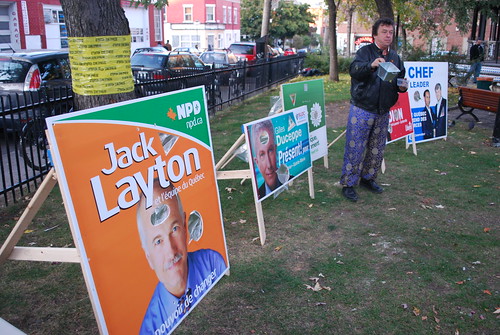
affiche_rabaska

Premières dans les cadres des Rencontres Internationales du Documentaire de Montréal :

J’achète mon billet. [Billeterie et salles – RIDM]

Pour visionner la bande-annonce et en savoir plus sur le film, visitez le : www.onf.ca/labataillederabaska

VENEZ VOIR LE FILM EN GRAND NOMBRE !

CHANGE – Le 10e anniversaire de l’ATSA

AnnieChange.0883
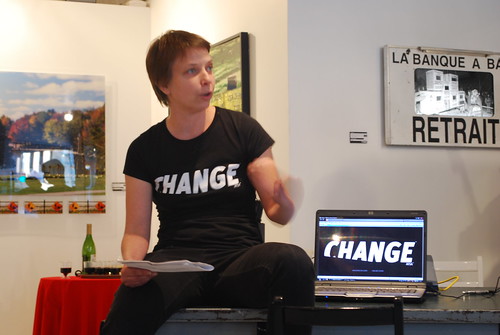
Annie Roy à l’occasion de l’overture de CHANGE, le nouveau magasin de l’ATSA

Cette semaine nous avons fait un tournage important lors du 10e anniversaire de l’ATSA, l’Action Terroriste Socialement Acceptable, sujet du film URGENCE CRÉATION que je fais avec Simon Bujold. Annie Roy et Pierre Allard lançaient une publication et ouvraient en même temps un magasin intitulé CHANGE sur la rue St. Laurent, à deux coins de rue de chez moi. CHANGE a ici un double sens: c’est à la fois le changement social et le petit change que Annie et Pierre voudraient ramasser en vendant des produits dérivés de leurs installations réalisées depuis dix ans. Le tout est un pied-de-nez à une société commerciale où tout est question d’argent et de produits.

Pour vous décrire les événements de la soirée de lancement, je laisse la parole à mon stagiaire Jorge Bustos-Estefan :

« L’ouverture de CHANGE (le nouveau magasin de l’ATSA sur Saint-Laurent, coin Marie-Anne) faisait partie des célébrations de leur 10e anniversaire. Annie Roy y a présenté un nouveau livre qui a pour titre ATSA, Quand l’art passe à l’action, auquel ont participé plusieurs écrivains et artistes. Elle a aussi expliqué qu’en ce moment, la motivation principale de l’ATSA est d’empêcher la victoire de Stephen Harper et des conservateurs aux prochaines élections fédérales. Ceci étant dit, le lancement du livre a été suivi par un rassemblement en plein air au Parc du Portugal, de l’autre côte de la rue, où des interventions d’artistes avaient pour principal sujet (et objet) les politiciens et les partis politiques. Ces interventions à l’allure de foire (un stand de tir, un stand d’un magicien, un bac à sable, etc.) invitaient le public à participer et prendre position avec eux. Autant l’ouverture du magasin que l’événement en plein air se sont déroulés magnifiquement et ont réussi à attirer une grande foule. Il y aura d’autres activités au magasin au cours des prochaines semaines. Pour l’instant, vous pouvez visiter leur magasin à Montréal ou le site web de CHANGE ici. »

FGourdchange888
Les politiciens et les partis politiques étaient le sujet principal de l’événement à l’extérieur.


Vidéo par Jorge Bustos-Estefan et Isabelle Kostecka

CHANGE – Fliming ATSA’s 10th Anniversary

AnnieChange.0883
Annie Roy speaking at the opening of ATSA’s new store CHANGE

The other day, we went to shoot an important event involving ATSA (Action Terrosite Socialement Acceptable). To commemorate their 10 years of doing art interventions, they opened a new store, CHANGE. The name has a double meaning, referring to both the spare change they hope to make by selling some of the franchise products, spinoffs from their major art installations over the last ten years, an social change. We got the chance to catch Pierre Allard and Annie Roy in the middle of bustling last-minute preparations (our film isn’t called CREATIVE EMERGENCY for nothing!) and what’s more, we got to see them interact with the crowd attracted by the press conference and the launch activities. Now I’ll let my intern Jorge Bustos-Estefan say a few words to fill you in:

“When I first heard about ATSA, I was intrigued by the name (ATSA is the French acronym for Socially Acceptable Terrorist Action). Then, as I read on and learned that it is really an art-driven venture, things started to make a little more sense; yet, it wasn’t until I got the chance to attend one of their events and be exposed to their art firsthand that I really caught on to the drive behind ATSA. Being the artists/activists that they are, they seek to engage the community in a number of topics through their art and events; and their agendas change over time, based on the issues they deem need to be dealt with most urgently at a particular moment.

The opening of CHANGE (ATSA’s new store on Saint-Laurent, corner Marie-Anne) was part of their 10-year anniversary celebration. There, Annie Roy presented a new book titled ATSA, Quand l’art passe à l’action, in which a variety of writers and artists participated. She also explained that ATSA’s main motivation these days is to galvanize people to prevent Stephen Harper and the conservatives from winning the upcoming federal election. With this in mind, the book launch was followed by an outdoor gathering at the Park of Portugal across the street, where the artists’ latest interventions treated the politicians and all the political parties as the main subject (and object). These interventions, which were of the street-festival type (shooting galleries, a magician’s stand, a sandbox, etc.) invited the public to take part and make a statement with them. Both the store opening and the outdoor event were successful in attracting a lot of people and turned out magnificently. I am looking forward to their next event. In the meantime, you can come and visit the store in Montreal or go the CHANGE website here.”

FGourdchange888
The politicians and the political parties were the main subject at the outdoors event.

Video by Jorge Bustos-Estefan and Isabelle Kostecka [in French]

With the Raging Grannies at Bread and Puppets

With the Raging Grannies at Bread and Puppets
Myself and Martin Duckworth filming the Grannies in Vermont.

I am still working on my film about the Raging Grannies, the movement of elderly women fighting for peace, social justice and the environment with satirical songs and the occasional guerrilla action. I have decided to edit some of the Grannies’ songs as music videos, and so I am gathering some special footage in addition to the usual documentary material. The idea is, in my mind, to obtain striking visuals and special effects without having to spend much money. As part of this effort I recently went to the Bread and Puppets Theatre in Vermont with Louise-Édith Hébert, a francophone ‘Mémé déchaînée’ who is an important person in my film. Two other members of our team, Carole Roy and Terre Nash came along for the weekend, along with my wife Jocelyne who has vivid memories from visits to the Bread and Puppets theatre when she was young.

Indeed, Bread and Puppets has been going for several decades now, performing with giant puppets in a natural setting. I thought the images of the theatre could be a way to evoke street theatre as one of the original inspirations for the Raging Grannies, founded in Victoria, B.C., 21 years ago. And thanks to DOP Martin Duckworth, we did get some spectacular images of the Grannies and the puppets. Also, we filmed Louise-Édith making her own puppet and bringing it to the show. In addition, eleven Vermont Grannies responded to our appeal and showed up to sing some songs. A good time was had by all, and a few more tapes were added to my pile. This film is severely under-financed, and it is just the kind of film that will become harder to make with the conservative government’s cutbacks. In fact, if my friends and colleagues didn’t support it, I wouldn’t be able to make it at all.

Louise-Édith Hébert with puppet
Louise-Édith Hébert with the puppet she made. Bread and Puppets actors and staff are meeting in the background.

Thanks to Jorge Bustos-Estefan for help with this blog.

Uranium movie makes comeback

003Uranium_BW
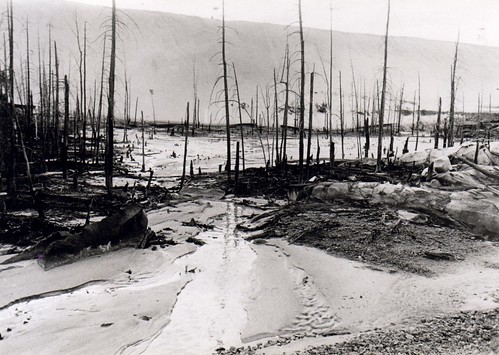
Radioactive uranium tailings at Elliot Lake.

One of my first films, released 18 years ago, was Uranium, about the radioactive wastes from uranium mining on aboriginal lands in Canada. Not a very exciting title, and there was a reason for it. Faced with intense pressure from the uranium mining industry, the NFB sent a letter to the industry promising that the film would not be called ‘Death Rock,’ my preferred title and the literal translation of ‘dada the’, the dene word for uranium. By the time I was told about it, the letter had gone out. I wasn’t happy. But the NFB really supported and promoted the film and organized an exciting cross-county tour with panel discussions. We picked up the award for best documentary at the Yorkton festival.

At the time, Canada was already the world’s leading producer and exporter of Uranium, and huge amounts of radioactive wastes were accumulating on native lands. There is a reason why aboriginal people are much affected by uranium mining, be it in Canada, in Australia or in the ‘four corners’ area in the U.S. Since they were shoved off the best lands but allowed to live on the infertile and rocky hinterlands, they find themselves in the same place as uranium ore.

And now, with oil prices rising, there is a huge upsurge in uranium exploration and mining.

As a result, my film is back in use. It has been shown at numerous conferences in Ontario in particular. According to the organizers, the only thing that has really changed since I made it are the hair cuts.

The man who acted as a consultant to our film back in ’89 was Gordon Edwards, of the Canadian Coalition for Nuclear Responsability. I asked him what he thinks about the present uranium mining boom.

“The soaring price of uranium is something we’ve seen before, in the early
1970’s. In a very short period of time the price went up tenfold. It turned out
to be due to price manipulation; the price then fell steadily for the next
15 years. The result was that uranium mines were welcomed by communtiies,
but the economic benefits never met their expectations. Meanwhile highly toxic long-lived uranium mill residues were left in those areas as a permanent radioactive legacy. Back in 1898, Marie Curie showed that the residues left over after uranium is extracted from the crushed ore are eight times more radioactive than the uranium itself. These residues contain some of the deadliest materials known to science: radium, radon, and especially polonium isotopes, which the industry admits is 250 billion times more toxic than cyanide. These toxic materials are inevitable radioactive byproducts of uranium, produced by the process of radioactive disintegration, and they remain dangerous for hundreds of thousands of years.”

This is from one of the coordinators of the present Ontario campaign, Lynn Daniluk:

The Community Coalition Against Mining Uranium (CCAMU) is a group of concerned citizens from the greater Ottawa Valley and Kingston area, who came together to prevent a uranium mine in Frontenac and Lanark region. A uranium exploration company has staked and claimed 30,000 acres of land at the headwaters of the Mississippi water system, which feeds the Ottawa River. Scientific experts and history tells us that if a uranium mine were developed in this region it would be a serious environmental and public health concern. Our area is renowned for cultural events, tourism, and cottage life.

Our non-native coalition made Canadian history by joining a peaceful protest that had been set up by the Shabot Obaadjiwan First Nation and the Ardoch Algonquin First Nation on June 28th, 2007.

On 15 February 2008, former chief Robert Lovelace, of the Ardoch Algonquin First Nation began serving 6 months in jail for refusing to comply with the court injunction, while following Algonquin law to protect Creation.

The judge in the case handed down this harsh sentence along with heavy fines, saying, “compliance with the orders of this court are not optional”. The underlying issue, however, is that the government of Ontario did not consult with the First Nation community before issuing exploration licenses in Algonquin territory.

To date, fifteen municipalities in eastern Ontario have called for a moratorium on uranium exploration and mining in Eastern Ontario, including the cities of Ottawa and Kingston.

We also have the support of such organizations as Amnesty International, Council of Canadians, Greenpeace Canada, Mining Watch Canada, International Land Coalition, Green Party of Canada and Ontario, United Church of Canada, Physicians for Global Survival, Ontario College of Family Physicians, Lanark Health and Community Services, David Suzuki Foundation, Canadian Association of Physicians for the Environment and many local organizations in the region.

An inquiry was held in four locations (Shabot Lake, Kingston, Peterborough and Ottawa) throughout the month of April 2008. CCAMU now in the process of complying the information and will be writing a report to present the government. For more information go to http://www.ccamu.ca/

a really inspiring doc: Young@Heart

groupshot[1]
Young@Heart

One of the most inspiring documentaries I have seen in recent years is playing in at least one theatre in Montreal right now. Young@Heart , by British filmmaker Stephen Walker, tells the story of a choir of elderly people preparing for an important concert in their Massachusetts home town. But they are not singing old folk songs and the national anthem. Classics of rock and roll and hip hop like Yes We Can or Shizofrenia take on a completely new meaning – or perhaps they just reveal their true meaning – when sung by people who are at the end of their lives. The preparations for the concert give the film a natural dramatic arc, but unforeseen events add surprising and touching turns of events. An impromptu prison concert is one of the best scenes in the film, and the death of two of the choir’s oldest members in the last week before the big concert adds a lot of poignancy. This is a must see film !

And it’s of special interest to me in the context of my own work. About ten years ago I made a film about a choir of homeless men in Montreal, called Enfants de Choeur in French and The Choir Boys in English. It was edited by Louise Côté and produced by Paul Lapointe at Érezi productions. Of all my own films, this is one of my favourites. It tells the real inside story behind the simple success story much covered by the media. The main theme of the film is the conflict between the choir director, a Mormon missionary, and the chorists who – in spite of all their addictions and other issues – aspire to controlling their own lives. As in Young@Heart, thanks to Louise, the songs really speak to what’s going on in the lives of the characters. The film was broadcast on the CBC and and on Radio-Canada’s flagship sunday night program Les Beaux Dimanches, a blessing in disguise as it came on the heels of the sound mix and on-line and prevented any theatrical distribution.

Also, right now I am working on the creative aspects of my film on the Raging Grannies, another film which will combine music and entertainment with serious social issues. As in Young@Heart and another recent film, Acros the Universe, I am planning to shoot some of the songs as video clips. This is going to be a lot of fun, for me and the crew, and also for our Granny friends who tend to be in their eighties.

Launching the Granny Power fundraising campaign

Grannies unvonv,,int.#D6B12
Raging Grannies at their last Unconvention. Photo Simon Bujold.

For the last three years I have been working on a film about the Raging Grannies. This film is about a Canadian movement which has become international. It’s about using humour to fight for peace, social justice and the environment. It’s about learning how to grow old and remain an active citizen. It’s about a voice in society for older women. We have a French-language broadcaster but there is little interest among English-language ones. That’s why we – our producers at Island Filmworks and our team – are launching a private fundraising drive. We want to collect some of the money needed for the film, and we want to build momentum.

My desire to make a film about the Raging Grannies stems from many years of seeing these wonderful and inspiring women in action, at rallies and demonstrations for peace, environmental protection and social justice. The theme that runs through all my work is that of people standing up for their rights. And whenever there’s a David fighting a Goliath, the Grannies are never far away! I even remember seeing them singing, one of them in a wheelchair, against the background of clouds of teargas at the Quebec City Summit of the Americas.

Over the last three years I have been privileged to meet and get to know Raging Grannies across Canada and the U.S., including the founding Grannies in Victoria B.C. I filmed their 20th anniversary celebrations (see my previous post on the Victoria Grannies shoot), as well as several other events we didn’t want to miss – the arrest and trial of 20 grannies arrested for their anti-war protests in New York was one of them. It was a little unfortunate that so much of the travel and other expenses had to be charged to our credit cards – but the footage is in the can, that’s what counts.

And here is a short video which gives you an idea of what kind of situations you might find in the film:
[youtube 8yDj098xCGE]

I have the privilege of working with some veteran filmmakers who are also good friends on this project, Martin Duckworth, Carole Roy and Terre Nash among them. It seems all the conditions are there for making a great film. My personal hope is that we will succeed in doing just what those wonderful Grannies do: use humor, irony and creativity to entertain an audience while making it think about important issues.

One of our main characters, Muriel Duckworth, is now preparing to celebrate her 99th birthday. The founding Grannies in Victoria are still active but frail as they celebrate the 20th anniversary of the movement. It is high time to make this film. If the broadcasters won’t support us, we’re convinced the public will.

I am fortunate to have an excellent coordinator for the fundraising campaign, Dijana Lazar. I’ll let her tell you how it is organized:

We have decided to launch a private on-line fundraising campaign to help finance the Granny Power project, using an internet fundraising platform called GiveMeaning.Com

With the help of a Montreal based NGO called Alternatives and our interns from Montreal and Toronto, we are aiming to raise 25000$ to kick start the project and prove we have popular support. We need your help to achieve that!

You can contribute to this campaign in many ways : by voting for our project (voting process lasts for another week), by supporting it financially (fundraising starts on February 12th and all donations over 5$ are tax deductible), by spreading the word amongst your friends and contacts, by posting a link for our web page on your blog or web site…
Your support will be greatly appreciated!

Please visit our web page on GiveMeaning : Granny Power project

And our web site for the Granny Power film

Thank you!

Lancement de la campagne de financement pour Granny Power

Grannies unvonv,,int.#D6B12
Les Mémés Déchaînées à l’occasion de leur dernière ‘Unconvention’. Photo Simon Bujold

Depuis trois ans je travaille sur un film sur les Mémés Déchaînées, un mouvement canadien à la base, mais qui est depuis devenu international. C’est un film qui va montrer comment se servir de l’humour pour réclamer la paix, la justice sociale et le respect de l’environnement, c’est un film sur le vieillissement et comment rester actif, c’est un film qui donne la parole aux femmes âgées dans notre société. Nous avons un télédiffuseur de langue française, mais il y a peu d’intérêt du côté des télédiffuseurs de langue anglaise. C’est pour cela que notre équipe, appuyée par nos producteurs chez Films de l’Isle, lance une campagne de financement privé. Nous voulons recueillir une partie de la somme nécessaire pour réaliser le film et nous voulons aussi créer un élan d’énergie entourant ce film.

Mon désir de faire un film sur les Mémés Déchaînées découle de mon expérience de voir pendant des années ces magnifiques femmes protester lors des manifestations pour la paix, la protection de l’environnement et la justice sociale. Le thème qui traverse tout mon travail est celui des gens qui militent pour leurs droits. Et les Mémés ne sont jamais loin quand il y a un David qui lutte contre un Goliath! Je me souviens de les avoir vues, une des mémés était même en chaise roulante, en plein milieu d’un nuage de gaz lacrymogène pendant le Sommet des Amériques.

Pendant ces trois dernières années, j’ai eu le privilège de rencontrer les Mémés Déchaînées à travers le Canada et les États-Unis, y compris les Mémés fondatrices à Victoria en Colombie-Britannique. J’ai filmé les célébrations à l’occasion de leur 20ème anniversaire (voir mon post précédent sur le tournage à Victoria), ainsi que plusieurs autres événements importants, dont l’arrestation à New York de 20 mémés lors d’une manifestation contre la guerre en Iraq. Malheureusement une grande partie des déplacements et autres coûts reliés au tournage devaient être chargés sur nos cartes de crédits, mais l’important c’est que nous avons le matériel filmé.

Et voici un petit vidéo qui montre le genre de situations que vous allez voir dans le film:
[youtube 8yDj098xCGE]

J’ai aussi la chance de travailler avec quelques vétérans du métier, qui sont aussi mes très bons amis, dont Martin Duckworth, Carole Roy et Terre Nash. Mon souhait personnel est qu’on réussisse à faire exactement ce que les mémés font : utiliser l’humour, l’ironie et la créativité pour divertir le public tout en le faisant réfléchir à des problèmes pressants.

Un de nos personnages principaux, Muriel Duckworth se prépare à fêter son 99ème anniversaire. Les mémés fondatrices à Victoria sont toujours actives mais fragiles, en célébrant le 20ème anniversaire de leur mouvement. C’est vraiment le moment de faire ce film. Si les télédiffuseurs ne veulent pas nous appuyer, nous sommes convaincus que le public le fera.

J’ai la chance de travailler avec une excellente coordonnatrice pour la campagne de levée de fonds, Dijana Lazar. Elle va vous expliquer comment ça marche:

Nous avons décidé de lancer une campagne de levée de fonds en ligne pour aider à financer le projet de film Granny Power, en utilisant la plateforme Internet de collecte de fonds appelé GiveMeaning.Com

Avec l’aide de l’ONG montréalaise Alternatives et nos stagiaires basés à Montréal et à Toronto, on vise à recueillir 25000$ pour démarrer le projet et montrer qu’il bénéficie d’un support populaire. Et nous avons besoin de votre aide pour atteindre ce but!

Vous pouvez contribuer à cette campagne de plusieurs façons: en votant pour le projet (le processus de vote se poursuit encore une semaine), en faisant un don monétaire (la collecte de fonds débute le 12 février et tous les dons de 5 $ et plus sont déductibles d’impôts), en faisant suivre le message à vos contacts et amis, en affichant le lien pour notre page web sur votre site ou blogue…
Votre appui sera grandement apprécié!

Veuillez visiter notre page web sur Give Meaning : Projet Granny Power

Ainsi que le site web du film: Granny Power film

Merci!

‘At the Crossroads,’ the last shoots

Y&Yjouent.33

With my friend and colleague Martin Duckworth I am just now doing the last days of shooting for our film ‘At the Crossroads’ ( working title.) For three and a half years we have been following the conflict surrounding the proposed Rabaska liquefied natural gas port in Lévis, Qué. It would be located on the south shore of the St.Lawrence river, opposite l’Île d’Orléans, famous for its natural beauty and historical significance. To the economic élite and the construction workers of the area, this $ 800-million project represents manna from heaven. But many residents of the Beaumont village and the eastern part of Lévis want to protect the agricultural, residential and recreational nature of the area, and for three years put up a strong fight to stop the project. They found allies in several large environmental organizations, but In the end it seems they lost, as the government has given an official go-ahead to the project. Rabaska has yet to negotiate its supplies of natural gas though, and there are two rival LNG projects in Quebec – so perhaps all is not all decided yet.

The film will allow us to throw some light on certain recent social debates in Quebec, notably regarding ‘l’immobilisme,’ – the supposedly unjustified resistance of Quebecers to all major economic projects – and the so-called NIMBY ( not in my back yard) trends.

I am co-directing with Martin – he does camera and I do sound. The film is entirely and NFB ( french program) production, which has many advantages. The film is financed over a four-year period, and we a minimal crew we have been able to follow all the twists and turns of the Rabaska story as well as some related political developments. This long shooting period has allowed us to become very close to our main characters. We have been able to have in-depth discussions with our producers Yves Bisaillon and Johanne Bergeron about the character and story development throughout the process, aided by the fact that we hav done five periods of editing since we started shooting. It’s one of those high-risk projects where you have no idea how the story will end – just my kind – and the NFB is one of the few places where you can still find support for this approach.

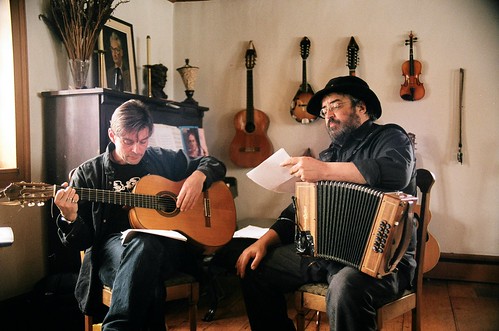
Recently we filmed one of your main characters, Yves St-Laurent, with well-knowf folk musician Yves Lambert. They played ‘Le Tour de l’Isle,’ a song about Île d’Orléans by Quebec’s most popular singer-songwriter Félix Leclerc. ( See photo above.)

When we filmed the last demonstration agains the Rabaska project in front of Quebec’s National Assembly, my friend Simon Bujold shot this little video:

[youtube 6AxfxSEI8rY]

As film projects go, this one is very similar to some of my previous films, following a conflictual situation over a long period of time. But making this one together with Martin has undoubtedly brought other qualities to the film, which will be released later this year.

A la Croisée des Chemins: les derniers tournages

Y&Yjouent.33

Avec mon collègue et ami Martin Duckworth je suis en train de faire les derniers tournages pour un film provisoirement intitulé ‘A la croisée des chemins.’ Pendant trois ans nous avons suivi le conflit autour du projet de port méthanier Rabaska, sur la rive sud du St.Laurent, en face de l’Île d’Orléans. Pour l’élite économique et les travailleurs de la construction ce projet de 800 millions représente un dévéloppement économique très souhaitable. Mais beaucoup de résidants des municipalités de Beaumont et la partie orientale de Lévis souhaitent protéger le caractère agricole, résidentiel et patrimonial de la région, et se sont battus pendant trois ans pour arrêter le projet. Ils ont reçu l’appui de plusieurs groupes environnementaux ‘nationaux,’ notamment Québec-Kyoto et l’AQLPA. Après trois ans, ils semblent avoir perdu la bataille, dans la mesure où le gouvernement du Québec a donné feu vert au projet. Mais l’approvisionnement en gaz de Rabaska n’est pas encore assuré, et il y a trois projets de ports méthaniers au Québec. Alors rien n’est encore ‘dans le béton.’

Le film nous permettra de jeter un éclairage particulier sur plusieurs débats de société, notamment celui qui concerne ‘l’immobilisme’ des québecois et le phénomène de ‘pas dans ma cour.’

Le film que je co-réalise avec Martin ( il fait la caméra, je fais la prise de son ) est une production de l’ONF, ce qui a de grands avantages pour nous. La production est répartie sur quatre ans et nous avons pu suivre tous les revirements de situations et rebondissements de l’histoire de Rabaska. La durée nous a aussi permis de nous rapprocher beaucoup des personnages. Nous avons des discussions très intéressantes avec nos producteurs Yves Bisaillon et Johanne Bergeron sur la trame narrative, le développement des personnages et la facture du film. Nous avons pu faire plusieurs périodes de montage en cours de route, ce qui nous a permis de raffiner notre stratégie de tournage à mesure. C’est le genre de projet risqué où nous ne savons pas en commeçant le film comment il va se terminer. L’ONF est la seule institution qui nous permet de procéder de cette façon – ma façon préférée de travailler.

Nous avons récemment filmé un de nos principaux personnages, Yves Lambert, en train de jouer la chanson ‘Tour de l’Isle’ de Félix Leclerc. ( Voir photo ci-haut.)

Lors de la dernière manifestation des opposants contre le projet Rabaska devant l’Assemblée Nationale à Québec, mon ami Simon Bujold a tourné ce petit vidéo:

[youtube 6AxfxSEI8rY]

Au niveau de la démarche, le film ressemble beaucoup à des films que j’ai déjà fait, comme ‘Power’ ou ‘Maxime, McDuff & McDo.’ Mais cette fois j’ai l’avantage de co-réaliser avec Martin, et nos sensibilités semblent bien se compléter. Le film sortira plus tard cette année.