Projection-événement: ‘Enfants de Choeur’ à la cinémathèque

EC!  2 (horiz)

Mon film ‘Enfants de Choeur‘ sur la chorale des sans-abris de Montréal, terminé il y a dix ans, sera projeté à la Cinémathéque québecoise à Montréal ce samedi le 19 Décembre. Et ce sera une projection-événement puisque la nouvelle incarnation du groupe, la Chorale sous les étoiles – autrefois Chorele de l’Acceuil Bonneau – sera présente pour chanter. Je serai en Europe, mais le producteur Paul Lapointe y sera, ainsi que le Directeur de la chorale, Pierre Anthian. Le film était en nomination pour meilleur documentaire à Hot Docs (Toronto) et aux Jutras, et il s’est mérité le prix du meilleur moyen-métrage documentaire à Mumbai en 2000. Je suis reconnaissant au cinéaste Bernard Émond (son dernier film La Donation est à l’affiche dans plusieurs salles au Quebec actuellement) d’avoir écrit le petit texte qui suit sur Les Enfants de Choeur en vue de la projection à la cinémathèque. Et j’ajoute que Louise Côté qui a monté La donation et la plupart des autres films d’Émond a aussi assuré l’excellent montage de mon film. Bernard écrit:

‘Il y a deux films dans Enfants de choeur : en surface, un feel-good movie sur des marginaux qui retrouvent la dignité en chantant, et derrière, un film pénétrant sur la difficulté d’être et sur la difficulté d’aider. Il n’y a aucun angélisme dans ce film ; on est dans l’humain jusqu’au cou : les choristes sont poqués, égoïstes, et manipulateurs autant qu’ils sont généreux et attachants, et le désintéressement de leur directeur de chorale bénévole n’est pas exempte de prosélytisme et d’un certain goût du pouvoir et de la reconnaissance. La grande richesse du film tient justement à la tension entre ces éléments. On y comprend que le don n’existe pas sans une forme d’échange, et que dans l’échange, on se compromet toujours. Cela n’enlève rien à la générosité et au courage des protagonistes, sans lesquels la chorale n’aurait jamais existé ; seulement, le film ne cède ni aux simplifications, ni aux bons sentiments. Enfants de choeur rend la vie dans toute sa beauté et sa complexité.’

Merci à Jessica Berglund pour l’aide avec ce blogue.

Première de ‘L’art en action’ aux RIDM

Équipe_lancement

Simon Bujold, Jeannine Gagné, MI, Annie Roy et Pierre Allard. Photo: Ariane Jacob

Dans le cadre des Rencontres Internationales du documentaire de Montréal, nous avons lancé L’art en action, notre film sur les deux artistes Annie Roy et Pierre Allard qui forment l’ATSA, L’action terroriste socialement acceptable. Les 300 personnes environ présentes dans la salle ont reçu le film de manière enthousiaste, ce qui nous a évidemment rechauffé le coeur – à moi, le réalisaeur associé et DOP Simon Bujold, la productrice Jeannine Gagné de Amazone film, et nos deux ‘personnages principaux’ qui seront désormais simplement nos amis.

Le meilleur compliment que j’ai eu pendant la fête qui a suivi venait de Hugo Latulippe, le cinéaste de Bacon et l’admirable Ce qui Reste de Nous, qui me disait:

Je suis entré dans la salle un peu découragé parce que je n’arrive pas à financer mes films, mais je suis sorti du visionnement en me disant, ‘ostie, c’est décidé, je tourne !’ C’est la leçon que tu nous donnes Magnus, il faut tourner…..’

Je suis content de sortir un film que les gens trouvent inspirant, car le film que j’ai sorti aux Rencontres l’année passée, LA BATAILLE DE RABASKA (co-réalisé avec Martin Duckworth) se terminait de façon assez triste. L’art en action, comme Annie et Pierre, semble donner le goût aux gens d’agir, on ne peut pas souhaiter mieux.

Le film qui est distribué par les Films du 3 Mars prendra l’affiche au Cinéma Parallèle à Montréal le 20 Nov., et au Cinéma Cartier à Québec le 4 décembre.

Poster L'Art en Action

A Tribute to Muriel Duckworth

Muriel reading_pic1
Muriel reading. Photo: Terre Nash

Sadly we just learned that our friend Muriel Duckworth, pioneering feminist and peace activist, passed away Saturday morning at the venerable age of 100. I say we, because many of my relatives and friends knew and admired Muriel, a tireless opponent of war and injustice in all forms. You can read a biography of Muriel below.

Muriel is also one of the main characters in the documentary I am making about the Raging Grannies, together with Muriel’s son Martin who is doing the camera work, Carole Roy, Minerva Gow, Étienne Gagnon and our producers at Island Film Works. The last time I saw Muriel was when we did our last shoot with her some five weeks ago, at the Magog hospital. She received a visit from another Raging Granny, Marguerite Bilodeau, who is a retired nurse in addition to being a singer and peace activist. In characteristic fashion, ever the good-humoured activist, Muriel repeated her mantra ‘War is stupid.’

Marguerite & Muriel_pic2
Marguerite and Muriel – my photo

Last year, we filmed Muriel’s 100th birthday party in the Eastern Townships – only one of three parties. I don’t believe in documentary being purely observational, and I helped organize a contingent of Raging Grannies from several cities who sang a song about Muriel, written by Granny Barbara Seifred. The song was in two parts. It’s a worthy tribute to a remarkable woman.

[Tune: Sweet Betsy from Pike]

Imagine Muriel Duckworth 100 this year….!
An occasion for a rousing good cheer…
With a cake and bright candles and much love to share…
To show our dear Muriel how much we care.

Oh Muriel Duckworth is a dear friend of ours…
In th’ Peace activist firmament she’s recognized as a Star!
Living legend…national treasure….beyond measure…by far…
Muriel Duckworth is our brightest spark!

[Tune: Clementine A SONG FOR MURIEL]

Muriel Duckworth, dear Muriel Duckworth…
Raging Granny….Superfine!
Peace activist and living legend….
A gold standard for Womankind!
A humanitarian…sometimes contrarian….
A hell-raiser with the Raging Grans ….
She wouldn’t be part of the revolution
Unless….like Emma…..she could dance!

She’s a Living National Treasure….
An inspiration for our lifetime….
A Quaker…a Peace maker
And mischief-maker…by design!
A founding member of Voice of Women….
She’s by definition: a pacifist…..
And a pilgrim to Hiroshima….
True anti-nuclear activist….

Muriel has the Order of Canada….
An impressive list of…..honorary degrees…..
To that we’ll add our Happy Birthday….
And our song….in a heartbeat!

[Tune: Sweet Betsy]

To Muriel Duckworth…femme formidable!
We treasure you as a friend….vraiment inestimable…
So here’s our Happy Birthday…you know that it’s meant
With Good Health and Good Cheer….and much merriment

Muriel H. Duckworth (born October 31, 1908) is a Canadian pacifist, feminist and social and community activist. She is also a practising Quaker, a religious faith deeply committed to non-violence.

Duckworth was a founding member of the Nova Scotia Voice of Women, a provincial branch of the Voice of Women (VOW). She served as the National President of VOW, now called the Canadian Voice of Women for
Peace
, from 1967 to 1971. She also helped establish the Canadian Council for International Cooperation, a coalition of about 100 Canadian organizations working for the elimination of poverty in Canada and around the world. Duckworth was among the first women in Nova Scotia to run for political office as a New Democratic Party candidate in Halifax during the provincial elections of 1974 and 1978. She was the 1991 recipient of the Pearson Medal of Peace for furthering the cause of international peace as well as the equality of women and men. She was made a Member of the Order of Canada in 1983.

Grannies protest CANSEC arms fair

Marching Grannies
Marching Grannies

All photos by Alan Auvaart (see below)

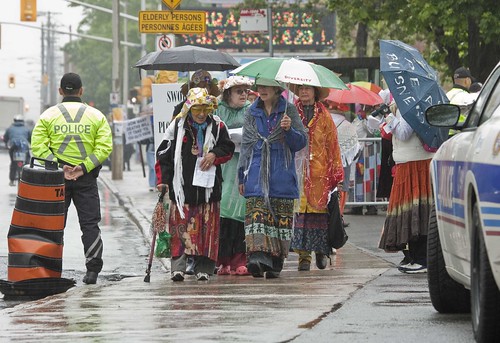
I just came back from filming the Raging Grannies in action at the protest against the CANSEC arms fair in Ottawa. It is the largest event of its kind in Canada, showcasing all the best new ways to inflict pain, cause death and create mayhem. It was held this year in Lansdowne Park inside the city limits. A protest action was organized by COAT – you can find all the information on Canada’s role in the arms trade on their web site. Arms bazaars were banned from Ottawa twenty years ago, but because of municipal fusions this measure has to be adopted again to be valid. Needless to say there is a citizen campaign underfoot to do just that.

On the Roll Granny
On the roll Granny

The Raging Grannies from several cities and Mémés déchaînées from Montreal played a major role at this protest, setting up a Peace Garden and slowing traffic in and out of the exhibition, singing their songs and getting their message across. They sang, among other songs, WAR BUSINESS (you can guess to what tune…)

THERE’S NO BUSINESS LIKE WAR BUSINESS
THE BEST BUSINESS THEY KNOW!
NEVER MIND THE HOMELESS AND THE HUNGRY
NEVER MIND THE PEOPLE WITHOUT JOBS
WAR’S A STUPID WAY TO SPEND OUR MONEY
IT JUST AIN’T FUNNY! LET’S MAKE IT STOP!

And

Tune: Battle Hymn (Glory, Glory)

THE PROFITEERS ARE COMING HERE
AND THEY HAVE COME TO BUY
THE GADGETS THAT ARE ON DISPLAY
THAT BURN, EXPLODE AND FRY
AND ALL LAID OUT SO THEY CAN SEE
WHICH ONES THEY’D LIKE TO TRY
AT THE CANSEC TRADING SHOW.

For our shoot we had the help of some terrific Ottawa volunteers, including excellent photographer Alan Auvaart. It was his first encounter with the Grannies and he had this to say:’ The resilience of the Grannies to come out in such inclement weather to protest for what they believe in is truly amazing. I hope none of them catch colds!’ Here is his shot of the crew: myself, Martin Duckworth (on camera with assistant Kendall McQueen).

The Crew
Part of the crew: Magnus Isacsson, Kendall McQueen, and Martin Duckworth

Thanks to Jorge Bustos-Estefan for help with this blog.

‘Brave New 1984’ on the NFB’s Citizenshift website

BraveNew1984-title

Power is in inflicting pain and humiliation. Power is in tearing human minds to pieces and putting them together again in shapes of your own choosing…If you want a picture of the future, imagine a boot stamping on a human face – forever.

George Orwell, Nineteen Eighty-four, 1949

A really efficient totalitarian state would be one in which the all-powerful executive of political bosses and their army of managers control a population of slaves who do not have to be coerced, because they love their servitude.

Aldous Huxley, Introduction to the reprint of Brave New World, 1945

Two terrifying novels haunted the 20th Century and continue to trouble us today: Orwell’s Nineteen Eighty-four and Huxley’s Brave New World. Every day, newspapers invoke their nightmarish visions, whether driven by Orwell’s ‘Big Brother’ repression or Huxley’s consumer seduction and conditioning.

Several generations of readers have used these two novels as beacons, throwing light on contemporary realities. Young people still read them today, and use them to make sense of what’s going on in the world. Orwell and Huxley could never have imagined some of the amazing technological advances of the last few decade. But they understood the fundamental tendencies at work in modern society, and that’s why they are still read today.

Orwell foresaw surveillance, repression, constant war and torture. Huxley imagined rampant commercialism, deception, conditioning and genetic manipulation. Today, unfortunately, many of the daily realities we and people around the world experience combine the ‘Orwellian’ with the ‘Huxleyan.’ Our willing participation in the invasion of our own privacy through our use of Facebook and other social sites on the web is just one recent example.

There is a time-honoured tradition of debate about which one of the two authors, Orwell or Huxley, was more prescient. In the end, authors like Margaret Atwood have concluded that the main issue isn’t ‘who was right,’ but in what ways both authors were right – and what we can learn from using their insights. This is also our view.

For several years now, Varda Burstyn and myself have been working on a film about these issues. However, the subject seemed too large and sprawling to really make a good film, and the most enthusiasm for this project comes from young people who are most interested in participatory, interactive web-based experiences. The project has now found a home on the NFB’s web site Citizenshift. Check it out, comment, contribute!

http://citizen.nfb.ca/brave-new-1984

If they came back to life, Orwell and Huxley would feel vindicated for many of the dystopian trends they foresaw. At the same time, they might well be surprised – and delighted – to see the amount of resistance to these trends, all over the world. Huxley called for caution, for vigilance and for a greater awareness of the potential totalitarian power of scientific and technological innovation. Orwell called for a mobilization of the common people against power and privilege sustained by repression and elite omnipotence. These concerns are echoed in many civil society movements today.

That is why we think this project has a great deal of potential to capture the imagination of video makers and web users.

Thanks to Jorge Bustos-Estefan for help with this blog.

Grannies rage against war toys

GranssingEatonCtr
Mémés and Grannies sing in front of Eaton Center

Continuing to shoot our film abut the Raging Grannies and their French-speaking sisters, the Mémés Déchaïnées. Last week we joined Louise-Édith Hébert and Anna-Louise Fontaine as they picked up several other Mémés and brought them down to a rehearsal with the Raging Grannies. They then went over to the Eaton Center to sing, first outside and then inside, in front of a video games store. Their message: there are certain kinds of presents our kids don’t need ! Here is one of the songs they sang together:

Vive le vent – War toys

Couplet :
Pendant l’temps / pendant l’ temps /
Des grandes ventes d’hiver / /
Faudrait pas vendre / les jouets de guerre / /
Qui enragent les grand-mères / /Non / / /

Pour Noël / pour Noël /
Voici l’ vœu d’ ces grand-mères / /
Assez / assez / de violence //
Les jouets de guerre / à la poubelle / Ouiiiiiiiii !

(CHORUS)
When we go to shop / To buy a gift or two /
Let’s think of books and paints / and fun things kids can do / /
With skates / a bike / a ball / Our message will be clear /
Peace on Earth / goodwill to all /
Today and through the year / / / Oh !

Jingle bells / Jingle bells /
Jingle of dismay
It’s no fun to shop today /
With war toys on display / / /

Praise for ‘The Battle of Rabaska’

Journaux_RABASKA

This film which I co-directed with Martin Duckworth, has been playing in three theatres in Montreal and Quebec City over the last few weeks. Martin and myself attended many of the screenings and stayed for Q’s & A’s, sometimes in the company of some of the film’s main characters. We have received many messages stating that the film has given the opposition to the LNG port project a real boost. One newspaper, La Vie rurale, which had previously supported the port project went as far as saying the film has completely changed its perception of the opposition, from naive and selfish to credible citizens whose concerns are to be taken seriously. Newspaper reviews have been excellent. Here are some excerpts:
« In case there aren’t enough reasons to spike your blood pressure at this time of year, watch The Battle of Rabaska. »
John Griffin, The Gazette

“Tells us far more about citizen engagement and human nature than a whole pile of sociological studies. Very edifying.”
Mario Cloutier, La Presse
“A shocking film!”
Catherine Lachaussée, Radio-Canada

« Not afraid of taking sides, this film portrays the situation convincingly, with many strong arguments but also with a strong human dimension. »
Kevin Laforest, voir

La Bataille de Rabaska – Critiques des journaux

Journaux_RABASKA

Depuis deux semaines, les journaux et médias électroniques ont beaucoup parlé du film LA BATAILLE DE RABASKA que j’ai co-réalisé avec Martin Duckworth. (Production ONF, Yves Bisaillon et Johanne Bergeron.) Toute cette attention est due en partie à l’excellent travail de notre relationniste Marie-Claude Lamoureux. Je vous reviendrai sur l’impact que toute cette couverture médiatique a eu sur le mouvement d’opposition, mais voici d’abord les critiques des journaux. Le film est encore projeté dans trois salles, au Cinéma ONF à Montréal, au Cinéma du Parc ( avec sous-titres anglais) et au Cinéma Cartier à Québec. Voir www.onf.ca/labataillederabaska

«Comme dans une fiction, le spectateur s’identifie aux protagonistes selon ses propres opinions. …nous en apprend plus sur l’engagement citoyen et la nature humaine que bien des précis de sociologie. Édifiant. »
Mario Cloutier, La Presse

« D’habitude, c’est pas ma tasse de thé ce genre de film, mais ça, c’est vraiment du cinéma! »
Franco Nuovo, Radio-Canada

« …un document fascinant (…) qui pose des questions pertinentes sur l’état de la démocratie québécoise. »
Médiafilm

« …prouve, de façon éloquente, que le vieil adage demeure d’une cruelle actualité : « Si tu ne t’occupes pas de la politique… » »
André Lavoir, Le Devoir

« In case there aren’t enough reasons to spike your blood pressure at this time of year, watch La bataille de Rabaska. »
John Griffin, The Gazette

« Clairement engagé, le film résume la situation de façon concise et convaincante, avec nombre d’arguments probants, mais aussi une forte dimension humaine. »
Kevin Laforest, Voir

« En évaluant le poids de la mobilisation citoyenne contre celui des ténors de l’industrie, les cinéastes tracent un portrait touchant du visage des militants et des enjeux environnementaux québécois. »
Frédéric Towner-Sarault, Alternatives

« …un film marquant, dont on sort en colère contre le système qui a permis à un groupe industriel de faire changer le zonage agricole pour répondre à des besoins en énergie complètement artificiels. »
Sophie Bernard, www.lienmultimédia.com <http://www.lienmultimédia.com>

Qui enquêtera sur Rabaska ?

porc_methanier

Martin Duckworth et moi préparons actuellement avec l’ONF la sortie en salle de notre film LA BATAILLE DE RABASKA. Martin et moi serons présents à plusieurs des visionnements en salle (Cinéma de l’ONF à Montréal et Cinéma Cartier à Québec, à partir du 5 décembre). Aussi, nous aurons l’occasion d’accorder plusieurs entrevues aux médias. Il nous fera évidemment plaisir de parler du film, des personnages, etc. Mais j’ai aussi l’intention de poser la question suivante : n’y aurait-il pas lieu de faire une enquête sur le processus décisionnel qui a mené à l’approbation de ce projet ?

On voit dans le film que Rabaska produira des quantités énormes de gaz à effet de serre, que le projet représente un danger sérieux pour la population locale et qu’il menace une région à forte valeur patrimoniale. Pourquoi, alors, les institutions et agences qui auraient dû protéger les intérêts de la population n’ont-elles pas soulevé des objections ? Il faut dire que la Commission de protection du territoire agricole du Québec (CPTAQ) en a soulevé – et le gouvernement lui a enlevé tout pouvoir par rapport au projet Rabaska. Mais où était la Commission des biens culturels ? Pourquoi la ministre de la culture n’a pas demandé l’avis de la commission, et pourquoi celle-ci ne s’est-elle pas manifestée ? Pourquoi les gens au Ministère de la santé et dans les conseils régionaux de la santé qui étaient en désaccord avec le projet ont dû se taire ? Pourquoi le rapport d’évaluation environnementale conjointe du fédéral et du provincial (souvent appelé BAPE) a simplement mentionné des problèmes sans s’objecter au projet ? La liste est longue, les questions nombreuses.

Nous avons fait un film, pas une enquête journalistique. Mais nous avons quand même ramassé des éléments fort troublants en cours de route. Dans le film, on voit que le Ministre de l’Environnement de l’époque, Thomas Mulcair, se retrouve simple député en bonne partie à cause de ses désaccords avec le premier ministre Charest et son entourage au sujet de Rabaska. Il explique qu’il avait défendu le principe que tout projet soit traité de manière égale, indépendemment de sa taille, et que cela avait soulevé des dissensions au sein du parti. Autrement dit – c’est mon interprétation – Rabaska a bénéficié d’un traitement de faveur. Au lancement de notre film à Montréal, M. Mulcair a affirmé – sans révéler ce qui s’était passé au Conseil des ministres – qu’il y avait eu « de l’ingérence » de la part du cabinet du Premier ministre pour l’empêcher d’annoncer qu’il avait décidé de ne pas envoyer Rabaska au BAPE. En privé, il m’a expliqué qu’il considérait ce projet trop dangereux pour même le soumettre au BAPE. Et, pour sa part, l’ancien ministre de l’agriculture Jean Garon – qu’on voit dans le film comme Maire de Lévis, favorisant le projet à un moment crucial- a déclaré au Soleil lors de notre lancement à Québec, dans sonlangage direct et coloré, que le débat n’a jamais eu lieu parce que ‘le gouvernement a fermé la gueule à tout le monde.’

Mulcair
Thomas Mulcair : ancien Ministre de l’Environnement; actuellement, Député du NPD pour Outremont

Est-ce que le fait que le Chef de cabinet du prmier ministre Charest, Stéphane Betrand, était un ancien vice-président de Gaz Métro a pu jouer un rôle dans ce dossier ? Plusieurs des personnes impliquées dans l’histoire le pensent. (Gaz Métro est un des partenaires du consortium Rabaska.)

LA BATAILLE DE RABASKA a été produit par Yves Bisaillon et Johanne Bergeron au Programme Français de l’ONF.

Merci à Jorge Bustos-Estefan pour l’aide avec ce blogue.

Launching ‘The Battle of Rabaska’

rabaska_affiche_haut

Last week Martin Duckworth and I launched the original French-language version of our feature doc LA BATAILLE DE RABASKA – THE BATTLE OF RABASKA, in the framework of the Rencontres internationales du documentaire de Montréal. The film tells the story of the four-year fight by groups of citizens against a projected LNG (liquefied natural gas) import facility on the south shore of the St. Lawrence, opposite the famous Île d’Orléans. The project makes no sense because of its impact on climate change, health and safety for the population in the immediate area, and the protection of the cultural heritage of the region. But business interests and construction unions in the area backed it, and a powerful lobby intervened to push for it on all levels of government. Last October, the provincial government gave the project a green light.

The first screening of our film took place at the Museum of Civilization in Quebec City. It was an emotional event, as many of the people who participated in the struggle were there. They have felt quite abandoned both by politicians and government agencies, and really appreciated having their experience documented and shown on the big screen. Former Quebec Agriculture minister and Mayor of Lévis, Jean Garon, who is seen supporting the project in the film, surprised everyone by stating that ‘the debate never really happened,’ and that ‘the government shut everyone up.’ Other revelations followed at the Montreal premiere a few days later, with former Environment minister Thomas Mulcair (now NDP MP for my riding) stating that there had been undue government interference in the assessment process.

Although the project has received a green light, it doesn’t seem certain that it will actually be built. Rabaska has signed an agreement in principle with the Russian energy giant Gazprom, but there is no final agreement and the gas field which is supposed to supply the project is not in operation. With the economic crisis and reduced energy needs it seems even more absurd than it already was, in a province which has a huge potential for renewable energy sources.

The film, shot over four years, was produced by Yves Bisaillon and Johanne Bergeron at the ONF (National Film Board, French program). It will be in theatres in Quebec City and Montreal starting on December 5th.

Thanks to Jorge Bustos-Estefan for help with this blog.