Black Wave – l’héritage désastreux de Exxon Valdez

DSC_5406 - 72
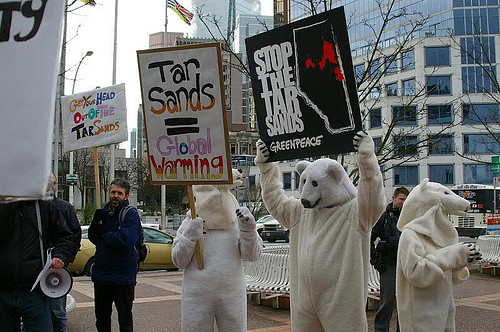
Manifestation en août 2006, réclamant que Exxon nettoie les plages et qu’il paie pour les dommages.

Un des meilleurs films que j’avais vu aux Rencontres Internationales du Documentaire de Montréal au mois de novembre sera aussi présenté cette semaine au Festival des Films sur les Droits, aussi à Montréal, et sera également diffusé à Radio-Canada la semaine prochaine. Le film est le produit d’un travail d’enquête de longue haleine, réalisé par Robert Cornellier dans le cadre de l’excellente maison de production Macumba International – dont je vous reparlerai au cours des prochaines semaines. Black Wave raconte la choquante histoire de l’impact environnemental dévastateur de l’accident du pétrolier Exxon Valdez en Alaska et la lutte des communautés affectés pour des réparations et une compensation adéquate. Je me suis entretenu avec Robert Cornellier.

Cette histoire est choquante. A-t-elle été bien couverte par les médias ? Aux États-Unis notamment ?

Il y a eu une grande couverture médiatique au moment de la catastrophe en 1989. Des journalistes et des caméras du monde entier se sont rendus sur les lieux pendant quelques mois. Puis cette histoire est tombée, peu à peu, dans l’oubli. Il y a eu un regain d’attention, principalement en Alaska, au moment du 10e anniversaire. Quelques bons articles faisant un bilan des conséquences ont été publiés. Puis c’est tombé dans l’oubli. J’ai commencé à couvrir cette histoire en 2004, lors du 15e anniversaire. Riki Ott et un groupe de citoyens de Cordova ont alors organisé une conférence de presse et quelques événements à Washington DC pour attirer l’attention sur leur cause, mais il n’y a pratiquemment pas eu de couverture. À peine quelques lignes provenant d’agences de presse. Finalement il y a eu une petite attention apportée par les médias lorsque la cause a été entendue à la Cour Suprême. Mais aucun papier d’analyse ou reportage de fond sur cette question. Pourtant les conséquences de ce jugement sont très importantes pour l‚avenir. Les citoyens américains viennent, ni plus ni moins, de perdre toute forme recours contre les compagnies pétrolières en cas de déversement pétrolier.

J’ai beaucoup aimé le film, seulement j’avais l’impression qu’on racontait beaucoup des événements du passé plutôt que de les vivre au moment ou les choses se passaient. Les événements se sont déroulés sur quelle période, et tu as tourné sur quelle période ?

J’ai commencé à travailler sur cette histoire en janvier 2004. La catastrophe datait déjà d’il y a 15 ans. À Cordova, le village de pêcheurs où nous avons tourné, les gens ne voulaient plus parler de cette histoire. Ils voulaient simplement reprendre leur vie en main et tourner la page sur le passé. Et la saga judiciaire était rendu au niveau de la Cour d’Appel (9th Circuit Court), et traînait depuis plusieurs années. La difficulté qui s’est posé, c‚est qu’il ne se passait pas grand chose. Le tournage de Black Wave a débuté en août 2006 avec la manifestation de bateaux juste en face du village. Ce fut la seule qu’il y a eu au cours des deux années du tournage. J’ai été constamment à l’affût d’événements. J’ai fait une douzaine de voyages en Alaska. Nous sommes allés pour le carnaval, pour la fête du 4 juillet. À chaque fois que j’apprenais que quelque chose allait se dérouler dans le village ou ailleurs, je m’y rendais. Il faut dire aussi, que du mois d’avril jusqu’au mois de septembre, toute la vie s’articule autour de la pêche. Le village est alors très tranquille. Puis au cours de l’hiver, une grande partie du village se vide, parce que beaucoup de pêcheurs et leur famille vivent ailleurs où ils gagnent leur vie parce qu’à Cordova il n’y a rien. Ce fut donc un réel défi de parler de cette histoire et d’essayer de la rendre vivante, parce qu’il ne se passait pas grand chose.Comme il y a eu beaucoup de déplacements, il fallait aussi faire des choix pour essayer de garder les coûts de production le plus bas possible. Il y a une partie du tournage où j’étais seul, c’est-à-dire que je réalisais, faisait la caméra et le son. Au cours de ce tournage j’ai réalisé à quel point c’est difficile de parler d’événements qui se sont déroulés dans un passé récent mais qui ne sont plus dans l’actualité, tout en essayant de les rendre le plus vivant possible.
DSC_5142 Equipe - 72
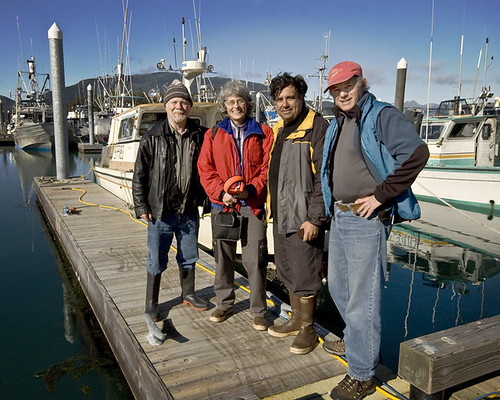
Equipe: Une partie de l’équipe de tournage à Cordova: de la gauche: Robert Vanherweghem, dir. photo; Riki Ott; Paul Carvalho, co-producteur et scénariste; Robert Cornellier, réalisateur et co-producteur.

Thanks to Jorge Bustos-Estefan for help with this blog.
8, la fiction au service de l’engagement

J’étais invité à l’ouverture du 4ème Festival de Films sur les Droits de la Personne de Montréal il y a quelques jours mais je n’ai pas pu y aller. Mon proche collaborateur Franck Le Coroller s’y est rendu à ma place et nous fait le résumé suivant.

eight_film
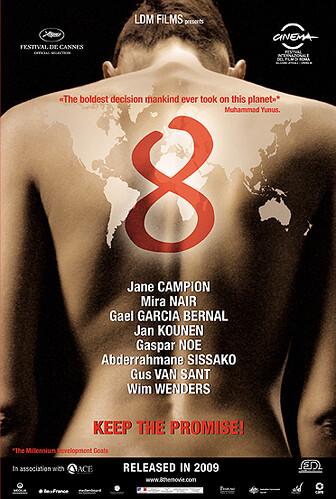
Affiche du film 8

La salle était pleine à craquer. On aurait pu s’attendre à voir un documentaire en film d’ouverture, genre de prédilection pour l’engagement et la justice sociale mais c’est une compilation de 7 courts métrages de fiction et d’un documentaire qui était à l’honneur.

Les Objectifs du Millénaire pour le Développement (OMD) : un plan clair qui s’est probablement effacé peu à peu de notre mémoire. Voilà déjà 9 ans que 191 gouvernements ont adopté officiellement un plan visant à éliminer la pauvreté dans le monde d’ici 2015. LDM Productions a eu la fabuleuse idée de convoquer 8 réalisateurs de renom et leur a laissé carte blanche pour traiter chacun d’un de ces 8 objectifs. Ce film s’adresse à tout un chacun mais vise surtout à rappeler aux gouvernements leur engagement vis-à-vis des plus démunis de notre planète. À mi-parcours, les objectifs paraissent malheureusement bien loin.

Une magnifique séquence d’ouverture nous rappelle les étapes ayant mené à l’adoption de ce plan depuis la seconde guerre mondiale avec notamment la transformation de la Société des Nations en l’ONU et la dégradation accélérée de la condition humaine de par le globe. Des images d’archives des dirigeants de ce monde sont projetées sur un corps maigre et nu. Le ton est donné : ce film vous rentre dans le corps.

La plupart des courts métrages, tournés un peu partout sur la planète, abordent leur objectif à travers le portrait d’une personne. Le journal d’une petite fille, le rêve d’une autre, les pensées d’un petit garçon, la maladie d’un homme, le sort d’une femme enceinte prennent le singulier pour parler d’un universalisme à résoudre. On est pris aux tripes dans les histoires de ces personnes. Un sens de la réalité sait effacer toute trace de misérabilisme. Ces petits moments magiques qui nous accrochent dans un documentaire sont habilement et subtilement mis en scène. Le documentaire c’est « le traitement créatif de la réalité », nous disait John Grierson, ne serait-ce pas valable aussi pour la fiction engagée?

Dans SIDA, le seul documentaire, Gaspar Noé nous emmène dans cette maladie et toutes celles qu’elle convie. Le traitement visuel épuré (un enchaînement quasi total de plans fixes, la nuit) met l’accent sur la voix off de l’homme que nous voyons, seul. Tout comme dans Irréversible, rien n’est épargné. La réalité brutale de cet homme nous contant son histoire est hypnotisante : ses maux, son combat, ses conseils, ses regrets et sa solitude n’ont d’égale que la triste puissance de ce virus dont la propagation doit être enrayée au plus vite, ne l’oublions pas.

8 met aussi en lumière les rapports Nord-Sud, cruciaux pour améliorer le sort de tous. Dans Le rêve de Tiya d’Abderrahmane Sissako, l’instituteur demande à Tiya pourquoi elle ne dit pas plus fort le premier objectif du millénaire qu’est la réduction de la faim et de l’extrême pauvreté. Tiya répond : « Parce que je n’y crois pas. La réduction de la pauvreté, ça passe par le partage et on ne partage pas. » Un rappel urgent et efficace. Wim Wenders dans Person To Person termine le film avec une salle d’information cynique prise d’assaut par ceux qui ont des solutions, continuant ainsi la vague d’espoir et d’engagement indispensable pour aller de l’avant. Les sujets de l’information sortent des écrans de montage et refusent qu’on ne les voit que dans la misère. Ils agissent déjà (par le micro-crédit entre autres) et convient les médias occidentaux à les suivre. C’est une superbe pirouette cinématographique de Wim Wenders pour exprimer le besoin de partenariat Nord-Sud.

Certains verront peut-être dans 8 un film de propagande mais il fait surtout l’état des lieux sur une situation qui nous concerne tous. On ne peut pas rester indifférent à notre sort commun. Et s’il y a une promesse que nos gouvernements devraient tenir, c’est bien celle-là, surtout en contexte de récession mondiale.

Depuis 2000, le gouvernement du Canada a réduit sa participation financière vouée aux Objectifs du Millénaire pour le Développement alors qu’il avait promis de l’augmenter jusqu’à 0,7 % de son PIB.

8 [site officiel du film]
Festival de Films sur les Droits de la Personne de Montréal [site officiel]

Merci à Jorge Bustos-Estefan pour l’aide avec ce blogue.

A couple of links: Age of Stupid, Slumdog Millionaire

I am screening a ton of rushes, not much time for writing. But I thought I’d pass on a couple of interesting links.

Age_of_Stupid
An image from the documentary ‘The Age of Stupid’

First, about the ‘crowd-funded’ documentary The Age of Stupid, by British documentarian Director Franny Armstrong and Producer Lizzie Gillett. Film completed, their aim over the coming months is to “turn 250 million viewers into activists, all focused on the UN Climate Summit in Copenhagen, December 2009
where the successor to the Kyoto Treaty must be finalized.”

I am familiar with Armstrong’s previous work, because she was one of the co-directors of McLibel, about the young activists in the U.K. who sued McDonald’s. During the same period, I made two films about attempts to unionize McDonald’s in Quebec (see my web site) and of course Morgan Spurlock made Super Size Me.

Making-of film (50 minutes) [here]

Article [here]

(Thanks to Mark Hamilton and the Doc list serve.)

slumdog
A frame from ‘Slumdog Millionaire’

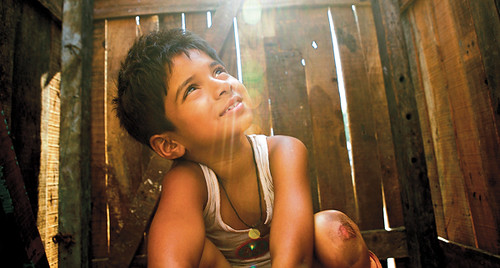
And now for some fiction, both acclaimed and controversial. Slumdog Millionaire is without any question the most successful film of the year, taking home numerous Oscars, including best film, Golden Globe award in the same category. It’s such a household word by now, I won’t describe it. Personally I liked it a lot, for its clever structure and great camerawork and editing. But I have close friends who are documentary filmmakers from Bombay, and they were not so thrilled. The sent me the following articles:

Mitu Sengupta: “Slumdog Millionaire: a Hollow Message of Social Justice” [here]

Jeremy Seabrook: “Betraying India’s poor” [here]

Aarundhati Roy: “Caught on Film: India ‘not shining'” [here]

(Thanks to Ali Kazimi and Anand Patwardhan.)

Thanks to Jorge Bustos-Estefan for help with this blog.
The philosopher-filmmaker at Rideau Hall – part 2

Obama_Jean_Lalonde
Barack Obama, Michaëlle Jean, and Jean-Daniel Lafond

‘Cinéaste frustré, philosophe comblé.‘ (‘Frustrated filmmaker, fulfilled philosopher.’)

Following up on my post from last week, here’s part two of my interview with Jean-Daniel Lafond. How has he adapted to his newest role as “His Excellency” and a very active partner to Canada’s Governor General, Michaëlle Jean?
[Video interview clip further down.]

Of his current circumstances, Jean-Daniel says, “The challenge is to remain oneself and to defend the values one has always defended. There is a space for that.” His position is of a volunteer with an official status. He jokes that Canadians are getting “two for the price of one” and professes total solidarity with Michaëlle.

In his official capacity, Jean-Daniel has made culture his bailiwick, and suggests perhaps it is sorely in need of being defended in this country. It is critical to demonstrate the importance of culture, not just complain about lack of support, he says. He has created Point des arts/Art Matters, a forum and network for reflection and debate about artistic matters from all disciplines, bringing together practitioners, theorists and arts administrators of all political stripes. He has initiated the internet site Citizen Voices/Écoute des citoyens in an attempt to make the office of the Governor General more relevant and accessible, particularly to Canadian youth.

About making films, Jean-Daniel says he finds himself constantly in unexpected and extraordinary circumstances, for example in private conversation with heads of state, and in a most privileged position to observe the world, governance, diplomacy, the very highest echelons of power. He finds it simultaneously stimulating and frustrating. Given the opportunity, he would be making films all the time, but contents himself with gathering as much information – and some video material – as possible, building blocks or sources of inspiration for future projects.

Thanks to Jocelyne Clarke and Jorge Bustos-Estefan for help with this blog.
The philosopher-filmmaker at Rideau Hall – part 1

Jean-Daniel Lafond
Jean-Daniel Lafond

The other day, as U.S. President Obama touched down in Ottawa, I asked my students at l’INIS, the Quebec Film school, a question. ‘Which documentary filmmaker will be meeting with Obama today?’ Puzzled looks, no answers. They asked for a lead. ‘OK, I said, he is also a French citizen.’ ‘Oh, of course,’ said Nathalie who used to work at the NFB. ‘I know who it is, but he’s not there because he’s a filmmaker.’

I recently had a chance to meet with and interview Jean-Daniel Lafond, the husband of Governor General Michaëlle Jean, during a visit to Montreal and on the occasion of a retrospective of his works, curated by Tom McSorley at the Canadian Film Institute in Ottawa and running until March 8th. The vast conceptual range of the 15 films he has directed since 1986 defy obvious notions of a continuous oeuvre.

I asked Jean-Daniel two questions, which, given his habitual eloquence, spun into a 30-minute answer, weaving in and through a wide range of topics and philosophical musings about his life’s work. Given how much there is to report from our discussion, I’ll share the first answer with you this week and the second next week.
[Video interview clip further down.]

Folle_de_dieu
Marie Tifo playing the role of Marie de l’Incarnation, in the film ‘Folle de Dieu’ (‘The Madwoman of God’)

First question: What impulses and/or issues tie together what initially appears to be a very disparate range of works?

Jean-Daniel begins enigmatically by saying “Nous faisons ce que nous faisons en suivant le chemin qui nous échappe…” by which he means that the documentary impulse for him is always a movement toward the unknown, and stems from a desire to understand. He cites Spinoza at the start of his 2006 film, The Fugitive, “Not laughter, not tears, understanding”, an adage which he says is perhaps most fundamental to his work.

Jean-Daniel says that this retrospective, along with a “perspectives” tribute at La Rochelle documentary festival last year, have enabled him to articulate more clearly the connecting threads. He sees his most recent film, Folle de Dieu (The Madwoman of God), about the ideas and writings of an 18th mystic – Marie de l’Incarnation – who came to Nouvelle France to found a country, as utterly coherent with his first film, Les Traces du rêve (Dream Tracks), a portrait of seminal documentarist Pierre Perrault and of his films in relation to the creation of a country. Both interrogate the act of writing/filmmaking in the context of ideas of place, Otherness, dreams and utopias.

What he calls his fight for “the humanization of humanity” precedes his trajectory as a filmmaker. His first career was as a philosopher, a political thinker and defender of culture against the “absolute evil” of ignorance. He was transformed both by his exile and by his encounter with cinema, which he says is humbling, because it always begins from a place of ignorance. “As a philosopher, I always transmitted what I knew. As a filmmaker, I transmit my experience of the unknown, of the unpredictable, what is beyond me.”

Lafond’s films defy categories and cannot easily be summarized, as they offer an almost seamless extension of his philosophical journey, exploring and confronting the major ideas of the past half-century – exile, négritude, religion, the Other, barbarism.

Next week, the second question: How has Jean-Daniel adapted to his newest role as “His Excellency” and a very active partner to Canada’s Governor General, Michaëlle Jean?

Thanks to Jocelyne Clarke and Jorge Bustos-Estefan for help with this blog.

Interesting structure, interesting texture: ¿¡Revolución!?

Revolucion
Venezuela’s President Hugo Chavez

Hugo Chavez, the President of Venezuela, has won his most recent referendum, modifying the constitution so that elected officials – notably including himself – can be reelected for several terms. Is this good or bad ? Only the future will tell, but at least he submitted the change to a popular vote, in stark contrast to the may military coups in Latin America, supported by – if not orchestrated by – some of the countries who like to suggest Chavez is a dictator-in-the making.

I recently organized a screening of a film I really like, ¿¡Revolución!?, directed by Charles Gervais. It is a doc about Chavez’s ‘Bolivarian’ revolution in Venezuela. In terms of the meaning of that revolution the film is generally positive but not at all uncritical, and Chavez’s enemies are given lots of space. That gives the film a healthy tension and it certainly avoids the pitfalls of propaganda. And it has many other qualities. There is one important strand of the film made up of animated images of Cervantes’s Don Quixote, with a gravelly voice-over which seems to represent the knowledge of a veteran revolutionary formulating some general principles for social and political upheavals – you could imagine him to be a Che Guevara speaking from the grave, but his thoughts also remind one of Machiavelli, formulating some general principles about his subject based on years of experience. There are ten of these principles in as many segments, and they signpost ten chapters in the film. The actuality material is very well edited – by Étienne Gagnon – and was treated for contrast and texture in a way more reminiscent of edgy fiction films than of documentaries. I asked Charles how he developed this treatment.

How did you come upon the Don Quixote idea? Was it hard to make it work in the film?

Charles Gervais: In 2005, when I first got the idea of making this documentary, Chavez was distributing 1 million copies of Don Quixote books to the people of Venezuela. Chavez said that it was necessary to nourish the minds, to be inspired by someone who searched “to rectify the wrongs and to rearrange the world”. I found it unusual for a political leader, fascinating. At that time, I knew little about Chavez, and it brought me wanting to know more. During my research, what I found is that Chavez is in fact a real Quixotic figure: a dreamer that wants to do good to the people, but becomes so overwhelmed in his quest that he doesn’t always see the reality clearly anymore. How did I suggest this in the film? Don Quixote is everywhere in the film. At the very beginning, Chavez refers to him when he talks about passion, and drawings of Quixote’s adventures are used to present the theory of a modern revolution; and at the end, the storyline of Chavez and Don Quixote clearly mix together. It’s even a quote of Quixote himself that closes the film, warning Chavez to be careful not to lose himself in passion forgetting his true cause. (“Let not thine own passion blind thee in another man’s cause.” / Miguel de Cervantes)

Your film has a very interesting structure, and also an interesting texture. How did you develop those?

Charles Gervais: We wanted to create a structure that would give the film a possibility to stay interesting and insightful, whatever happens with Hugo Chavez. That led us to invent a step-by-step guide for a modern revolution that would succeed in bringing about radical change without resorting to violence and repression. (I worked on this with a specialist in Theory of the Revolution from the Trudeau Centre for Peace and Conflict Studies.) So if Chavez got mad with power and ended up as a true dictator, our film could help understand why. And if he continued to work on his «socialist revolution of the 21st century» on a democratic way, we could even pretend that we might have helped him! (I’ll let you decide which path he is on today!)

Talking about the texture, we wanted to follow a certain aesthetic about slums, poverty and «end of the world» kind of places that was brought by some great movies like City of God or Traffic. The dominant color all over the film, amber, reminds me of an old newspaper that was forgotten for a long time under the hard sun – how the people living in Venezuela’s slums possibly felt like. So technically, we took the almost too perfect HD images (shot with a Sony CineAlta F900) and alter the signal with a kind of «bleach bypass». The resulting images, with deep black and deep white, but cold, was then colored with this amber texture.

REVOLUCION_POSTER_ENG small

Thanks to Jorge Bustos-Estefan for help with this blog.

Taking Root: The Vision of Wangari Maathai

takingrootfilmWangari Maathai [Photo credit: Lisa Merton]

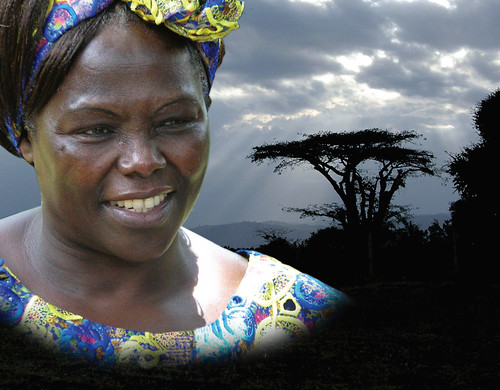
One of the best films I saw at the Rencontres Internationales du Documentaire de Montréal last November was Taking Root: The Vision of Wangari Maathai, which won both the best documentary award in the ‘Eco-camera’ section and the audience award for the whole festival. The film documents the struggle of Maathai and the Green Belt Movement she started, against authoritarian governments and for the protection of the environment in Kenya. I was particularly impressed by the way archival footage of past actions and repression were interwoven with contextual and current materials, making for a compelling and inspiring story. The filmmakers, Lisa Merton and Alan Dator, told me they were far from the only ones who wanted to make a film about Maathai.

Maathai directors.6992
Alan Dater and Lisa Merton, the directors of the film [Photo: Andrei Khabad]

Alan: I think we got to make the film because we got along well with Wangari. And because we started making the film before she won the Nobel Peace Prize, before she had that level of recognition. We weren’t after a “famous” person, we were interested in her life and her work for its own sake. Her story is universal.

We grew up on the land as Wangari did and so we have similar sensibilities in many ways; we understand the rhythms of the natural world, the web of life of which we all are part, and our total dependence on the natural world for our very survival. Something she understood from childhood.

You succeed in portraying the person, the movement and, at least to some extent, the situation in the country. Was that difficult, or did it come naturally?

Lisa: It came naturally. Wangari’s approach to change is holistic so we wanted to show that in the way we made the film. She links sustainable development, democracy and peace in a beautiful, organic way in her life and work. When she had no choice but to become political, she became political. She and the women of the Green Belt Movement could not plant trees without speaking truth to power.

We also felt that we couldn’t make the film without putting it in historical context. The way people survive on the land they live on is an integral part of how their culture is shaped over time. For us the cultural aspect of Wangari’s work is deeply important. Her recognition of the ways in which people lost themselves, their dignity, and their sense of self-worth during colonialism and neo-colonialism is part of what the Green Belt Movement (GBM) addresses in its Civic and Environmental Education Seminars that we show toward the end of the film. It is here that the participants of GBM make the linkages themselves – they learn to know themselves in a new light and therefore are also able to understand what is best for the common good.

Takingroot5
[Photo Credit: Ariel Poster]

Merci à Jorge Bustos-Estefan pour l’aide avec ce blogue et à Andrei Khabad pour la photo des cinéastes.

A year in class, fiction meets documentary.

Entre_les_murs
A still from Laurent Catnet’s film The Class [original French title: Entre les murs]

Have you noticed how many and how many recent fiction films look like documentaries, or are inspired by documentaries? I recently wrote about Milk – up for several Oscars – which borrows many scenes from the documentary The Times of Harvey Milk. Last fall I saw a marvellous fiction film which had many scenes with a purely documentary quality, Tulpan, a story from the life of sheep herders on the Kazakh steppes, by Sergei Dvortsevoy. And one of my favourite films this year, nominated for best foreign film at the Oscars, is the French film The Class, by Laurent Cantet (Entre les murs is the French title). The director came upon a reality-inspired novel by François Begaudeau, a teacher in a ‘difficult’ multiracial school in the suburbs of Paris, describing some of the challenges he was up against. Cantet then organized improvisation groups with actual college students and did a combination of casting and training, until he was able to put together his own fictional class. The students drew upon their own experiences to develop their characters. The result is surprisingly convincing, subtle but dramatic, and very documentary-like. It got the ‘Golden Palm’ award at Cannes.

Etre_et_avoir
A frame from Nicolas Philibert’s documentary Être et avoir [‘To Be and to Have‘]

Seeing this film reminded me of two other excellent documentaries which also did nothing more than spend a year in class, but did it well. There was the touching Être et avoir (To Be and to Have) by Nicolas Philibert, shot in a small class in a primary school in France, which had a long run in theatres there and in many other countries. The film got additional press coverage as the main character, the marvelously attentive school teacher Georges Lopez who showed another side of his personality and claimed large sums of money from the producers after the film was successful. And there was La Classe de Madame Lise, a film shot in the multicultural neighborhood of Mile-End in Montreal, nearby where I live. Directed by Sylvie Groulx and produced by Galafilm, the film got a Genie for best doumentary in 2006.

(Another Oscar-nominee for best foreign film this year is Waltz with Bashir, a hybrid, combining documentary and animation.)

La_classe_de_Mme_Lise
An image from La Classe de Madame Lise – a movie by Sylvie Groulx

Thanks to Jorge Bustos-Estefan for help with this blog.

‘Islam Québec’ à Canal Vie: les défis de la production

Hafsi_72dpi

Lorsque la série Manifestes en série de Hugo Latulippe a été télédiffusée l’année passée, j’étais trop occupé pour regarder plus que quelques bribes, mais j’ai pris bonne note du fait qu’un réseau spécialisé (Canal D) diffusait une série intéressante et progressiste. Maintenant, une autre chaîne spécialisée, Canal Vie – aussi propriété d’Astral Média – vient aussi de commencer la diffusion d’une série fort intéressante, Islam Québec. Sous-titré ‘un accès privilégié chez de nouveaux arrivants’ cette série de 13 épisodes nous fait entrer dans le quotidien de trois familles du Maghreb vivant au Québec depuis quelques années seulement. Le premier épisode nous a fait rencontrer des gens hautement scolarisés, très articulés et sympathiques, qui sont dans un impasse: malgré tous les beaux discours sur l’ouverture et l’intégration, trouver un emploi s’avère presque impossible. On sent le découragement et la désillusion. Du point de vue production, on sent que la série n’avait pas des moyens illimités, loin de là, mais les auteurs ont certainement pris le temps de construire une relation de confiance avec les sujets.

Ma collègue Louise Lemelin a développé le projet et en a assuré la production déléguée avec les deux réalisateurs Charles Gervais et Sophie Lambert, dans le cadre de la maison d’une production Trinôme. Je lui ai posé deux questions.

LouiseL.1642
Louise Lemelin

VERSION COURTE

Magnus Isacsson : Tu as déjà travaillé pour Radio-Canada en tant que contractuelle et en faisant des films avec des producteurs privés mais pour la télévision publique. Faire une série pour la télévision spécialisée, est-ce bien différent ? Comment il faut adapter ses méthodes de travail ?

Louise Lemelin : Les télévisions spécialisées sont parmi celles qui diffusent le plus de séries documentaires. Ces diffusions répétées permettent d’avoir un impact intéressant sur le débat public. Aussi, Canal Vie, avec des émissions de déco et de mode atteint un auditoire de femmes modernes, allumées, auquel elle présente aussi une programmation documentaire costaude : pensons au Voyage d’une vie, à Bouffe Malbouffe, aux Dessous de l’assiette, à Trisomie 21 / Défi Pérou. On peut donc atteindre par ce diffuseur un auditoire qui n’est pas celui des télévisions généralistes et qui pourrait être plus influencé que d’autres par la mauvaise presse dont sont victimes les musulmans installés au Québec. Va sans dire qu’il faut tenir compte des habitudes de ces téléspectatrices et du style du diffuseur auquel elles sont attachées.

Évidemment, les moyens de production disponibles ne sont pas les mêmes. Le nombre de jours de tournage et de montage sont même plus restreints que c’est le cas pour les reportages d’actualités produits pour les télévisions généralistes. J’ai passé 8 mois à faire la recherche et à scénariser avant d’entrer en production pour savoir où l’on allait et pouvoir s’ajuster rapidement devant l’imprévu. Ça m’a aidé en production à gérer le projet en fonction des objectifs visés. La production s’est adjoint des réalisateurs imaginatifs, sensibles et inventifs. Vous remarquerez à la diffusion qu’en fixant certains patterns de tournage, ils ont facilité le montage et diminué les besoins en narrations. Les réalisateurs ont combiné plusieurs approches pour filmer les épisodes: la manière du cinéma vérité, des plans plus cadrés et des séquences suscitées. Ces façons de procéder permettent plus de contractions et donnent à la série sa signature particulière, deux avantages dans un environnement télé. Toutefois, la durée de 22 minutes entrecoupée de pauses publicitaires rendait inévitable l’usage de narrations. D’autant plus qu’une télévision qui présente beaucoup de magazines crée des attentes en ce sens. Faire une série avec un financement de télévision spécialisé, cela exige une production hyper ficelée et beaucoup beaucoup de talent et d’énergie.

MI : Le sujet que vous avez abordé n’est pas facile, on sait qu’il y a des perceptions négatives pour ne pas dire des préjugés. Par quelles réflexions êtes-vous passés avant d’arriver à la formule, le style, le contenu que vous avez choisi ?

LL : Au départ, j’étais très intéressée à me pencher sur ce qui était, dans la foulée des débats sur les accommodements raisonnables, l’un des grands enjeux de notre société. À l’origine, la série devait être une série documentaire où nous filmerions le quotidien d’une famille musulmane s’installant au Québec. Rien de tel qu’une démarche documentaire dans la durée. Nous nous sommes rendus compte qu’en percevant les musulmans installés au Québec comme une communauté d’abord préoccupée d’obtenir des accommodements religieux, et risquant de faire revenir le Québec à l’époque de la grande noirceur, nous, les Québécois nés ici, étions vraiment très loin de la réalité! Les statistiques effarantes sur le chômage des Maghrébins nous ont particulièrement ébranlés.

La question de l’égalité des femmes préoccupait toute l’équipe. Au départ, plusieurs d’entre nous étaient plutôt réfractaires à l’idée du voile et le considéraient comme un signe de soumission. La recherche et la production dans la durée nous ont amenés à voir les choses de façon beaucoup plus nuancée. L’immigration demande beaucoup de courage et exige des couples énormément de complicité. Les femmes, voilées ou non, en mènent large, à la fois dans ce projet et dans la vie de famille. Plusieurs sont des professionnelles de haut niveau. Le drame, c’est que ces couples sont venus sans se rendre compte de la difficulté d’accès aux métiers et aux professions régis par des ordres professionnels. Ils se retrouvent en situations très précaires. Le vrai danger pour le Québec c’est la formation d’une communauté humiliée, vilipendée, où la dépression se répand de façon insidieuse.

Pour tout le monde, et indépendamment de la sympathie que nous pouvions ressentir pour l’un ou l’autre des participants, le tournage a été très ardu. La série doit beaucoup aux familles participantes et aux autres personnes qui ont témoigné. Pour les Maghrébins, l’expérience documentaire et télé est complètement exotique. Il n’existe ni au Maroc, ni en Algérie l’équivalent de l’émission que nous étions en train de faire. Alors que nous filmions avec grande parcimonie, nos participants trouvaient le tournage épuisant. Tous les musulmans interviewés craignaient de se voir dénigrer à nouveau comme c’est trop souvent le cas depuis 2001, particulièrement avec l’incident d’Hérouxville et les débordements devant la Commission Bouchard-Taylor

C’est ainsi que la série est devenu ce documentaire réalité qui combine l’enquête sur des enjeux fondamentaux et la découverte d’êtres humains touchants, à la fois semblables et différents de nous. Nous croyons que les Québécois qui verront la série s’attacheront aux personnages et s’attaqueront, dans la mesure de leurs moyens, aux obstacles qui bloquent leur intégration, au premier chef, l’intégration en emploi. Au nom de l’équipe, j’émets un vœu : que des employeurs qui auront vent de la série offrent enfin aux parents des trois familles suivies pendant près d’un an, des emplois à hauteur de leurs compétences et de leur expérience!

Pour lire la VERSION LONGUE cliquez ici.

A Violinist in the Metro

bell

As a New Year’s greeting I sent all my friends a touching, revealing and thought-provoking story which I had received from Carole Roy who is working with me on the film about the Raging Grannies. It says a lot about how we live and it certainly made me think, because on most days I would have behaved just like the people in the story.

I got a lot of responses to my message. At the end, a comment from filmmaker (‘His Excellency’) Jean-Daniel Lafond. Jennifer Alleyn – one of those people who would have stopped and listened, I’m sure – sent me the whole original story from the Washington Post. As usual, Jorge Bustos-Estefan helped with the blog.

A Violinist in the Metro

A man sat at a metro station in Washington DC and started to play the violin; it was a cold January morning. He played six Bach pieces for about 45 minutes. During that time, since it was rush hour, it was calculated that thousand of people went through the station, most of them on their way to work.

Three minutes went by and a middle aged man noticed there was musician playing. He slowed his pace and stopped for a few seconds and then hurried up to meet his schedule.

A minute later, the violinist received his first dollar tip: a woman threw the money in the till and without stopping continued to walk.

A few minutes later, someone leaned against the wall to listen to him, but the man looked at his watch and started to walk again. Clearly he was late for work.

The one who paid the most attention was a 3 year old boy. His mother tagged him along, hurried but the kid stopped to look at the violinist. Finally the mother pushed hard and the child continued to walk turning his head all the time. This action was repeated by several other children. All the parents, without exception, forced them to move on.

In the 45 minutes the musician played, only 6 people stopped and stayed for a while. About 20 gave him money but continued to walk their normal pace. He collected $32. When he finished playing and silence took over, no one noticed it. No one applauded, nor was there any recognition.

No one knew this but the violinist was Joshua Bell, one of the best musicians in the world. He played one of the most intricate pieces ever written with a violin worth 3.5 million dollars.

Two days before his playing in the subway, Joshua Bell sold out at a theater in Boston and the seats average $100.

This is a real story. Joshua Bell playing incognito in the metro station was organized by the Washington Post as part of an social experiment about perception, taste and priorities of people. The outlines were: in a commonplace environment at an inappropriate hour: Do we perceive beauty? Do we stop to appreciate it? Do we recognize the talent in an unexpected context?

One of the possible conclusions from this experience could be: If we do not have a moment to stop and listen to one of the best musicians in the world playing the best music ever written, how many other things are we missing?

Joshua_Bell_DC_metro
A frame from the surveillance camera in the D.C. metro.

A Comment from Jean-Daniel Lafond (my translation):

‘When beauty and culture become merchandise, it is no longer a matter of life but of property. Things are valued for their price and their wrapping. It becomes a matter of ownership. When, on the other hand, beauty is given as a gift, it becomes a shared resource, as essential as the air we breathe. This, I imagine, is what a three-year old child responds to. ‘

‘Quand la beauté comme la culture est une marchandise, elle relève de l’avoir et non plus de l’être. On la reconnaît à son prix et à l’emballage. C’est une valeur de possession. Alors que la beauté se donne en partage, elle est une valeur commune, aussi essentielle que l’air que l’on respire. Ce qu’un enfant de trois ans peut sans doute ressentir.’
Bonne année.
JD

Listen to Bell’s full metro performance here.
Read the full story from the Washington Post here.

Thanks to Jorge Bustos-Estefan for help with this blog.