Première de ‘L’art en action’ aux RIDM

Équipe_lancement

Simon Bujold, Jeannine Gagné, MI, Annie Roy et Pierre Allard. Photo: Ariane Jacob

Dans le cadre des Rencontres Internationales du documentaire de Montréal, nous avons lancé L’art en action, notre film sur les deux artistes Annie Roy et Pierre Allard qui forment l’ATSA, L’action terroriste socialement acceptable. Les 300 personnes environ présentes dans la salle ont reçu le film de manière enthousiaste, ce qui nous a évidemment rechauffé le coeur – à moi, le réalisaeur associé et DOP Simon Bujold, la productrice Jeannine Gagné de Amazone film, et nos deux ‘personnages principaux’ qui seront désormais simplement nos amis.

Le meilleur compliment que j’ai eu pendant la fête qui a suivi venait de Hugo Latulippe, le cinéaste de Bacon et l’admirable Ce qui Reste de Nous, qui me disait:

Je suis entré dans la salle un peu découragé parce que je n’arrive pas à financer mes films, mais je suis sorti du visionnement en me disant, ‘ostie, c’est décidé, je tourne !’ C’est la leçon que tu nous donnes Magnus, il faut tourner…..’

Je suis content de sortir un film que les gens trouvent inspirant, car le film que j’ai sorti aux Rencontres l’année passée, LA BATAILLE DE RABASKA (co-réalisé avec Martin Duckworth) se terminait de façon assez triste. L’art en action, comme Annie et Pierre, semble donner le goût aux gens d’agir, on ne peut pas souhaiter mieux.

Le film qui est distribué par les Films du 3 Mars prendra l’affiche au Cinéma Parallèle à Montréal le 20 Nov., et au Cinéma Cartier à Québec le 4 décembre.

Poster L'Art en Action

Small Giants take on big challenge.

Photo1_Les_petits_geants
Maxime in Les Petits Géants.

Normally I would write this in French, but many francophones who read this blog will already know about this film, and it deserves to be widely distributed. So here goes…

Les Petits Géants ( The Small Giants) is a documentary about children from low-income neighborhoods who take on the challenge of performing Verdi’s opera The Masked Ball. ( the expression ‘on the other side of the track’ applies nicely here, as this is across the tracks from upscale Westmount) The film was directed and shot by Anaïs Barbeau-Lavalette and Émile Proulx-Cloutier, two young Quebec filmmakers – Anaïs is far from unknown though, having successfully directed both documentaries and fiction – and was the closing film at the annual Rendez-vous du cinéma Québecois last winter. The film follows five boys, 10-12 years old, through the rehearsals to the final performance, but also spends a lot of time with them in their families. The strength of the film lies here, in the terrific closeness to the characters and the seemingly complete access to their domestic environments. Having seen their family contexts which feature all manner of cultural handicaps, poverty and emotional deprivation, we completely understand that the discipline and self-confidence required to perform operatic roles in front of an audience don’t come easy. There are some very moving and sometimes funny moments when the youngsters express their insecurities, their dreams and aspirations.

Pet.Géants filmmakers132 copy
Émile and Anaïs

I saw the film at the theatrical debut at the Cinéma Parallèle in Montreal, where it’s still playing.

In the discussion afterwards the filmmakers answered questions. Someone asked about the extreme close-up framing often used in the interviews with the guys. They explained that their whole objective was to see the experience from the point of view of the kids, or at least very close to them – which is also why the camera often stays on their faces while we hear adults giving instructions or opinions off-camera. I asked them why they followed five boys and no girls, something I found surprising given that there were some very interesting-looking girls in some of the rehearsal shots. Anaïs and Émile explained that they had discovered that in this particular age group, 10-12 years, girls are a lot more self-conscious and controlled than the boys. They found it much easier to have access to the boys’ emotions, and didn’t want any political correctness concerns come in the way of finding the five best characters for the film.

The film was produced by Amérimage-Spectra.

Thanks to Jessica Berglund for the help with this blog post.

Tusarnituuq: the MSO goes to Nunavik

IMG_3145_thmb
Kent Nagano directs throatsingers Taqralik Partridge and Evie Mark
(credit: Robert Fréchette)

The other day at Cinéma Parallèle I saw a really excellent new documentary on the Montreal Symphonic Orchestra‘s visit to three Inuit communities in Nunavik. Tusarnituuq! Nagano in the Land of the Inuit was directed by Félix Lajeunesse and produced by Katarina Soukoup. It’s a moving account of the preparations for and the realization of this exceptional concert tour and of Nagano and his musicians encountering the Arctic and Inuit culture. The real strength of the film is in the characters from the young Inuit throat singers to famed MSO conductor Kent Nagano whose unassuming charm makes for a compelling screen presence. The editing by Marie-Christine Sarda is excellent. I put a couple of questions to the director and the producer.

Felix, this shoot was a very concentrated one, just a few days. Was that difficult? How did you prepare?

Answer : It definitely was a very intense shoot! I knew from the start that most of the 52 minutes film would have to be shot in just four days. So I tried to figure out in advance what «moments» or scenes were absolutely essential for the characters and story of the film. By imagining those moments in advance, I knew I would get a better sense of what to focus on during the actual shooting, and what sacrifices I could make. As an example, I knew that four days was a very short time for M.Nagano and the musicians to adapt to the North and the Inuit culture. So I spoke to my producer Katarina (who was also producing and organizing the Tour itself) and we both agreed that it was necessary, as early and often as possible in the Tour, to bring Kent Nagano and the musicians somewhere far out on the land (with Inuit guides), away from their schedules, rehearsals and instruments. Because I knew from my own previous Arctic experiences, that when you travel into the emptiness and grandeur of the Arctic with Inuit people (whether it’s the first time or whether you haven’t done it in a while), something quickly changes inside you. Time, space and light as you knew them cease to exist and you need to raise your awareness, open-mindedness and sensitivity to fuse with this new and powerful reality. I knew these moments would somehow make the characters of the film «come out» and it would help in bringing together the Inuit and OSM musicians. I worked with my director of photography and soundman to make sure we would be ready to film these moments properly when they come.


IMG_0760_thmb
The full-house at the first concert in Inukjuak (photo: Robert Fréchette)

Katarina, you had almost all the key players on board, this must have taken quite a bit of time?

Answer : I found out about the tour while I was working with Avataq Cultural Institute. In addition to producing documentaries for Catbird, at the time I was also organizing a new Nunavik Arts Secretariat for Inuit artists in northern Quebec through Avataq. Avataq is a non-profit organization for the preservation and promotion of Inuit language and culture in Northern Quebec and the OSM approached them to help organize a tour of Nunavik about 2 ½ years ago. The idea of making a documentary about the tour came to me almost instantly – I knew that an artistic collaboration across cultures such as this one would be a very, very special encounter and felt it was vitally important to bear witness and share it with a wider public through the medium of film. I gathered up a group of talented collaborators, including Félix, who are all experienced in filming in the Arctic (and more importantly, working with Inuit) and we started brainstorming about how to make the film. The financing for the documentary, however, was quite tough, probably a reflection of how difficult it is to finance arts documentaries in these times. I started pitching it about 6 months before the tour began and knocked on every door you could imagine. We actually didn’t close financing until our documentary was at the rough cut stage, which meant Catbird took a huge financial risk in going ahead with the shoot with no guarantee that we would be able to finish the film. It made for quite a few sleepless nights! But ultimately what made me take that risk was the strong, driving belief that this cross cultural moment HAD to be documented and shared no matter what. And I hope our audiences find that it was worth it too.

Our financers include Radio-Canada and ARTV (the first broadcasters to become attached to the project), as well as Rogers Fund, SODEC, APTN, Filmoption International, Department of Indian and Northern Affairs, the Kativik Regional Government, and tax credits. It’s a mix of standard and non-traditional doc financing, again I think a reflection of how creative doc producers must be these days in raising the financing for their films.

Thanks to Jessica Berglund for the help with this post.

A Tribute to Muriel Duckworth

Muriel reading_pic1
Muriel reading. Photo: Terre Nash

Sadly we just learned that our friend Muriel Duckworth, pioneering feminist and peace activist, passed away Saturday morning at the venerable age of 100. I say we, because many of my relatives and friends knew and admired Muriel, a tireless opponent of war and injustice in all forms. You can read a biography of Muriel below.

Muriel is also one of the main characters in the documentary I am making about the Raging Grannies, together with Muriel’s son Martin who is doing the camera work, Carole Roy, Minerva Gow, Étienne Gagnon and our producers at Island Film Works. The last time I saw Muriel was when we did our last shoot with her some five weeks ago, at the Magog hospital. She received a visit from another Raging Granny, Marguerite Bilodeau, who is a retired nurse in addition to being a singer and peace activist. In characteristic fashion, ever the good-humoured activist, Muriel repeated her mantra ‘War is stupid.’

Marguerite & Muriel_pic2
Marguerite and Muriel – my photo

Last year, we filmed Muriel’s 100th birthday party in the Eastern Townships – only one of three parties. I don’t believe in documentary being purely observational, and I helped organize a contingent of Raging Grannies from several cities who sang a song about Muriel, written by Granny Barbara Seifred. The song was in two parts. It’s a worthy tribute to a remarkable woman.

[Tune: Sweet Betsy from Pike]

Imagine Muriel Duckworth 100 this year….!
An occasion for a rousing good cheer…
With a cake and bright candles and much love to share…
To show our dear Muriel how much we care.

Oh Muriel Duckworth is a dear friend of ours…
In th’ Peace activist firmament she’s recognized as a Star!
Living legend…national treasure….beyond measure…by far…
Muriel Duckworth is our brightest spark!

[Tune: Clementine A SONG FOR MURIEL]

Muriel Duckworth, dear Muriel Duckworth…
Raging Granny….Superfine!
Peace activist and living legend….
A gold standard for Womankind!
A humanitarian…sometimes contrarian….
A hell-raiser with the Raging Grans ….
She wouldn’t be part of the revolution
Unless….like Emma…..she could dance!

She’s a Living National Treasure….
An inspiration for our lifetime….
A Quaker…a Peace maker
And mischief-maker…by design!
A founding member of Voice of Women….
She’s by definition: a pacifist…..
And a pilgrim to Hiroshima….
True anti-nuclear activist….

Muriel has the Order of Canada….
An impressive list of…..honorary degrees…..
To that we’ll add our Happy Birthday….
And our song….in a heartbeat!

[Tune: Sweet Betsy]

To Muriel Duckworth…femme formidable!
We treasure you as a friend….vraiment inestimable…
So here’s our Happy Birthday…you know that it’s meant
With Good Health and Good Cheer….and much merriment

Muriel H. Duckworth (born October 31, 1908) is a Canadian pacifist, feminist and social and community activist. She is also a practising Quaker, a religious faith deeply committed to non-violence.

Duckworth was a founding member of the Nova Scotia Voice of Women, a provincial branch of the Voice of Women (VOW). She served as the National President of VOW, now called the Canadian Voice of Women for
Peace
, from 1967 to 1971. She also helped establish the Canadian Council for International Cooperation, a coalition of about 100 Canadian organizations working for the elimination of poverty in Canada and around the world. Duckworth was among the first women in Nova Scotia to run for political office as a New Democratic Party candidate in Halifax during the provincial elections of 1974 and 1978. She was the 1991 recipient of the Pearson Medal of Peace for furthering the cause of international peace as well as the equality of women and men. She was made a Member of the Order of Canada in 1983.

Grannies protest CANSEC arms fair

Marching Grannies
Marching Grannies

All photos by Alan Auvaart (see below)

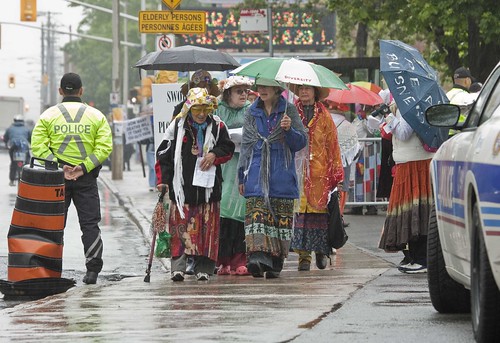
I just came back from filming the Raging Grannies in action at the protest against the CANSEC arms fair in Ottawa. It is the largest event of its kind in Canada, showcasing all the best new ways to inflict pain, cause death and create mayhem. It was held this year in Lansdowne Park inside the city limits. A protest action was organized by COAT – you can find all the information on Canada’s role in the arms trade on their web site. Arms bazaars were banned from Ottawa twenty years ago, but because of municipal fusions this measure has to be adopted again to be valid. Needless to say there is a citizen campaign underfoot to do just that.

On the Roll Granny
On the roll Granny

The Raging Grannies from several cities and Mémés déchaînées from Montreal played a major role at this protest, setting up a Peace Garden and slowing traffic in and out of the exhibition, singing their songs and getting their message across. They sang, among other songs, WAR BUSINESS (you can guess to what tune…)

THERE’S NO BUSINESS LIKE WAR BUSINESS
THE BEST BUSINESS THEY KNOW!
NEVER MIND THE HOMELESS AND THE HUNGRY
NEVER MIND THE PEOPLE WITHOUT JOBS
WAR’S A STUPID WAY TO SPEND OUR MONEY
IT JUST AIN’T FUNNY! LET’S MAKE IT STOP!

And

Tune: Battle Hymn (Glory, Glory)

THE PROFITEERS ARE COMING HERE
AND THEY HAVE COME TO BUY
THE GADGETS THAT ARE ON DISPLAY
THAT BURN, EXPLODE AND FRY
AND ALL LAID OUT SO THEY CAN SEE
WHICH ONES THEY’D LIKE TO TRY
AT THE CANSEC TRADING SHOW.

For our shoot we had the help of some terrific Ottawa volunteers, including excellent photographer Alan Auvaart. It was his first encounter with the Grannies and he had this to say:’ The resilience of the Grannies to come out in such inclement weather to protest for what they believe in is truly amazing. I hope none of them catch colds!’ Here is his shot of the crew: myself, Martin Duckworth (on camera with assistant Kendall McQueen).

The Crew
Part of the crew: Magnus Isacsson, Kendall McQueen, and Martin Duckworth

Thanks to Jorge Bustos-Estefan for help with this blog.

This trade union knows how to use film and video!

Final_Offer
Still from the film ‘Final Offer’ directed by Sturla Gunnarsson

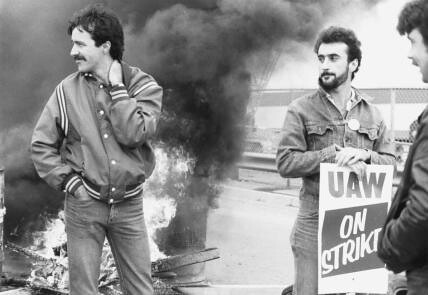
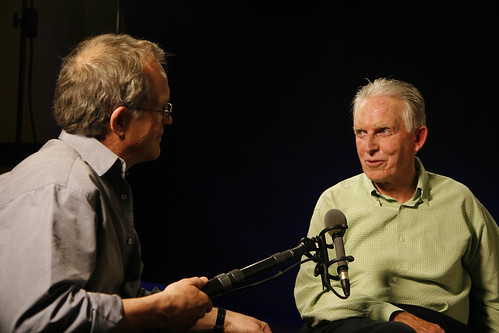
I recently had the opportunity to co-direct a 25-minute video for the Canadian Auto Workers with my wife Jocelyne Clarke. This is one of the very few commissioned pieces I have worked on in my 30 years of doing audiovisual work, but the Auto Workers is one organization I am pleased to work with. Not only does that union have a strong commitment to social justice, but it knows how to use film and video for educational purposes. The leadership of the union has also over the years shown an extraordinary openness to documentary filmmakers, not being afraid of letting them film life as it really was. This is evident in Sturla Gunnarson‘s excellent 1984 film Final Offer (NFB) which documented not just an important strike but the birth of the CAW as a Canadian Union, breaking off from the ‘international’ (US dominated) UAW. Another example is Barry Greenwald‘s terrific film The Negotiator (Barna-Alper 1995) which followed CAW president ‘Buzz’ Hargrove through some very difficult negotiations. And in Quebec, Louise Lemelin and Hélène Pichette made the excellent Troc: Made in Quebec which documented the fight against the closing of the Kenworth plant in Ste-Thérèse for Radio-Canada. I had an opportunity to talk to former CAW president Bob White, the main character of Final Offer, about the union’s attitude towards documentaries. If everyone shared his opinions, we would have an easier time making films ! Video below the photo.

BobWhite
Interviewing Bob White, President of the Canadian Auto Workers

Thanks to Jorge Bustos-Estefan for help with this blog.

Excellent doc: Malls R Us

Malls_R_Us
An image from Helene Klodawsky’s documentary ‘Malls R Us’

Last week I had a chance to see Malls R Us, an excellent new documentary by an excellent Montreal filmmaker, Helene Klodawsky. Helene has made some terrific films, my favourite being No More Tears Sister, a story from Sri Lanka which beautifully illustrates the notion that ‘the personal is political.’ Not in a didactic or sloganeering kind of way, but just by telling a personal story set in the context of civil war and exile. One of the most interesting things about that film is the way colour has been manipulated through chemical treatment of the actual film stock.

Here’s a trailer for Malls R Us.

Malls R Us (produced by Ina Fichman of Instinct Films and Luc Martin-Glousset of Point du Jour) is about shopping malls, and the film gets inside the malls, from North America to Dubai, India and Japan, in every conceivable way. Rather than standing on the outside looking in – or spitting at them for that matter – the film takes us inside the mall not just physically but mentally, inside the heads of the people who conceive, design and build malls as well as the people who use them. One way Helene does that is by interviewing an impressive cast of key characters (kudos for convincing them), the other is by capturing some revealing conversations in the mall context. The film is also very thoughtful, about the deeper meaning of the prevalence of malls. Are they the cathedrals of modern times or – as author Ray Bradbury suggests in the film – today’s version of the town square? Or are they monuments to an era dominated by consumerism to the detriment of higher values? In her narration Helene takes care not to hit us over the head with any ready-made conclusions, which actually makes the film scarier, in a deeper and more subtle way. I asked Helene to talk about her creative process and editorial choices.

Helene_Klodawsky
Helene Klodawsky

In 2006, while editing Family Motel (an alternative fiction film on a Somali refugee family’s journey into homelessness), I read the initial research on a new project being developed by Instinct Films. Writer Harold Crooks and researcher Terri Foxman were working closely with producer Ina Fichman on her idea about the global spread of shopping malls. I soon signed onto the project as director. Right from the start, there were many challenges as the film had been developed and sold as an international coproduction with many themes, contrasts, characters and locations. I needed to find a way to tell the 70-year-old story of these huge temples to consumerism, describe why malls hold such appeal for the billions of people who visit them, as well as provide a critique of their worldwide proliferation. Added to this was the complexity of getting into to malls to shoot. Think of gaining access to a prison; most of the time it was that difficult, and hence we were extremely limited in what and when we could shoot.

Early on I decided to focus on characters that were intensely involved in the world of malls – whether out of passion or despair – rather than intellectuals or social critics who observed malls only from a distance. I felt it was important that my intended audience (those who both adore and despise shopping centres) listen directly to those people who are fully committed to bringing malls to every corner of the globe. I knew I would have only a few days in each location and hence decided to construct a highly stylized post-modern collage made up of mini portraits of each character alongside malls that represented an issue or struggle. Wherever we shot I was surprised by what we found. For example, who would have thought that Science Fiction guru Ray Bradbury would be a proponent of malls, or that young men travel the US mourning the loss of once thriving, but now dead, malls? I am most proud of capturing the little known anti-mall protests in India – as in most of the world, mall developments seems to be a done deal, quietly accepted by most of the population. Audiences tell me how much they appreciate the complex reading that Malls R Us provides – waking us up to ways in which culture and the environment are being shaped by the everyday places that dot our cities and suburbs.

Thanks to Jorge Bustos-Estefan for help with this blog.

Thought-provoking! Lech Kowalski and the ‘post-doc’ age

Hey_Is_Dee_Dee_Home
An image from Lech Kowalski’s ‘Hey! Is Dee Dee Home?’

Last week I saw the most creatively radical documentary I have ever seen, East of Paradise (2004) by Lech Kowalski. It breaks every convention of story development. The first half of the film is made up of an interview with Kowalski’s mother, about the horrors she experienced as a young girl at the end of the Second World War, in Russian-occupied Poland. Then he cuts to a medley of his own films of junkies on the New York underground scene, filmed over the last couple of decades. And what’s the link? The extreme. That becomes clear in the film, towards the end. Kowalski was here in Montreal for a retrospective of his films at the Cinémathèque Québecoise and had a chance to elaborate. To Kowalski life is real when you’re at the extreme limits of what can be tolerated, and that is what throws light on the rest of our existence. He explained how the horrors his mother had experienced set a sort of standard against which, it seemed, all his own experiences had to be measured. This led him to search out, in his own life and work, some extremely harsh realities. So in a sense, the totally unorthodox structure of his film was totally logical. At the discussion after the film the son of a holocaust victim talked about how he totally identified with this psychological dilemma, and brought up the question of a ‘survival gene.’ Kowalski totally agreed, he had received that also from his parents. After all they had been through to survive, he would not have the right to waste his own life, to become one of those junkies you see dying of overdose or AIDS in his own films.

Lech_Kowalski
Lech Kowalski [Photo: Jocelyne Clarke]

Kowalski believes that we are in a ‘post-documentary era’ where reality is too complex to be dealt with in an ordinary film, especially since film production and distribution are largely controlled by vested interests who are set against free creativity and analysis. He has created a web site called Camera War TV to create a new kind of documentary experience. I think this is a great concept, even though I found some of the films on the site less than impressive.

A fascinating encounter. And during the coming month we will have the time to see more of Kowalski’s films. D.O.A.: A Right of Passage (1980), Born to Lose: The Last Rock and Roll Movie (1999), Gringo: The Story of a Junkie (1987), Rock Soup (1991) and two films on Eastern Europe: The Boot Factory (2000) and On Hitler’s Highway (2002).

There is an excellent interview with Kowalski [in French] on the Cinémathèque’s web site.

P.S. I am sure you saw the British clip on YouTube about Susan Boyle, the ‘unattractive’ woman singer whose performance brings down the house in a resounding victory over prejudice (represented by the attitudes of a talent-show jury). A wonderful little film with important issues, suspense, a terrific main character, excellent character development, a surprising turn-around, an uplifting outcome, reminiscent of classical stories like the ugly duckling and Cinderella. What more can you ask of a doc?

http://www.youtube.com/watch?v=9lp0IWv8QZY

Thanks to Jorge Bustos-Estefan for help with this blog.

‘Brave New 1984’ on the NFB’s Citizenshift website

BraveNew1984-title

Power is in inflicting pain and humiliation. Power is in tearing human minds to pieces and putting them together again in shapes of your own choosing…If you want a picture of the future, imagine a boot stamping on a human face – forever.

George Orwell, Nineteen Eighty-four, 1949

A really efficient totalitarian state would be one in which the all-powerful executive of political bosses and their army of managers control a population of slaves who do not have to be coerced, because they love their servitude.

Aldous Huxley, Introduction to the reprint of Brave New World, 1945

Two terrifying novels haunted the 20th Century and continue to trouble us today: Orwell’s Nineteen Eighty-four and Huxley’s Brave New World. Every day, newspapers invoke their nightmarish visions, whether driven by Orwell’s ‘Big Brother’ repression or Huxley’s consumer seduction and conditioning.

Several generations of readers have used these two novels as beacons, throwing light on contemporary realities. Young people still read them today, and use them to make sense of what’s going on in the world. Orwell and Huxley could never have imagined some of the amazing technological advances of the last few decade. But they understood the fundamental tendencies at work in modern society, and that’s why they are still read today.

Orwell foresaw surveillance, repression, constant war and torture. Huxley imagined rampant commercialism, deception, conditioning and genetic manipulation. Today, unfortunately, many of the daily realities we and people around the world experience combine the ‘Orwellian’ with the ‘Huxleyan.’ Our willing participation in the invasion of our own privacy through our use of Facebook and other social sites on the web is just one recent example.

There is a time-honoured tradition of debate about which one of the two authors, Orwell or Huxley, was more prescient. In the end, authors like Margaret Atwood have concluded that the main issue isn’t ‘who was right,’ but in what ways both authors were right – and what we can learn from using their insights. This is also our view.

For several years now, Varda Burstyn and myself have been working on a film about these issues. However, the subject seemed too large and sprawling to really make a good film, and the most enthusiasm for this project comes from young people who are most interested in participatory, interactive web-based experiences. The project has now found a home on the NFB’s web site Citizenshift. Check it out, comment, contribute!

http://citizen.nfb.ca/brave-new-1984

If they came back to life, Orwell and Huxley would feel vindicated for many of the dystopian trends they foresaw. At the same time, they might well be surprised – and delighted – to see the amount of resistance to these trends, all over the world. Huxley called for caution, for vigilance and for a greater awareness of the potential totalitarian power of scientific and technological innovation. Orwell called for a mobilization of the common people against power and privilege sustained by repression and elite omnipotence. These concerns are echoed in many civil society movements today.

That is why we think this project has a great deal of potential to capture the imagination of video makers and web users.

Thanks to Jorge Bustos-Estefan for help with this blog.

Our artists in Havana/Nos artistes à La Havane

Annie_Roy_Pierre_Allard_Havana
Annie Roy and Pierre Allard of ATSA with one component of their installation at the Havana Biennial
Annie Roy et Pierre Allard de ATSA avec une partie de leur installation à la Biennale de La Havane

[Français plus bas]

With my close collaborator Simon Bujold, I am just back from Cuba, where we were filming the artists Annie Roy and Pierre Allard of ATSA as they participated in the 10th Havana Biennial. The theme of the event is Integration and Resistance in a Global World. Annie and Pierre made an installation called Cannonballs and Bubblegum, a way of speaking about the repressive and destructive aspects of consumer culture – a kind of warning to people who live in a context of shortages but whose society might well experience huge changes in the decades to come. This was one of the last shoots for our film Creative Emergency (working title) produced by Amazone Film, already in editing and likely to be released before the end of the year.

Avec mon complice Simon Bujold, je suis tout juste de retour de Cuba, ou nous avons filmé Annie Roy et Pierre Allard de ATSA participant à la 10e Biennale de La Havane. Le thème de l’exposition est Intérgration et Résistance à l’époque de la mondialisation. Pierre et Annie sont venus faire une installation qui s’appelle Boules de canon et gum-balloune, façon de parler des dimensions répressives et destructrices de la société de consommation, sorte d’avertissement pour un pays qui vit la pénurie mais qui risque de vivre des changements importants au cours des prochaines décennies. C’était un de nos derniers tournages pour notre film Urgence Création (titre de travai) produit par Amazone Film – nous sommes déjà en montage, le film devrait sortit avant la fin de l’année.

Thanks to Jorge Bustos-Estefan for help with this blog.
Merci à Jorge Bustos-Estefan pour l’aide avec ce blogue.