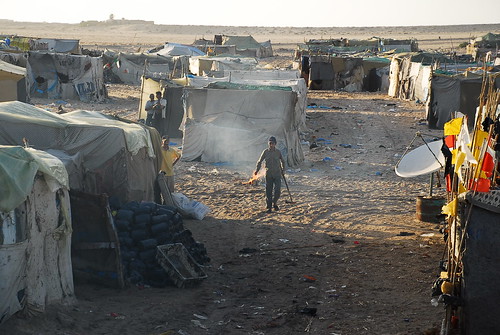
Orphélins à Port-au-Prince. Photo: Marcello Casal Jr/ABr
Selon l’UNICEF, le tremblement de terre en Haiti a crée la situation la plus désastreuse pour les enfants de toute l’histoire de l’humanité. Il y a des dizaines de milliers d’orphélins parmi les centaines de milliers de personnes blessées et sans-abri.
Ayant une fille d’Haiti, ayant déjà visité des orphélinats en Haiti, cette situation me préoccupe grandement. Il reste 5 jours pour faire des contributions qui seront ‘matchés’ par le gouvernement du Canada selon les critères plus bas – en plus d’être déductibles d’impôt évidemment.
Il va sans dire qu’avec les pluies qui s’en viennent en Haiti, toute contribution est d’une importance cruciale.
HAITI:
Pour être versé au Fonds d’aide aux victimes du séisme en Haïti, un don doit :
* être un don en argent ne dépassant pas 100 000 $;
* être fait par un particulier canadien;
* être fait à un organisme de bienfaisance enregistré qui reçoit des dons en réponse au séisme qui a frappé Haïti le 12 janvier
* être expressément réservé par de tels organismes à l’aide aux victimes du séisme;
* être fait entre le 12 janvier et le 12 février 2010.
Plusieurs cinéastes ont tourné des images des événements en Haiti et les rendent disponibles sur le web. A l’émission Dimanche magazine de Radio-Canada Akli Ait Abdallah racontait l’expérience des étudiants de la seule école de cinéma en Haiti – Ciné Institute, qui ont mis leurs images du tremblement de terre sur le l’internet.
Ebbe the movie by Jane Magnusson and Karin af Klintberg
The nominations for the Swedish Guldbagge, the equivalent of Quebec’s Jutras were very interesting. In the documentary category Ebbe the movie by Jane Magnusson and Karin af Klintberg is a fascinating film about Publisher Ebbe Carlson, a larger-than life character whose social climbing and political manipulations during several were so complex that it’s impossible to distinguish fact from fiction. Wisely, the filmmakers don’t try doing that, opting instead for an exploration of ambiguities and contradictions. And they got the award. Videocracy by Eric Gandini ( who also made Surplus and Sacrificio) takes us behind the scenes of Berlusconi’s media & political power grabs and corrupt schemes in Italy. The Queen and I, which I personally liked less, tells the story of Swedish-Iranian filmmaker Nahid Persson-Sarvestani’s relationship to the former Queen of Iran Farah Diba and the recent history of that country.
It’s interesting to see that two of these films were made by swedes born outside of Sweden. And overall in this years Swedish Jutras, the women had the majority of the important nominations. Not only among the documentarians ( 2 out of three for best documentary), but also in fiction: 2 out or 3 of the directors ( Lisa Siwe got the nod) and 2 out of 3 script writers. According to a film industry agreement, signed in 2006, the women “should” receive at least 40% of the subventions for script, directing and production. So far the goals haven’t been reached (it’s still between 20 to 30%) and the Swedish organization WIFT demands a change into making the 40% obligatory.
For more information, contact: info@wift.se
Ebbe the movie de Jane Magnusson et Karin af Klintberg Plusieurs films intéressants étaient en nomination pour l’équivalent des Jutras en Suède, les Guldbaggar.
Dans la catégorie documentaire, Ebbe the movie de Jane Magnusson et Karin af Klintberg est un portrait fascinant de l’éditeur Ebbe Carlsson qui a monté les échélons de la politiques suédoise grâce à des manoeuvres tellement complexes qu’on ne saurait distinguer la réalité de la fiction. Le film d’ailleurs évite sagement de le faire, et opte pour une exploration des ambiguités et contradictions. Récompense: prix du meilleur documentaire. Videocracy de Eric Gandini ( à qui on doit également Sacrificio – Who Betrayed Che Guevara et Surplus – Terrorized into being consumers) nous amène derrière les coulisses du régime médiatique et politique corrompu de Berlusconi en Italie. La Reine et moi, que j’ai personellement moins aimé, explore la relation de la réalisatrice Nahid Persson-Sarvestani’s avec la Reine déchue de l’Iran Farah Diba et l’histoire récente de ce pays.
Intéressant de voir que deux de ces films sont réalisés par des Suèdois originaires d’autres pays. Mais surtout,cette année, les femmes avaient une majorité des nominations importantes pour les Jutras Suédois. Pas seulement parmi les documentaristes, mais en fiction: 2 sur 3 en réalisation ( Lisa Siwe a eu le prix), et 2 sur 3 en scénarisation, 2 sur 3 pour meilleur documentaire. Selon une entente pour l’Industrie du cinéma signée en 2006 les femmes ‘doivent’ reçevoir au moins 40 % des subventions pour scénarisation, réalisation et production. Cependant l’objectif n’est pas encore atteint (on est encore entre 20 et 30 %) et l’organisation suédoise de WIFT réclame un changement pour rendre le 40 % obligatoire.
Pour plus d’info communiquer avec info@wift.se
We are all of course terribly sad about the tragedy in Haiti – our family not the least since we have a daughter who lived her first years in Port au Prince. I of course encourage everyone to contribute money to the relief and reconstruction efforts.
Among the many film crews now in Port au Prince there is one which has a particularly interesting documentary mandate: Inside Disaster. Conceptually planned and negotiated well ahead of the Haiti earthquake, it will allow for both complexity and follow-up.
“The website that is up now is Phase 1 of the overall web plan for the film – we’re developing a much larger version that will launch alongside the doc at the end of this year. It’s intended to be a community and educational resource for people interested in the world of humanitarian aid – we’ll have debates, data visualization materials and a glossary, all illustrated with photos and video from this website and of course, the film. To encourage redistribution, we’re taking the creative commons, “open” approach to all the current content on the site and using tools like Flickr and YouTube for distribution. Our site is currently funded by TVO, Bell Fund (Development funding), and the CTF Digital Fund.”
Some people have raised questions about the impact of numerous camera crews using precious resources in Haiti presently.
On the DOC Canada discussion forum, Katie had this to say:
“the bigger picture problem is that the huge influx of international media creates an artificially inflated market for everyday supplies – gasoline, fixers, cars, bottled water, etc. The “internationals” will pay whatever it takes, and that pushes prices for essentials out of the reach of everyday people. Yesterday’s NYT is reporting that a bottle of water in the downtown markets is now going for $6 – prices like that force people to be dependent on aid, even if they have the resources to be self-sufficient in a “normal” Haitian economy.
So, that is definitely a legit criticism that can apply to our team and the rest of the media down there.
The flipside, of course, is that the huge media presence is driving a record amount of donations into aid organizations; these donations matter, and their numbers are directly tied to media coverage. Our team is going to be there until February 16th, long after most of the international media has gone home.
They’re also going back in six months to film a follow-up on the recovery. And then when the film is released early next year – likely one year after the event – it will bring Haiti and its reconstruction back into the spotlight in Canada, and hopefully internationally.
So: we’re primarily storytellers, not fundraisers, but we’re glad when the two get tied together (which is why we have a IFRC donation button on our site).”
I just saw the filmThe Informant! labeled a dark comedy, directed by Steven Soderbergh, starring Matt Damon, based on the 2000 non-fiction book by the same name by journalist Kurt Eichenwald. It tells the story of a bumbling whistleblower who takes on the management of the giant agribusiness corporation he works for, but who is too naive and too compromised by his own complicity in the corporate game to succeed. Indeed, at the end of the movie he ends up in jail.
I often find fiction films more inspiring than documentaries when it comes to structure, style and texture, and this is one example. ( Another fairly recent one, which I loved for the style of shooting and editing, was Enemy of the State.) You can learn an awful lot from watching The Informant! about the amount of complexity a film can handle, about character development and ‘narrative economy’ and about a creative and entertaining way to convey the thoughts of the main character.
In addition, I have a long-standing interest in the role and fate of whistleblowers who play a key role in the fight for accountability and democracy. I sometimes discuss these issues with the Executive director of FAIR ( The Federal Accountability Initiative for Reform) David Hutton.
David has this to say about The Informant! :
“Yes I did see the movie, and it was very entertaining. However, although Mark Whitacre helps expose a massive corporate fraud, he turns out to be a delusional fraudster trying to cover his own tracks with layer upon layer of untruths. This makes him completely unlike any whistleblower that I know.
The common characteristic that I have found among whistleblowers is personal integrity. They are ordinary people whose personal values simply would not allow them to collude in wrongdoing that would harm others. So they feel compelled to speak out even though this puts their own careers at risk. Even when their careers have been ruined, they often express no regrets, saying that they felt they had no choice but to do what they did. So in my mind the word ‘whistleblower’ is synonymous with ‘truth-teller’. Thank goodness that there are so many of them: they typically pay dearly for their courage, but the world would be a poorer and more dangerous place without them.”
The personal crises typical of the whistleblower experience are well rendered in another Soderbergh film, Erin Brockowich, one whose strength lies more in the writing and in the performances than in the visual treatment. Brockovich, as played by Julia Roberts, gets so caught up in her inquiry into corporate wrongdoing that she starts neglecting her children and her lover. When she receives a threatening phone call, it leads to increased stress and separation. The personal crisis theme is even more developed in The Insider, where Jeff Wigand (played by Russell Crowe) is subjected to all manner of blackmail,threats, intimidation and violence, with disastrous consequences for his family life. Again, the story line of The Insider stayed very close to the real life story, as told in the Vanity Fair article on which the film was based.
Thanks to Jessica Berglund and David Hutton for help with this post.
A couple of days ago, I had the opportunity to once again see Burma VJ, one of the most remarkable documentaries from last year. The film documents the use of small digital cameras by courageous Video Journalists – VJ’s – to reveal what goes on inside the Burmese dictatorship.With digital cameras and satellite uploads it is possible to distribute images worldwide within hours. Working with the Democratic Voice of Burma, a non-profit media organization based in Norway where it gets some of its funding, these courageous video activists do just this. Their work made all the difference during the 2007 uprising led by buddhist monks across the country. Although international news crews were banned and the Internet shut down, images of both the protests and the repression were quickly communicated to the outside world. This striking footage made the newscasts on major networks including the BBC and CNN. This was in stark contrast to the successful information blackout during the student revolt twenty years ago, in 1988. So, as we have seen with the use of digital images and Twitter messages in Iran recently, courage and technology can be a powerful force for social and political change.
Burma VJ by Danish filmmaker Anders Ostergaard, produced by Magic Hour Films, combines VJ footage with some recreations of their ‘tactical leader’ Joshua directing operations over the phone. As the threat of life imprisonment and even death becomes very tangible for the VJ activists, the tension in the film is almost unbearable.
Burma VJ was shown last fall at the Rencontres Internationales du Documentaire de Montréal in the presence of Khin Maung Win who is one of the leaders of The Democratic Voice of Burma. My assistant Alexander and I took advantage of the opportunity to ask him about the use of small video cameras.
Burma VJ has won some 30 International awards, the latest being the Grierson Best Documentary Award in Britain. The film is now on a short-list for best documentary at the Academy Awards. The finalists will be announced on February 2nd. I’m hoping that Burma VJ will be among them, because not only is this a cause that deserves all the attention it can get, but because it is also truly a great film.
Thanks for the help with this blog post to Alexander Carson and Jessica Berglund.
Mon film ‘Enfants de Choeur‘ sur la chorale des sans-abris de Montréal, terminé il y a dix ans, sera projeté à la Cinémathéque québecoise à Montréal ce samedi le 19 Décembre. Et ce sera une projection-événement puisque la nouvelle incarnation du groupe, la Chorale sous les étoiles – autrefois Chorele de l’Acceuil Bonneau – sera présente pour chanter. Je serai en Europe, mais le producteur Paul Lapointe y sera, ainsi que le Directeur de la chorale, Pierre Anthian. Le film était en nomination pour meilleur documentaire à Hot Docs (Toronto) et aux Jutras, et il s’est mérité le prix du meilleur moyen-métrage documentaire à Mumbai en 2000. Je suis reconnaissant au cinéaste Bernard Émond (son dernier film La Donation est à l’affiche dans plusieurs salles au Quebec actuellement) d’avoir écrit le petit texte qui suit sur Les Enfants de Choeur en vue de la projection à la cinémathèque. Et j’ajoute que Louise Côté qui a monté La donation et la plupart des autres films d’Émond a aussi assuré l’excellent montage de mon film. Bernard écrit:
‘Il y a deux films dans Enfants de choeur : en surface, un feel-good movie sur des marginaux qui retrouvent la dignité en chantant, et derrière, un film pénétrant sur la difficulté d’être et sur la difficulté d’aider. Il n’y a aucun angélisme dans ce film ; on est dans l’humain jusqu’au cou : les choristes sont poqués, égoïstes, et manipulateurs autant qu’ils sont généreux et attachants, et le désintéressement de leur directeur de chorale bénévole n’est pas exempte de prosélytisme et d’un certain goût du pouvoir et de la reconnaissance. La grande richesse du film tient justement à la tension entre ces éléments. On y comprend que le don n’existe pas sans une forme d’échange, et que dans l’échange, on se compromet toujours. Cela n’enlève rien à la générosité et au courage des protagonistes, sans lesquels la chorale n’aurait jamais existé ; seulement, le film ne cède ni aux simplifications, ni aux bons sentiments. Enfants de choeur rend la vie dans toute sa beauté et sa complexité.’
This is about a film which was nominated in three categories at the recent Rencontres internatinales du documentaire de Montreal, and which I saw at Cinema Parallèle the other day. Very much à propos, as the Copenhagen climate change conference enters the real negotiating stage. The film, H2Oil by Shannon Walsh (Loaded Pictures), is about the incredibly wasteful and polluting oil sands industry in Northern Alberta and its impact on both people and the environment. It struck me how similar this film is to my own first films, somewhere midway between a journalistic ‘dossier noir’ and a dramatically structured film. The footage of the tar sands is depressingly impressive, and some of the characters are excellent, including a doctor who shows real civil courage and some very touching aboriginal people from the most affected community, Fort Chipewayan.
I asked Shannon a couple of questions.
Shannon Walsh, the director of H2Oil.
·This is a huge subject which one would think would attract a lot of television journalists and filmmakers – have there been other films?
I was really shocked that there weren’t really any feature length films on the subject. There had been a doc aired on CBC called “Tar Sands: The Selling of Alberta” while we were still filming, and there were a couple of pro-industry pieces that had been done, but there really wasn’t much. I felt a lot of responsibility to try to tell the story in as complete a way as I could without losing the human dimension because so many people I met had no idea what was happening in the tar sands.
·And how did you get the funding to do yours in what I presume to be a competitive context?
I think we were in the first wave of projects coming through on the subject looking for funds, but to be honest it is such a complex and difficult subject to tackle. With the help of some supportive initial private funding we made our first trips out to Alberta and put together a short demo that I think reflected the film we wanted to make. That demo I think was a big part of how we set ourselves apart and were able to show that we could handle the subject matter with a sensitive approach.
·Excellent animation, how did you work on that?
I really wanted to find a way to get across some of the tough informative details in a fun and engaging way. I loved the work James Braithwaite had done on “I Met the Walrus” and I thought it would work for H2Oil, so we got in touch with him to see if he was interested. James brought in the excellent animators Dale Hayward and Sylvie Trouve, and we brainstormed together around the content I wanted to put in each of the three animations. I had basic points of what I felt needed to be put together in the animations then I set about writing the scripts. James did the initial drawings and Dale and Sylvie brought them to life. We met several times to tighten and revise the sequences, as the initial drafts became more formal drawings, and were finally. It was amazing working with such talented, smart creative people who really understood what I wanted to do.
·Which were your biggest challenges?
There were a lot of challenges: Getting access to the government and industry. Trying to tell a rounded story that still got to the heart of the issues. Weaving all these very complex technical details, and making an argument without being didactic and losing the human story….END.
RCI, the International arm of the CBC, has announced a competition called Roots, calling for videos under 8 minutes. Sounds like a good challenge ! Rest here: http://roots.rcinet.ca/
Aux Rencontres internationales du documentaire de Montréal j’ai vu un film formidable, intitulé Les Damnés de la mer – qui a reçu le prix du meilleur film dans la section Écosociété. C’est aussi un film qui a eu un impact dans la réalité qu’il décrit. Le réalisateur Jawad Rhalib filme avec aplomb la surexploitation des ressources de pêche du Sud de la côte Atlantique du Maroc par d’énormes chalutiers venant d’autre pays, qui laissent les pêcheurs côtiers dans une situation intenable de pénurie et de misère. Rhalib a eu accès à des chalutiers Suédois qui sortent de l’eau d’énormes quantités de poisson à l’aide d’instruments ultra-modernes mais aussi de méthodes illégales. Les images sont impressionantes. Il les met en contraste avec le matériel tourné de façon très subtile, près des personnages, dans le village côtier de La Sarga, ou les pêcheurs ne savent plus quoi faire pour assurer leur survie. Et au coeur de cette situation il situe une femme, Ghizlaine, qui se bat contre une discrimination bien installée qui réserve le droit de pêcher aux hommes. C’est un coup de génie qui donne une dimension additionelle à un film déjà porteur de problématiques essentielles.
J’ai posé deux questions à Jawad Rhalib.
Ton film a l’air tellement parfait. Est-ce que tu l’avais scénarisé, ou imaginé comme il est là, ou les morceaux sont tombés en place à mesure que tu travaillais ?
Jawad: Si vous avez l’occasion de voir mon avant-dernier film “El Ejido, la loi du profit”, vous comprendrez ma façon de filmer, de traiter mes sujets, de leur donner la parole. Il y a toute un processus de repérage, de rencontre avec les personnes et d’écriture, il y a un canevas, un traitement qui me permet de savoir où aller. Je ne filme jamais à l’aveuglette, je ne pars jamais à la chasse à l’image et dire « on filme et on verra ce que nous ferons avec les images après », je suis contre ce procédé sauf si on fait du reportage d’investigation. J’ai une histoire, des personnes et je décide de la façon dont je vais les mettre en avant, mettre au devant de la scène leur message, choisir la meilleure forme. Bien entendu, il y a toujours des surprises vu que ce sont des personnes réelles, mais généralement ce sont toujours de bonnes surprises. Un réalisateur doit avoir aussi de la chance.
Pour Ghizlane, oui, au moment où je l’ai rencontré je savais qu’elle allait être mon personnage central, mais il y aussi l’histoire de la fête du mouton. Ghizlane était l’élément qui ramenait un peu l’histoire à sa dimension humaine. J’ai toujours était sensible à la situation de la femme dans mon pays d’origine, et avoir une histoire de femme au milieu de la mondialisation, le profit, la globalisation était tout simplement parfait. Ghizlane c’est un peu l’histoire dans l’histoire. Bien sûr, il ne faut pas mettre de côté les autres personnes qui restent aussi forts que la femme.
Le film a aidé à forcer des changements de politique, tu peux nous en parler ?
Jawad: Il y avait quelques mouvements mais c’était très timide. A croire que les mouvements en question avaient besoin d’une preuve pour dire au monde ce qui se passe dans ce coin du Maroc. Pour dire aux marocains ce qui se trame dans leur propre pays, avec leur propre ressource et pour dire au monde ce que le Nord, avec son poids politique et économique, inflige au sud. Dakhla et le Maroc n’est qu’un exemple de ce qui se passe dans le monde, en Afrique, en Asie et en Amérique du Sud. Oui, je ne boude pas mon plaisir de dire que le film, comme El Ejido, la loi du profit, a apporté des changements inespérés. Il y a le gouvernement suédois qui vient de prendre des décisions pour réduire, voire interdire à sa flotte de piller les ressources du sud, il y a le gouvernement marocain qui vient d’arrêter les deux chalutiers suédois, et entrain de mettre en place de nouvelles lois pour la protection des ressources, et enfin il y a un changement de la loi vis-à-vis des femmes qui veulent devenir « pêcheuses ». Et Ghizlane vient d’avoir son permis de pêche. Il faut savoir que Ghizlan sortait en mer sans permis, et si elle se faisait arrêter, elle risquait la prison et le patron de la barque une amende et la perte de sa barque. Aujourd’hui le film sert de preuve et de support pour changer les choses.
Merci à Jessica Berglund pour l’aide avec le blogue.
During the Rencontres Internationales du documentaire de Montréal which just ended, I saw a number of really excellent documentaries. Over the next few weeks I’ll tell you about a couple of them, not just because of their qualities as films but because they are making a difference, having a real impact. To start with, here is a Swedish film which I already saw in Stockholm a few months ago, Bananas!*, by Fredrik Gertten.
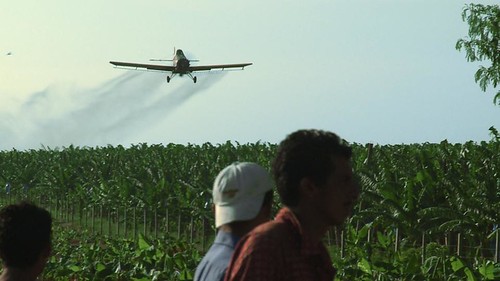
It tells the outrageous story of the banana plantation workers in Nicaragua and Honduras who have been made sterile by exposure to the pesticide DBCP (which goes under several brand names including Nemagon) and the flamboyant L.A. lawuer Juan ‘Accidentes’ Dominguez who takes their defense. He does so without any funding, at his own expense, choosing a group of only 12 workers as a test case. The film has real suspense, following the ups and downs of the legal case. I was at the edge of my seat, dying to see how the law suit was going to end. Well shot, well edited, and with judicious use of archives and court room footage, this is a really important film.
The film has its suspense, and so did the release of the film. Dole, the company running the plantations, put enormous pressure on the filmmakers and the L.A. film festival where the film premiered last June. The company managed to have the film removed from competition, but didn’t manage to have the screenings canceled. It then sued the filmmakers, surely a grave public relations mistake. There was an uproar among documentary filmmakers, and the producers filed an anti-SLAPP motion in the U.S. (A SLAPP is a ‘strategic lawsuit against public participation’ intended not to right a wrong but to force the defendants to spend more time and money than they can afford….) What also made a difference was the reaction in Sweden, where the main medical journal (Läkartidningen) examined the health impacts of DBCP, the federation of Journalists and the Swedish Film Institute condemned the law suit as a threat to freedom of expression, the hamburger chain MAX and major supermarket chains like ICA put their relationship with Dole into question. All this pressure led to Dole withdrawing the law suit on Oct. I5th.
You can read a detailed chronology of all these developments on the Bananas!* web site, complete with the director’s twitter messages.


![Tar sands.27[1]](http://farm3.static.flickr.com/2670/4184804629_677c21e34c.jpg)