Erica Pomerance et les défis des femmes africaines

Erica Pomerance: 'Mère et enfant'

Jocelyne Clarke qui contribue régulièrement à ce blogue nous parle d’une cinéaste très engagée, aussi basée à Montréal.

À Vues d’Afrique cette année, j’ai vu un film important réalisé par Erica Pomerance, « Opération survie », sur un sujet pas très « sexy » mais o combien pertinent pour les femmes africaines, la fistule obstétrique.

Selon les statistiques, environ 2 million de femmes dans le monde sont affligées par cette condition, généralement associée à des accouchements difficiles, sans aide médicale, et en Afrique, à l’excision qui continue à être pratiquée de manière courante dans certaines régions. C’est un problème à la fois physique et social – les femmes sont exclues de leurs communautés parce qu’elles sentent mauvais, perdant constamment leur urine.

Le film a été réalisé avec la collaboration du Dr. Danielle Perreault, médecin généraliste et urgentologue québécoise avec un intérêt spécial pour la santé des femmes, chroniqueuse à RDI et photographe. Elle voyage tant au Grand Nord que dans les pays du Sud, toujours dans le but de sensibiliser et d’instruire.
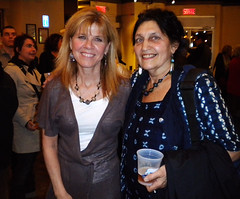
Dr. Danielle Perreault (gauche) avec Erica Pomerance

La Dr. Danielle Perreault et Erica Pomerance au lancement du film.

Erica Pomerance s’intéresse depuis longtemps à l’Afrique. En 1997 elle a réalisé le très beau « Tabala – rythmes dans le vent » sur la musique et la danse africaines à Montréal. En même temps, elle s’intéressait à la réalité des femmes africaines et avait amorcé une recherche sur l’excision, et surtout sur les gestes posés par les mouvements de femmes africaines qui s’y opposaient. Suite à presque dix ans de recherche et de travail acharné sur terrain, elle a sorti « Dabla ! Excision » avec la maison de production Virage et Monique Simard.

Depuis, elle a réalisé 4 autres films en l’Afrique : Miroir en Face (2006 Via Le Monde); Caravane (2008), auto-production avec l’intiative qu’elle a fondée, Taling Dialo, vouée à la formation vidéo en Afrique ; « Ndomo , Les Cinq Doigts de la Main » (2009), sur l’initiation des filles au Mali, co-réalisé avec Isabelle Garceau, et « Opération survie ».

Dans un contexte de production documentaire de plus en plus ardu, d’autant plus qu’elle parle de réalités lointaines, Erica possède une passion évidente et une détermination sans égal. Je la croise souvent alors qu’elle s’apprête à quitter le froid Canadien, caméra à la main, armée de la seule confiance qu’éventuellement elle trouvera le financement pour son nouveau projet.

À travers ses oeuvres et les réalités « autres » qu’elle nous fait connaître, Erica se mérite vraiment le titre de cinéaste engagée.
Seen at Hot Docs

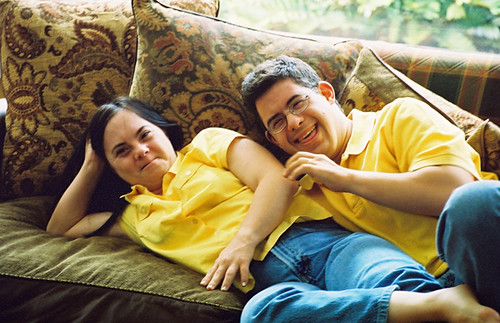
Monica and David_2
Monica and David

I was at Hot Docs in Toronto, now one of the world’s leading documentary festivals, all of last week. I wasn’t able to see some of the films I really wanted to see because of meetings. But here are a few screening notes.

The most surprising film I saw was Feathered Cocaine, an Icelandic film which starts out as a film about falconeering and falcon smuggling, then veers off into the drug trade, and finally ends up very convincingly proving that the U.S. authorities never really tried to catch their declared Enemy # 1, Ousama Bin Laden !

While the Americans claimed to be searching for him in Waziristan, he spent several months every year in meetings with his financiers in hunting camps in the Iranian desert, with his five falcons which were all equipped with radio emitters.

The U.S. authorities, including the CIA and the Pentagon, showed no interest in first-hand information about these facts. The story is no joke, it’s journalistically sound, backed up with solid evidence. Chapeau !

Another very impressive film: Secrets of the Tribe, a shocking story of how several generations of anthropologists have used unequal power relationships to take advantage of the Yamomami people of the Venezuelan rain forests. Medical experiments without informed consent, pedophilia, the building on scientific reputations and super-egos on the backs of unsuspecting aboriginals, it’s a real horror story.

As a reader of the world’s best newspaper, the Guardian Weekly, I was well aware of this story already. But the film tells it well and should be a must-see for the academic world.

But the most moving film I saw was Monica and David, a film about two young people with Downs syndrome who get married. As in any case where the social conventions are stripped away and you are confronted with strong emotions, this is captivating.

But in this case, the emotion is love, and the two young people show enormous courage in confronting their challenges -as do their mothers and other members of the family. I was very impressed by the quality of shooting, sound recording and editing in this first film by director Alexandra Codina. Great work !

ACodina2774
Director Alexandra Codina

I am leaving for a future post John Walker’s excellent film A Drummer’s Dream.

Thanks to Tobi Elliott for help with this post.

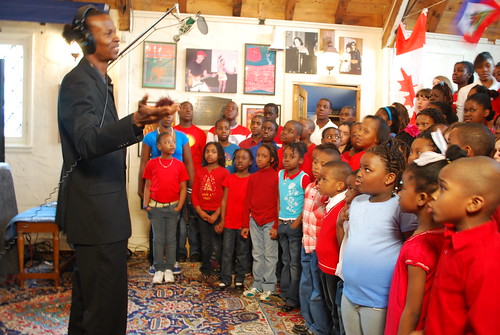
Singing for the children in Haiti

Géthro Auguste directs the children (Haiti).
Géthro Auguste directs the children. (Photo: Jocelyne Clarke)

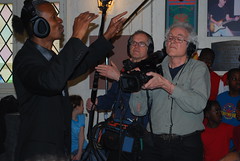
Over the last few months, Martin Duckworth and I have been shooting the rehearsals and recording sessions for a song for the orphans in Haiti, much more numerous since the January earthquake. The recording of the song is an initiative by Géthro Auguste, the head of a community cultural organization called Culture X in Montreal North, a neighborhood known as ‘underprivileged.’ It is home to the largest concentration of Haitians in Montreal, as well as immigrants from Latin America and North Africa – in addition to the Caucasian population. And the song: first, there will be a single, later a video clip. We are finding the whole experience very touching and inspiring, and I am thinking perhaps we could make a fifteen-minute film in addition to the music video. But where would we show the short film ? ( There is a link between these shoots and one of my film projects, more about that another time.)

Myself and DOP Martin Duckworth filming Géthro Auguste.

Thanks to Jocelyne Clarke (photos) and Jessica Berglund (blog assistance).

Lancement Les super-Mémés

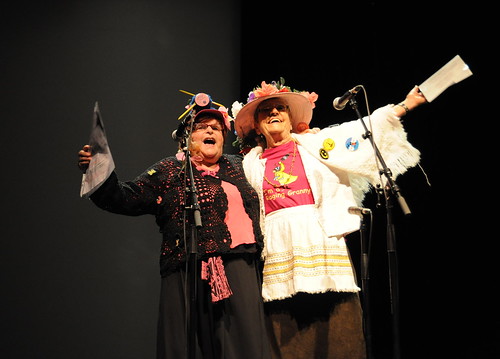
Louise et Marg, lancement QC4
Louise-Édith Hébert et Marguerite Bilodeau. Photo Marie-Pierre Savard.

Au cours des dernières semaines, nous avons lancé mon film Les Super-mémés, sur le mouvement des Raging Grannies et des Mémés déchaînées. C’est un film produit par Isabelle Couture et Ian Boyd aux films de l’Isle, avec une license cruciale de Canal Vie, et distribué par Vidéo-Femmes. Le film a d’abord été le film de clôture du Festival des films sur les droits humains, et a ensuite été lancé au Musée de la civilisation à Québec. Après six ans de travail et beaucoup de difficultés de financement, j’étais très touché de voir la réception du film à la fois par les journalistes et par le public. Paul Houde de FM 98,5 disait: ‘un super film, qui donne envie de vieillir dans la délinquence.’ Et à Québec, une spectatrice m’a expliqué l’importance du message du film de façon tellement éloquente que je lui ai demandé de mettre ces commentaires par écrit. La parole est à Thérèse Voisard:

Thérèse Voisard.726 copy
Thérèse Voisard

C’était la première fois que j’entendais parler de ce mouvement, qui allie l’humour à l’engagement social. Il s’agit, à mon avis, d’un mouvement qui gagne à être connu autant des personnes âgées que des plus jeunes.

….Ces dames peuvent s’autoriser un certain niveau de “délinquance” ou de désobéissance civile, qui ne serait pas toléré chez les jeunes. On n’utilisera pas de bâtons, de pistolets” taeser” ou autres contre des femmes de cet âge, au cours d’une manifestation”. alors que l’on hésitera pas à s’en servir contre des jeunes. De même on ne les jettera pas en prison et on ne les bousculera pas; ce que l’on hésitera pas à faire lorsqu’il s’agit de personnes plus jeunes. De plus, si elles peuvent déjouer et narguer la police, comme on l’a vu dans l’incroyable scène de canotage sur la Rivière des Outaouais, c’est grâce à leur sens de l’humour souvent beaucoup plus efficace que la violence. De même, leurs costumes très voyants leur assurent une visibilité à nulle autre pareille tandis que leurs chansons remplacent efficacement les cris de colères et les slogans agressifs. Leur âge leur assure aussi une crédibilité quant à la défense des valeurs nécessaires à la vie bonne. Elles en ont vu d’autres et savent d’expérience distinguer l’essentiel de l’illusoire sans que l’on puisse mettre leurs opinions sur le compte de l’inexpérience ou de la fougue irréfléchie de la jeunesse.

Ces impressionnantes “mémés” établissent sans contredit que ces avantages offerts par l’âge peuvent, comme le film le démontre si bien, être mis au service de la communauté.
Peut-être s’agit-il là du véritable rôle social des aînés.

Tous nos remerciements, pour ce magnifique film.

Thérèse Voisard

Launching French Granny film

Louise et Marg, lancement QC4
Louise-Édith Hébert and Marguerite Bilodeau, photo Marie-Pierre Savard

Over the past two weeks, we launched my French-language film on the Raging Grannies and Mémés Déchaînées, Les super-mémés. It premiered on the 20th of March as closing film for the Human rights film festival in Montreal, at the Park Cinema, and we had another launch screening in Quebec City at the Musée de la Civilisation. The film was produced by Isabelle Couture at Films de l’Isle and is distributed by Vidéo-femmes, based in Quebec City. We were able to make the film thanks to the support of Canal Vie, and more precisely Line Richard, now at the French production branch at the NFB. For several years, Line was the only person in the television world who supported this project while it was turned down by numerous English-language broadcasters. It is very heartwarming, after all the difficulties we had finding the funding, to see that the film is very well received both by journalists and audiences. Radio Host Paul Houde at FM 98,5 said: ‘This is a super film which makes you feel like being more of a delinquent as you grow old.’

Hommage à Macumba

Macumba International - the 3 founders
Patricio Henriquez, Robert Cornellier et Raymonde Provencher.

L’autre jour, à l’occasion de la remise du Prix Arthur Lamothe, dans le cadre du Festival de films sur les droits de la personne de Montréal, j’ai eu l’occasion de rendre hommage aux deux réalisateurs et la réalisatrice de Macumba International: Robert Cornellier, Patricio Henriquez et Raymonde Provencher. Vous trouverez l’ensemble de mon texte ici. Voici quelques extraits:

Depuis qu’ils travaillaient ensemble à l’émission Nord-Sud à Télé-Québec (Radio-Québec à l’époque), ils ont développé une compréhension profonde des défis auxquels font face les populations des pays du Tiers-Monde. Et ils ont développé des antennes: des sources et des canaux d’information privilégiés, qui leur permettent de proposer des sujets de reportages et de films inusités et pertinents. Inusités, pertinents, et aussi avec une orientation très claire en faveur des gens qui n’ont pas normalement accès aux grands moyens de communication. Depuis le tout début et jusqu’aux dernières productions, les gens qui n’ont pas le pouvoir et qui ont de la difficulté à se faire entendre sont au cœur de leur travail.

Robert, Patricio et Raymonde ont amorcé leur pratique du témoignage dans un réseau de télévision publique qui était capable d’y investir certaines ressources, ils l’ont continué en tant que producteurs indépendants en fondant en 1995 la compagnie Macumba International. Depuis, ils ont produit des émissions, des séries et des films documentaires dont l’excellence a été confirmée par de nombreux prix.

….. finalement, l’aspect de leur travail qui personnellement m’intéresse le plus: les documentaires d’auteur. Le premier que j’avais vu, c’était celui de Patricio 11 septembre 1973 : Le dernier combat de Salvador Allende, sorti en 1998. Le film a reçu 17 prix, et j’ai eu le plaisir de pouvoir en rapporter un pour Patricio du festival de Mumbai. War Babies…nés de la haine, de Raymonde témoigne du sort des enfants issus du viol lors de conflits armés – le film a gagné quatre prix Gémeaux 2003; Marée noire, l’héritage de l’Exxon Valdez, de Robert s’est récemment mérité le Gemini Award dans la catégorie meilleure réalisation documentaire. Et il faut absolument mentionner : Sous la cagoule, un voyage au bout de la torture, le film de Patricio qui a reçu le JUTRA du meilleur documentaire en 2009.

Le travail que font ces trois réalisateurs de Macumba est précieux et essentiel. Mais pourront-ils continuer à le faire? Le contexte de production n’est guère encourageant, et les possibilités de financement des documentaires se rétrécissent comme peau de chagrin. Est-ce que cette détérioration des conditions de production arrêtera nos amis Patricio, Raymonde et Robert? Ce serait mal les connaître. Mais disons qu’après trente-cinq ans de travail acharné, ils mériteraient mieux que d’avoir à se battre pour chaque nouveau projet comme si c’était leur premier.

ANY_CHARACTER_HERE

Merci à Jessica Berglund pour l’aide avec le blog.

A quoi bon un petit festival ?

The Day God Walked Away
Le jour où Dieu est parti en voyage

On dit souvent qu’il y a bien trop de festivals de films. Non seulement il doit y en avoir à peu près 10.000 dans le monde, mais dans une ville comme Montréal il y a presque toujours un festival en cours. Présentement, les Rendez-vous du Cinéma à peinte terminés, le FIFA ( Festival des films sur l’Art ) commence, alors que le Festival des films sur les droits de la personne bat encore son plein. Et ce festival, tenu à bout de Bras par Diya Angeli avec une équipe bien réduite, montre parfaitement pourquoi ces petits festivals méritent leur place. Jour après jour, la programmation est excellente, il y a plein de monde dans les salles, on a l’occasion de voir des films qu’on ne verrait pas autrement, et il y a des discussions animées aprés les films. C’est l’occasion de prendre conscience d’enjeux liés aux droits de la personne partout au monde. Parmi les excellents films que j’ai eu l’occasion de voir cette semaine il y avait l’excellent film d’ouverture, Le Jour ou Dieu est parti, un film sur une survivante du génocide au Rwanda qui donne l’impression d’être un film de maturité mais qui est en fait la première réalisation du directeur photo Philippe Van Leeuw.

Reporter
Reporter par Eric D. Metzger.

Il y avait Reporter, aussi un excellent film sur le journaliste Nick Kristof, celui qui a porté le génocide du Darfour à l’attention du monde et qui s’est deux foix mérité le prix Pulitzer. Un film bien construit, avec une narration exemplaire, sur un ton personnel. Et hier soir j’ai vu El Sistema, un film un peu trop long mais quand même exellent, sur le mouvement de musique pour les jeunes dans les bidonvilles au Vénézuela. Nous avons besoin de ses films, et besoin de ces festivals. Évidemment, on pourrait dire que je prêche pour ma paroisse, puisque mon film Les Super-Mémés est le film de clôture du festival. Je reviendrai sur le sujet.

Merci à Jessica Berglund pour l’aide avec ce blogue.

Challenge for Change revisited

Filgate-Duckw.DSCN0716 copy
The Zebra never loses its stripe: Martin Duckworth and Terence Macartney-Filgate check out a new camera.

Last weekend I attended the launch of Challenge for Change: Activist Documentary at the National Film Board, an anthology edited by my friends Tom Waugh ( Concordia Film Studies professor, in red shirt) and Ezra Winton (Cinema Politica Founder, to the right in picture) along with McGill PhD student Michael Brendan Baker.

Threestooges2.DSCN0700 copy
The authors Michael Brendan Baker, Tom Waugh and Ezra Winton.

Challenge for Change ( Société Nouvelle on the French side) was a groundbreaking National Film Board of Canada program, exceptionally progressive for a government institution, aiming at putting film and later video at the service of active citizens and their movements, and even sometimes giving them varying degrees of control over production. Many of the veterans of Challenge for Change participated in the launch event, while the francophones from the French program équivalent Société Nouvelle – some of them leading filmmakers like Maurice Bulbulian, Anne-Claire Poirier and Fernand Dansereau – were practically all absent, each for their own reasons. The authors had wisely decided to show clips from films made by those who were present, which made for some interesting presentations and comments. As there is a digital program playlist for Challenge for Change on the NFB site, created for this occasion, I won’t ask my assistant Jessica to link to all the individual film titles here. Among those who presented clips from their films were Colin Low ( Billy Craig Moves away), Terence Macartney-Filgate ( Up Against the System), Challenge for Change Executive Director 1968-70 George Stoney and Mike Mitchell (You’re on Indian Land), Dorothy Hénaut ( VTR St.Jacques), Martin Duckworth ( Cell 16), Peter Pearson ( Encounter with Saul Alinsky), Adam Symansky ( producer of Paper Wheat) and Francine Saia ( A qui appartient ce gage.)

Dorothy.DSCN0702
Dorothy Hénault

Stoney.DSCN0691 copy
George Stoney

It was great to meet these old-timers from Challenge for Change, and to see that some of them are still active and just can’t stop shooting. I thought it would have been interesting to have a discussion, notably to compare what was done during those heady years with what is done now with digital technologies and the web 2.0 interactivity, but time was up and we had to settle for refreshments and smalltalk. Presumably in the 38 articles and 500 pages of the book one will find many elements to enrich this discussion. Anyway, congrats to the authors for finishing a huge research and editing job, and for documenting this very important experience.

Publsiher: McGill-Queen’s University Press.

For Montrealers: you can buy the book at the Concordia Community Solidarity Co-op Bookstore.


Thanks to Jessica Berglund for the help with this blog.

The Reboot Experience and the guinea pigs.

The_Guinea_pig_detectives_coverpage
Guinea pig detectives cover page. Illustration by Pierre Durand.

Together with my friend and colleague Patricia Bergeron I spent last week in intensive consultations about cross-platform documentaries – meaning documentaries which aren’t just a film or a TV program but also play themselves out on the web, including in the social networks. ( Cross-platform or transmedia is different from multi-platform in that the content actually varies from one platform to the other, making for complementary parts of a greater whole.) With our project Guineapig Detectives – about citizen investigations of new forms of advertising – Patricia and I were finalists in the Reboot competition organized by DOC Canada. I will tell you more about our project at a later date but the graphics will give you some hints. As finalists we had the privilege of several sessions with pioneers of multi-platform production and even ARG‘s – alternate reality games. Among the mentors were moderator and Reboot organizer Brett Gaylor ( the director of Rip! A Remix Manifesto), Evan Jones of Stich media, Katarina Cizek who made a Filmmaker-in-Residence at the National Film Board and Lance Wieler, a partner in Seize the Media. You can actually see presentations by these people on the DOC web site, along with the keynote by digital distribution pioneer Robert Greenwald. Since Patricia is herself a new media expert ( lots of good material on her blog about the subject !), I am sure I learned more than anyone else during this week which ended very well indeed, because Patricia and I actually won the coast-to-coast competition ! Thanks Jessica Berglund and Franck Le Coroller for research help with the project.

The_Guniea_pig_Detectives_plan
Guinea pig detectives cross-platform overview.

New directions 1: short film competitions on the web

Béth5
Béthièle when she was five.

A documentary filmmaker in Canada today might be forgiven for being discouraged. The combined impact of the crisis of television, the more general economic crisis, and the Conservative government’s policies are having a devastating impact on our traditional sources of funding. There is definitely a ‘paradigm shift’ underway. New models of production and financing will surely emerge, but the transition is in many ways painful and the future uncertain. One way or the other I strongly believe there will still be a place and a role for documenting what goes on in society, and for making films which will contribute to public debate. And I would say, observing my own decision-making process so to speak, that I am in the process of finding new directions. In addition to one more traditional film project, I am beginning to explore multi-platform production ( more on that another day) and filmmaking for the web. In this process, I am learning a lot from my younger colleagues and not the least my interns.

I meant to participate in the short film competition about public service, organized by the CSN – deadline a few days ago. But my plans fell through due to the absolutely exceptional circumstance of no substantial snow fall in Montreal for almost a month. ( Last year we had four meters of snow !) Nonetheless, I extend my heartfelt thanks to the Société de Transport de Montréal and their employees who generously helped me prepare for a shoot which had to be put off to another year. On the other hand i will participate in the short film competition Roots, organized by RCI. This is a terrific idea, an initiative which will allow Canadian citizens from different background to tell their stories – or the stories of others, as you can already see on their web site. My contribution will be a video-letter to my daughter Béthièle who was born in Haiti and whose tenth birthday pretty much coincides with the competition deadline.

Thanks to Jessica Berglund for the help with this blog.