PIB/GDP: Une conversation avec Hélène Choquette

PIB/GDP: 'Une chance qu'il y a des mots'

An English version of this blog post will follow shortly, with thanks to Tobi Elliott.

Cette semaine: suite à mon petit texte sur le projet multi-plateforme PIB: L’indice humain de la crise économique canadienne de l’ONF, voici une entrevue avec Hélène Choquette, la réalisatrice-coordinatrice du projet.

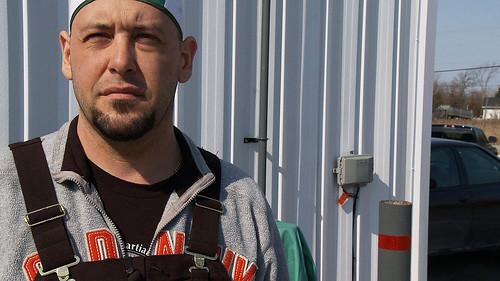
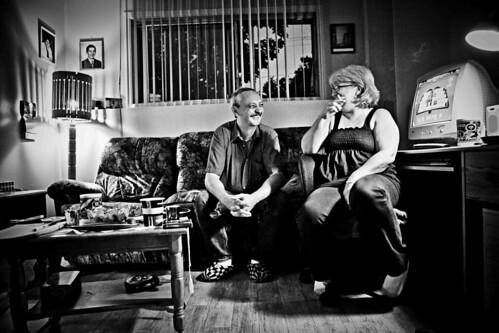
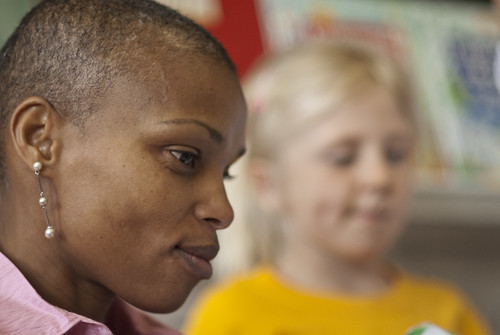
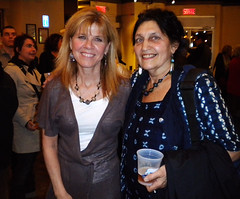
L’image ci-dessus est tiré de l’excellent photo-essai “Une chance qu’il y a les mots,” qui a comme sujet la jeune slammeuse Marjolaine Beauchamp. C’est une des composantes du projet PIB que Hélène a réalise elle-même.

1. Quelle a été la plus grande difficulté, le plus grand défi du projet PIB? Faire ça bilingue, à travers les solitudes, “coast to coast”? Ou d’autres choses?

Constituer une équipe de documentaristes et de photographes d’un bout à l’autre du pays autour d’un projet commun pendant un an était un défis en soi. Nous avons passé une semaine ensemble en juin 2009 où je leur ai présenté les bases du projet et où tous et chacun a pu partager son point de vu créatif.

Au-delà du bilinguisme, PIB propose des histoires humaines universelles. Quand on regarde la provenance des visionnages, les Québécois ne regardent pas que les films québécois et ainsi en est-il dans toutes les provinces. La résilience et les autres forces dont un humain doit faire preuve lorsque confronté à des situations de crise sont assurément universelles.

Nous avons également constaté que les internautes se reconnaissent dans les récits de gens qui travaillent dans des secteurs d’activité similaires au leur sans égard à la location géographique. En fait, le fait que le site soit bilingue, nous a permis de contrer cet écart linguistique.

J’ai aussi envie de te faire part des qualités du Web que nous avons découvert. Nous n’avons aucune restriction de durée, de nombre d’épisodes ou de cadence de mise en ligne. Nous suivons simplement le rythme naturel de nos histoires et ça c’est franchement merveilleux.
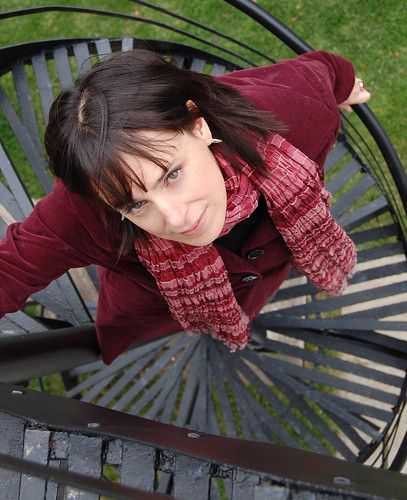
Hélène Choquette - PIB/GDP
Photo Crédit : Marc-André Grenier

2. Je trouve la qualité des petits films ou reportages très inégale, qu’en penses-tu? Raisons?

PIB est un projet pilote où essai et erreur ont une place. Quand il est question de processus créatif, cette notion d’essai/erreur est précieuse. C’est d’ailleurs ce qui a interpelé Fernand Dansereau lorsqu’il a découvert PIB en décembre dernier. Cette possibilité de jouer en dehors d’un cadre établit et sécuritaire.

On demande aux réalisateurs d’être homme-orchestre. Ils font à la fois leur caméra, leur prise de son et évidemment, la réalisation. C’est extrêmement exigeant. Certains sont plus forts techniquement, mais malgré ces limitations techniques, tous parviennent à pénétrer dans l’univers de leur protagoniste.

Bien sur, certaines histoires sont plus fortes, mais toutes ont une pertinence. Ce constat d’inégalité est malheureusement souvent le lot des oeuvres chorales. Cependant comme nous sommes sur le Web, l’internaute a le choix de regarder uniquement ce qui l’intéresse.

C’est étonnant de voir que les films et les essais les plus visionnés ne sont pas toujours les meilleurs d’un point vue technique et même narratif. C’est là une nouvelle donne du Web. L’internaute choisi ce qui lui plaît. Comme documentariste, j’aimerais les inciter à s’intéresser à une histoire plus qu’à une autre, mais je n’ai plus cet aval sur ce public virtuel.

3. Il y a des essais photo qui sont particulièrement réussis, es-tu d’accord? Raisons?

Les essais photographiques avaient pour but premier de documenter les impacts de la crise en régions éloignées. Ce sont des petites oeuvres uniques, donc beaucoup plus faciles à regarder à la pièce alors que la courbe narrative des films évolue pendant un an et prenne leur sens dans le temps. Ils ont une formidable force artistique.

Le web donne effectivement un souffle nouveau à certains médiums qui l’on précédé. La photographie retrouve un souffle nouveau, les photographes ont la chance de pousser leur créativité plus avant et cela m’enchante.

Merci à Tobi Elliott pour l’aide avec le blog.
G-20 Police violence: No escaping the citizen camera

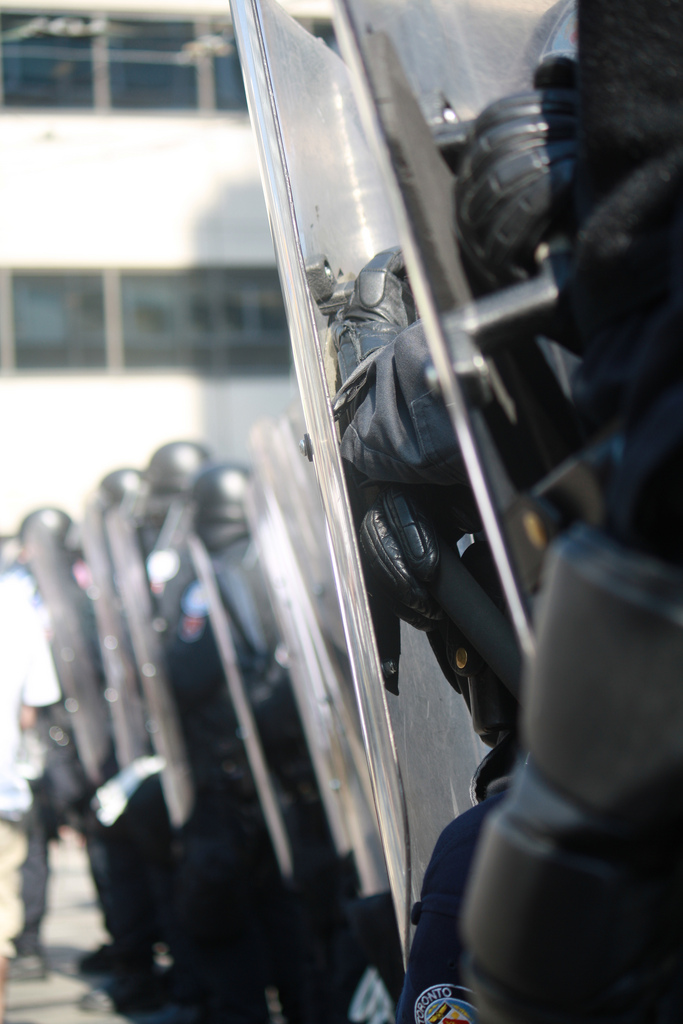
Riot police G20 Toronto
Riot police on the streets of Toronto for the G20 summit. Photo taken on June 25, 2010 by Katerkate (Flickr CreativeCommons)

Pioneering cinematographer Dziga Vertov (the Camera Eye) dreamed of an omnipresent camera, one which could look at reality from all angles and at all times. Could he ever have imagined today’s reality, with everyone recording video on their cameras and cell phones?

As Quebec filmmaker Philippe Falardeau says, we are in the age of “tout le monde filmant, tout filmé.” (“Everyone filming, everything filmed.”) And we have known since the 1991 case of Rodney King, a black man savagely beaten by police in which an amateur video proved there was a police cover-up, that video is now a precious tool for democracy and against repression.

Katarina Cizek and Peter Wintonick made a film about this ten years ago or so, (Seeing is Believing, 2002) and since then cell phones and social networks have caused the citizen camera phenomenon to grow exponentially.

The latest case in point is the way the scandalous brutality of the police intervention at the Toronto G20 summit was documented on video. For a good first-hand account and commentary by Ezra Winton (Cinema Politica, Art Threat) rest here.

I have had my share of experiences shooting at political summit meetings. With my friends Anna Paskal and Malcolm Guy, I made Pressure Point, about a civil disobedience action at the 1998 Montreal Conference. I documented the Summit of the Americas in Quebec City in 2001 with the help of six other directors and crews. (View from the Summit, co-produced by Erezi and the NFB.)

And I was at the Montebello summit in 2007, filming with the Raging Grannies. That’s where a police agent provocateur was caught on camera, providing conclusive proof – for those who still doubted it – that fueling violence to discredit and criminalize dissent is indeed a police tactic.

In Toronto, the authorities needed to show that there was serious trouble. How else would they justify spending more than a billion dollars on security?

Filmmaker Paul Manly and the Communications Energy and Paper Workers Union provided these links to images from the police intervention in Toronto. Watch and draw your own conclusions! Their comments included.

And there is quite a lot of conjecture about the footwear worn by some of the supposed Black Block smashers. It is rumoured that the police collective agreement specifies that regulation footwear be worn on the job no matter what, and it does seem that the smashers were wearing footwear that looked very like police footwear….
http://globalresearch.ca/index.php?context=va&aid=19928

http://www.youtube.com/watch?v=u6XgEI5dCrE
This video shows police dressed as anarchists helping with arrest raids at Queens park.

http://www.youtube.com/watch?v=CaoDCPDrQ18
http://www.youtube.com/watch?v=Ru4V3dPJGYw
This series shows police near police cars at King and Bay before the cars get trashed.

http://www.youtube.com/watch?v=xeU8ObPrI3I
http://www.youtube.com/watch?v=1M2NKWve-z4
http://www.youtube.com/watch?v=VlqHTUz3C9g
This series shows riot police half a block away from Young and College doing nothing.

http://www.youtube.com/watch?v=WjOMYlsVNCo

This is another angle of the police cars at Bay and King before the black bloc arrive – police had lots of time to act but didn’t.

http://www.youtube.com/watch?v=oMbWTc4pmUo

Thanks to Tobi Elliott for her help with this blog.

The crisis ad marem usque ad marem: the NFB’s GDP web docs

PIB/GDP: 'Famille à la casse'
Copyright: ONF/NFB

This week at Sunny Side of the Doc at La Rochelle, the NFB and Arte.tv France announced a collaboration for the production of webdocumentaries. They will produce one documentary per year, with a budget of $100,000 CDN. The two companies already have considerable experience with webdocs.

For almost a year, the NFB has hosted a major online project, GDP – Measuring the Human Side of the Canadian Economic Crisis. The NFB’s director of French programming, Monique Simard, a longtime union leader and former politician known for her involvement with social issues, took the initiative for this endeavor.

From the beginning, her intuition was that the economic crisis would not be a passing thing, but would profoundly affect the lives and directions of many people. The GDP project allowed many filmmakers and photographers across the country to follow people affected by the crisis. I haven’t had a chance to look at all of the stories, naturally, but here are some initial impressions.

First off, the site’s architecture is impressive, as is its design. We have access to stories told in both official languages, with subtitles as needed. You can watch multiple episodes in the order of choice. You can comment, share, and use social media tools to talk about the stories.

As for the content, I found it very uneven generally. There are some excellent stories, such as “Auto-workers at a crossroads“, the story of a couple who both work in the auto industry in Oshawa, Brian and Cassandra, who lose their jobs and must fight to survive. It’s very much in the documentary tradition, without the dramatic structure but in exchange having the advantage of following their story over time in several episodes.

The same goes for a report on an immigrant family who are staying in a motel in British Columbia – we enter in their universe, we understand the challenges they have to surmount, and their emotions. Occasionally a series starts well, like the story of a group of young women in the West who are trying to get out of debt – but at a certain point nothing much happens, the story isn’t going anywhere. In addition there are some stories that don’t reveal much of anything, neither a strong human story, nor strong production values.

Daniel Poulin / St-George de Beauce
Copyright: ONF / Photo : Renaud Philippe

One of the positive surprises of this project is the quality of the photo essays, produced notably by Renaud Philippe in Quebec, Brian Howell in Vancouver, Goh Irotomo and Craig Chivers in Toronto. The above photo is taken from one of Renaud Philippe’s photo essays titled “Willpower is power.”

Next week: a conversation with Hélène Choquette, director and coordinator of GDP/PIB.

Thanks to Tobi Elliott pour her help with this post.

La crise économique ad marem usque ad marem: PIB

PIB/GDP: 'Famille à la casse'
Copyright: ONF/NFB

Cette semaine à Sunny Side of the Doc à La Rochelle, l’ONF et ARTE France ont annoncé une collaboration pour la production de documentaires pour le web. Ils produiront un documentaire par année, avec un budget de 100.000 $ Can. Les deux ont déjà une expérience considérable avec les webdocs.

Depuis presque un an déjà, l’ONF a mis en ligne un projet majeur, PIB – L’indice humain de la crise économique Canadienne. La Directrice du programme français, Monique Simard, une ancienne dirigeante syndicale et politicienne dont les préoccupations sociales sont bien connues, a pris l’initiative de cette expérience.

Son intuition de départ: la crise économique ne serait pas passagère, et elle serait assez profonde pour changer le cours de la vie de beaucoup de gens. Le projet PIB a permis à beaucoup de cinéastes et photographes à travers le pays de suivre des personnes affectées par la crise. Je n’ai pas regardé tout, évidemment, mais voici quelques impressions.

D’abord, l’architecture du site est impressionnante, le design aussi. On a accès aux histoires racontées dans les deux langues officielles, avec sous-titres au besoin. On peut voir des épisodes multiples dans l’ordre qu’on choisit. On peut commenter, partager, utiliser les médias sociaux pour en parler.

Pour le contenu, je l’ai trouvé très inégal. Il y a d’excellentes histoires, comme ‘Famille à la Casse’, l’histoire d’un couple formé d’un travailleur et une travailleuse de l’automobile, Brian et Cassandra, qui perdent leurs emplois et doivent se battre pour survivre. C’est très dans la tradition du documentaire, sans la structure dramatique mais en échange l’avantage du suivi de l’histoire à travers les épisodes.

La même chose vaut pour un reportage sur une famille immigrée qui tient un motel en Colombie Britannique – on rentre dans leur univers, on comprend les défis qu’il doivent relever et leurs émotions. Parfois une série commence bien, comme cette histoire d’un groupe de jeunes femmes dans l’Ouest qui tentent de sortir de leur endettement – mais à un moment donné il ne se passe plus grand chose, on tourne en rond et on fait du remplissage. Et puis, il y a malheureusement des histoires qui ne donnent pas grande chose, ni côté humain ni côté production.

Daniel Poulin / St-George de Beauce
Copyright: ONF / Photo : Renaud Philippe

Une des plus belles surprises de ce projet est la qualité des reportages photo, réalisés notamment par Renaud Philippe à Québec, Brian Howell à Vancouver, Goh Irotomo et Craig Chivers à Toronto. La photo ci-haut est tirée justemment d’un reportage de Renaud Philippe intitulé ‘Le vouloir c’est le pouvoir’.

La semaine prochaine: une conversation avec Hélène Choquette, la réalisatrice qui coordonne PIB/GDP.

Merci à Tobi Elliott pour son aide avec ce blog.

Qimmit – the mysterious disappearance of the Inuit’s sled dogs

Joelie Sanguya's dog team

Last Friday night, Ole Gjerstad‘s and Joelie Sanguya‘s film Qimmit: A Clash of Two Truths premiered at the Cinéma Parallèle as part of the Présence autochtone aboriginal film festival.

Co-produced by Piksuk Media Inc. and the National Film Board of Canada, the film won the Rigoberta Menchu Second Prize at the 20th First Peoples’ Festival Awards.

Qimmit (“many dogs”) is the story of the seemingly mysterious disappearance of the dog teams in the Inuit communities of the Canadian north in the ’50s and ’60s, shortly after the Inuit were moved off the land and into communities. The film, sets out to tell the story of “one shock, two truths” as the Inuit and the ‘white’ authorities totally disagree on what happened.

Shot during a Quebec inquiry (for Nunavik, the Quebec Arctic territory) and a “truth commission” for Nunavut (the rest of the Eastern Canadian Arctic) the film is full of emotionally wrenching testimony. For the Inuit, there is no doubt that the authorities, and specifically the police, exterminated the dogs in order to force the aboriginal people to become sedentary.

The former constables interviewed for the film denounce these views as lies and fabrication. But the Inuit testimony is very convincing, and the filmmakers wisely see this whole story as an expression of a colonial power relationship. The film is very well made with some stylish and evocative but restrained re-enactments.

Ole Gjerstad and Joelie Sanguaya in Canadian North
Ole Gjerstad with Joelie Sanguya on the set of their film ‘Qimmit: A Clash of Two Truths'

I put a few questions to Ole Gjerstad, who also happens to be one of my best friends.

What was the greatest difficulty making this film?

To convey to an audience in 2010 the colonial reality of the Canadian Arctic forty to fifty years ago. White authority simply took it for granted that they knew what was best for Inuit; Inuit were too intimidated by white authority — as embodied by any white person in their communities — to protest or resist. Things have changed dramatically, but if we cannot get the minds of the audience back to those days it will be very difficult for them to understand how something like this could happen.

“One shock, two truths…” but in the end the Inuit version is so much more believable, partly because it’s emotional first-person testimony. How to explain that the ex-RCMP have blocked this out?

The RCMP produced an internal review, which was conducted much like a police investigation, looking for “proof” and pretty much excluding the context. Add to that the many controversies and scandals that have plagued the RCMP in recent years, and I believe that the top RCMP brass decided the Inuit claims weren’t of much consequence. As for the Sûreté du Quebec, which was responsible for the killing of thousands of dogs after they assumed control of Nunavik in 1961, they simply ignored our requests, as did the Quebec government, saying they didn’t want to discuss the matter until they heard from the Inuit about settling the claims.

I wondered when you say the dogs are back in the lives of the Inuit helping to reconnect with their traditions – it is of course a great thing to say at the end of a film, but is it a reality in many communities?

There are dog teams now in nearly all the communities in Nunavut and Nunavik. They’re used by Inuit outfitters for tourism, for trophy hunting by foreigners, by others for teaching traditional skills to young Inuit, and simply for pleasure. Nobody depends on the dogs to survive, but their return to the communities have established a visible link to a tradition that was at the heart of Inuit life not so long ago.

Last month we filmed a ten-day traditional sled dog race, the Nunavut Quest, for a television series. The enthusiasm and level of interest in all the communities involved leaves me in no doubt that the dogs are like a weapon in Inuit hands to fight against cultural obliteration.

Thanks to Tobi Elliott for her help with this blog.

multi-platform: just another way to tell a story?

Gaza Sderot Arte.tv
arte tv's webdocumentary 'Gaza/Sderot: Life in spite of everything' can be found at http://gaza-sderot.arte.tv

I have heard many people say that multi-platform production is ‘just another way to tell a story.’ It sounds simple, clear-cut, reassuring.

But is that it? I think not. There is a huge difference in the way you can communicate content with a multi-platform project.

When you tell a linear story, you are grappling with some time-honoured issues such as dramatic structure, character development, narrative progression, resolution. I have struggled with these for so long, in so many projects, that I feel they have become second nature. Now, when I approach a film idea, I look at it from that angle right away, not just as a subject or a theme or an issue.

But in conceiving a multi-platform project, you are NOT just telling a story, you are conceiving an experience. Not even just a viewer experience, but – due to the interactivity of Web 2.0 – a user or participant experience.

I worked with producer Patricia Bergeron for a couple of months, and learned from her that the user experience is central to any multi-platform experience. (Patricia has many excellent texts about cross-platform production on her Delicious account.) As the winners of the DOC Reboot contest, we had the opportunity to consult with several leading experts in the field, and with Brett Gaylor of Eyesteel films. (See my previous post.)

But one of the best explanations I have heard of multi-platform production was provided at an NFB panel at Hot Docs a few weeks ago, by Hugues Sweeney and Rob McLauglin, respectively from the French and English production branches of the NFB.

Said Sweeney: “In multi-platform, the creator is an architect. Even before shooting, he/she has to edit, to conceive a space into which the user can come to live an experience. The role of the author really is to define that experience. This means a lot of preparation, and you have to think of the audience as being actively involved in the experience.”

For my own work, I certainly hope to continue making feature length documentaries. But I see multi-platform production as a way to actually bring back many of the things I felt I had to sacrifice in making a film: the context and background, information about issues, debates and points of view on the subject. I think actually that films sometimes aren’t as good as they could be because they try to incorporate too much of this kind of material in a linear story.

Now, with the possibility of exploring these kinds of materials on the other platforms, we could feel even freer to focus a film on excellent storytelling.

Provided, of course, that there is continued support and funding for linear docs as well as the new platforms.

Thanks to Tobi Elliott for her help with this blog.

The Socalled Movie

Socalled and The Socalled Movie
Socalled performed following the Montreal premiere. Photo by Emilie Nguyen Ngoc.

I went to see Garry Beitel’s film The Socalled Movie when it premiered in Montreal a few days ago. A terrific evening: great film, great audience, all very Montreal. The post-screening Q & A was followed by a concert by the film’s main character, musician Socalled (aka Josh Dolgin) with his band.

Socalled is a truly original creator of hard-to-classify music which (to borrow a few lines from the press release) mashes up funk and hip-hop with Jewish klezmer. “Socalled is a pianist, singer, arranger, rapper, producer and composer – and also a magician, filmmaker and visual artist – a creative force who blasts through the boundaries that separate music of different cultures, eras and generations.”

Josh is funny, creative, touching, and unstoppable. Garry Beitel sees the star of his film as having “an amazing ability to take great music from the past and plug it into the current moment.”

Socalled Movie - NFB still

The Socalled Movie is structured in neat little chapters, inspired by François Girard’s Thirty-two Short Films About Glenn Gould (1993). In spite of this, the film has real unity and a dramatic arc that really works. During the Q&A, Garry said he felt this approach was appropriate because the main character is such a multi-talented chameleon: “Just when you think you’ve figured out who he is, you discover another dimension which challenges your perception.”

Seeing Garry’s film, I had a sense of a filmmaker having reached real maturity. Everything about the film breathes experience and long-standing collaborative relationships – notably with DOP Marc Gadoury and editor Dominique Sicotte, who both did fantastic work.

The film was produced by Barry Lazar (reFrame Films) and Ravida Din (The National Film Board of Canada.)

The Socalled Movie begins its cross-Canada theatrical run June 4 – 11 here in Montreal @ Cinéma du Parc (3575 Ave. Du Parc), and June 5 – 8 & 10 @ CinemaSpace, Segal Centre (5170 Cote-Ste-Catherine).

It opens in Quebec City June 4 @ Le Clap (2360 chemin Sainte-Foy) and plays New York City’s NewFest June 08 @ JCC in Manhattan (334 Amsterdam Avenue.)

Other release dates on the film’s blog here.

Thanks to Tobi Elliott for help with this post.

The multi-platform revolution

Prison Valley webdocumentary (screengrab)

This is a still taken from an excellent interactive web documentary, Prison Valley by David Dufresne & Philippe Brault, produced by arte.tv and upian.com, in partnership with FranceInter, Libération.fr and Yahoo.com.

The world of documentary production is in the midst of an upheaval, the likes of which have not been seen since the coming of cinema vérité/direct cinema in the first years of the sixties.

Digital technology and the Web 2.0 has meant that virtually anyone can be a content producer – or filmmaker – and that the user can express opinions and interact with other producers. We are no longer limited to watching programs on TV at predetermined times – and with commercial breaks.

There is no longer “an audience,” there are audiences. What used to be small niche audiences on a given territory can now be a substantial global audience. It is a revolution, and as all revolutions it comes with pain and loss as well as increased freedom.

We are experiencing this transition in quite a radical way in Canada right now, because government agencies such as the National Film Board and the new Canadian Media Fund have decided to invest heavily in multi-platform production.

Some filmmakers are focusing on the negative consequences. I think this is a mistake, because multi-platform production opens the door to new ways of reaching and audience, and new ways of telling stories. I don’t see these as replacing the traditional ‘linear’ stories but rather, complementing them.

But even this means a substantial change in the way we work.

More on this another day, as I will review several of these multi-platform projects and interview their authors.

Thanks to Tobi Elliot for help with this post.

Marcel Simard’s last film

MARCEL SIMARD, filmmaker
Director Marcel Simard

There is a reason why I write this in English. Most francophones in Quebec who take an interest in cinema will already be aware of what I’m about to tell you.

“There are adults who have antennas for the secret pain of our little ones – forms of suffering that are often taken to be unimportant.” Those are the opening words of Marcel Simard’s last film, spoken by himself. ‘Last film’, because Marcel is no longer with us.

Like the people he portrayed in his films, Marcel was incredibly sensitive. The sometimes overwhelming challenges of being alive and people who were close to the edge were not only his subjects, they were also an inescapable part of his own life. As he said in a statement read at his funeral, this suffering had become unbearable, and he wasn’t able to face it one more day. He isn’t here to enjoy the success of his film.

Le petit monde d’Elourdes, the title of Marcel’s beautiful film, is a play on words. It means Elourdes’ children, or Elourde’s little world. It follows the first- to third-grade students of a special Montreal school, and their incredible teacher Elourdes Pierre over a period of a year.

Elourdes Pierre, Montreal teacher
Montreal teacher Elourdes Pierre

A woman of colour, Elourdes is beautiful, sensitive, intelligent and caring. With infinite patience she attends to all the seemingly small dramas that play themselves out among the children. Many of them revolve around the conflicts between the girls who often seek exclusive friendship (a father of two daughters, I am very familiar with this. Margaret Atwood has written about it…), but others have to do with the aggressiveness of some of the boys.

For the children these are deadly serious issues, and Elourdes – just like Marcel – understands this. Her interaction with the children is beautifully filmed by Arnaud Bouquet – and kudos to sound man Pierre Duplessis who doesn’t miss one word of what the children say, or sometimes whisper.

In a very moving scene Elourdes explains her agenda: if she can teach these children to resolve their conflicts here, at this age, without violence or residual resentment, they will have learned a skill for life, and our world will be better for it.

In following the class for a year, this film resonates with other French-language films like Être et Avoir and La classe de Mme Lise. In its study of human motions as expressed at an early age, it is reminiscent of Claire Simon’s La récréation.

I made three films with Marcel Simard and his wife Monique Simard, at Les Productions Virage. (For titles see my web site.) Virage produced many of the best social-issue documentaries in Quebec. I loved Marcel’s understanding of people (he seemed to see right through any kind of façade or disguise, seeing people’s soul…) and of cinema.

Like a lot of Quebec filmmakers, social workers and people involved in fights for social justice, I will miss him enormously.

Erica Pomerance and the challenges facing African women

Erica Pomerance: 'Mère et enfant'

Regular guest blogger Jocelyne Clarke wrote this about a very committed Montreal filmmaker.

At the recent edition of Vues d’Afrique, I attended Erica Pomerance’s just completed film, ‘Opération Survie’, about a medical condition that affects approximately two million women worldwide : obstetrical fistula.

Generally associated with primitive birthing conditions, delivery complications and inadequate health care, the condition leaves women incontinent, and as a result, socially excluded. In Africa, excision and genital mutilations, still practiced on young girls in many regions, are also a factor.

The film was made with the collaboration of Dr. Danielle Perreault, a Quebec emergency doctor, television commentator and photographer with a special interest in women’s health, who travels worldwide to educate and train. The film partially takes place in a center where women live while awaiting the simple surgery that will often enable them to re-integrate normal society. Sadly, many women are so damaged by repeated childbirths that they will never recover normal bodily functions.

Dr. Danielle Perreault (gauche) avec Erica Pomerance

Dr. Danielle Perreault and Erica Pomerance at the film’s launch.

Erica has a long term interest in Africa. In 1997, she directed ‘Tabala – Rhythms in the Wind’, about African music and dance culture in Montreal. Simultaneously, she had developed an interest in the realities of African women and begun research on female circumcision, and particularly on the work being done by women’s organizations in Africa. Following ten years of research and on the ground work, ultimately collaborating with Monique Simard and Virage Productions, she released ‘Dabla! Excision’ (2003).

Since then, Erica has directed four films in West Africa, including ‘Opération Survie’: Miroir en face‘ (2006, Via le Monde); ‘Caravane’ (2008), self-produced with the Taling Dialo initiative, a video training association she founded, and ‘Ndomo, les cinq doigts de la main’, about girls’ initiation in Mali, co-directed with Isabelle Garceau.

In the extremely and increasingly difficult context of documentary production, even more so given the « distant » nature of the realities she explores, Erica’s passion and determination are an inspiration. I often see her just as she is about to board a place to West Africa, small camera in hand and hopeful that the funding will eventually be found for some new project.

Her films and the personal commitment she brings to them offer precious glimpses into « other » worlds, both sobering and inspiring.