Qimmit – the mysterious disappearance of the Inuit’s sled dogs

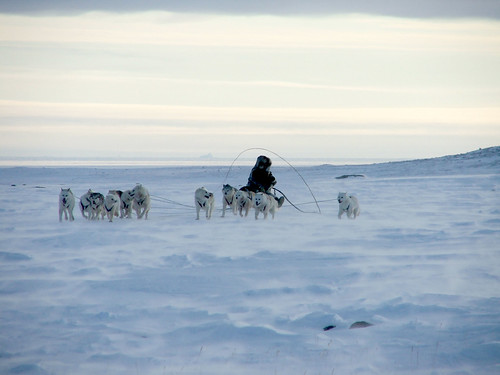
Joelie Sanguya's dog team

Last Friday night, Ole Gjerstad‘s and Joelie Sanguya‘s film Qimmit: A Clash of Two Truths premiered at the Cinéma Parallèle as part of the Présence autochtone aboriginal film festival.

Co-produced by Piksuk Media Inc. and the National Film Board of Canada, the film won the Rigoberta Menchu Second Prize at the 20th First Peoples’ Festival Awards.

Qimmit (“many dogs”) is the story of the seemingly mysterious disappearance of the dog teams in the Inuit communities of the Canadian north in the ’50s and ’60s, shortly after the Inuit were moved off the land and into communities. The film, sets out to tell the story of “one shock, two truths” as the Inuit and the ‘white’ authorities totally disagree on what happened.

Shot during a Quebec inquiry (for Nunavik, the Quebec Arctic territory) and a “truth commission” for Nunavut (the rest of the Eastern Canadian Arctic) the film is full of emotionally wrenching testimony. For the Inuit, there is no doubt that the authorities, and specifically the police, exterminated the dogs in order to force the aboriginal people to become sedentary.

The former constables interviewed for the film denounce these views as lies and fabrication. But the Inuit testimony is very convincing, and the filmmakers wisely see this whole story as an expression of a colonial power relationship. The film is very well made with some stylish and evocative but restrained re-enactments.
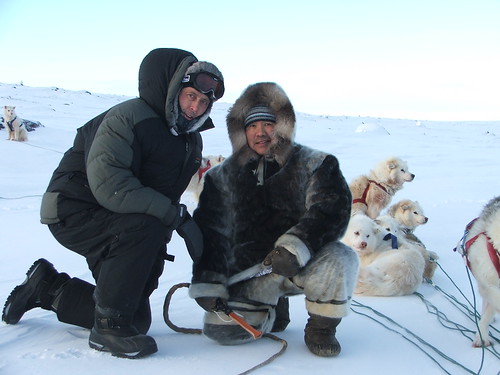
Ole Gjerstad and Joelie Sanguaya in Canadian North
Ole Gjerstad with Joelie Sanguya on the set of their film ‘Qimmit: A Clash of Two Truths'

I put a few questions to Ole Gjerstad, who also happens to be one of my best friends.

What was the greatest difficulty making this film?

To convey to an audience in 2010 the colonial reality of the Canadian Arctic forty to fifty years ago. White authority simply took it for granted that they knew what was best for Inuit; Inuit were too intimidated by white authority — as embodied by any white person in their communities — to protest or resist. Things have changed dramatically, but if we cannot get the minds of the audience back to those days it will be very difficult for them to understand how something like this could happen.

“One shock, two truths…” but in the end the Inuit version is so much more believable, partly because it’s emotional first-person testimony. How to explain that the ex-RCMP have blocked this out?

The RCMP produced an internal review, which was conducted much like a police investigation, looking for “proof” and pretty much excluding the context. Add to that the many controversies and scandals that have plagued the RCMP in recent years, and I believe that the top RCMP brass decided the Inuit claims weren’t of much consequence. As for the Sûreté du Quebec, which was responsible for the killing of thousands of dogs after they assumed control of Nunavik in 1961, they simply ignored our requests, as did the Quebec government, saying they didn’t want to discuss the matter until they heard from the Inuit about settling the claims.

I wondered when you say the dogs are back in the lives of the Inuit helping to reconnect with their traditions – it is of course a great thing to say at the end of a film, but is it a reality in many communities?

There are dog teams now in nearly all the communities in Nunavut and Nunavik. They’re used by Inuit outfitters for tourism, for trophy hunting by foreigners, by others for teaching traditional skills to young Inuit, and simply for pleasure. Nobody depends on the dogs to survive, but their return to the communities have established a visible link to a tradition that was at the heart of Inuit life not so long ago.

Last month we filmed a ten-day traditional sled dog race, the Nunavut Quest, for a television series. The enthusiasm and level of interest in all the communities involved leaves me in no doubt that the dogs are like a weapon in Inuit hands to fight against cultural obliteration.

Thanks to Tobi Elliott for her help with this blog.

The Socalled Movie

Socalled and The Socalled Movie
Socalled performed following the Montreal premiere. Photo by Emilie Nguyen Ngoc.

I went to see Garry Beitel’s film The Socalled Movie when it premiered in Montreal a few days ago. A terrific evening: great film, great audience, all very Montreal. The post-screening Q & A was followed by a concert by the film’s main character, musician Socalled (aka Josh Dolgin) with his band.

Socalled is a truly original creator of hard-to-classify music which (to borrow a few lines from the press release) mashes up funk and hip-hop with Jewish klezmer. “Socalled is a pianist, singer, arranger, rapper, producer and composer – and also a magician, filmmaker and visual artist – a creative force who blasts through the boundaries that separate music of different cultures, eras and generations.”

Josh is funny, creative, touching, and unstoppable. Garry Beitel sees the star of his film as having “an amazing ability to take great music from the past and plug it into the current moment.”

Socalled Movie - NFB still

The Socalled Movie is structured in neat little chapters, inspired by François Girard’s Thirty-two Short Films About Glenn Gould (1993). In spite of this, the film has real unity and a dramatic arc that really works. During the Q&A, Garry said he felt this approach was appropriate because the main character is such a multi-talented chameleon: “Just when you think you’ve figured out who he is, you discover another dimension which challenges your perception.”

Seeing Garry’s film, I had a sense of a filmmaker having reached real maturity. Everything about the film breathes experience and long-standing collaborative relationships – notably with DOP Marc Gadoury and editor Dominique Sicotte, who both did fantastic work.

The film was produced by Barry Lazar (reFrame Films) and Ravida Din (The National Film Board of Canada.)

The Socalled Movie begins its cross-Canada theatrical run June 4 – 11 here in Montreal @ Cinéma du Parc (3575 Ave. Du Parc), and June 5 – 8 & 10 @ CinemaSpace, Segal Centre (5170 Cote-Ste-Catherine).

It opens in Quebec City June 4 @ Le Clap (2360 chemin Sainte-Foy) and plays New York City’s NewFest June 08 @ JCC in Manhattan (334 Amsterdam Avenue.)

Other release dates on the film’s blog here.

Thanks to Tobi Elliott for help with this post.

Erica Pomerance and the challenges facing African women

Erica Pomerance: 'Mère et enfant'

Regular guest blogger Jocelyne Clarke wrote this about a very committed Montreal filmmaker.

At the recent edition of Vues d’Afrique, I attended Erica Pomerance’s just completed film, ‘Opération Survie’, about a medical condition that affects approximately two million women worldwide : obstetrical fistula.

Generally associated with primitive birthing conditions, delivery complications and inadequate health care, the condition leaves women incontinent, and as a result, socially excluded. In Africa, excision and genital mutilations, still practiced on young girls in many regions, are also a factor.

The film was made with the collaboration of Dr. Danielle Perreault, a Quebec emergency doctor, television commentator and photographer with a special interest in women’s health, who travels worldwide to educate and train. The film partially takes place in a center where women live while awaiting the simple surgery that will often enable them to re-integrate normal society. Sadly, many women are so damaged by repeated childbirths that they will never recover normal bodily functions.

Dr. Danielle Perreault (gauche) avec Erica Pomerance

Dr. Danielle Perreault and Erica Pomerance at the film’s launch.

Erica has a long term interest in Africa. In 1997, she directed ‘Tabala – Rhythms in the Wind’, about African music and dance culture in Montreal. Simultaneously, she had developed an interest in the realities of African women and begun research on female circumcision, and particularly on the work being done by women’s organizations in Africa. Following ten years of research and on the ground work, ultimately collaborating with Monique Simard and Virage Productions, she released ‘Dabla! Excision’ (2003).

Since then, Erica has directed four films in West Africa, including ‘Opération Survie’: Miroir en face‘ (2006, Via le Monde); ‘Caravane’ (2008), self-produced with the Taling Dialo initiative, a video training association she founded, and ‘Ndomo, les cinq doigts de la main’, about girls’ initiation in Mali, co-directed with Isabelle Garceau.

In the extremely and increasingly difficult context of documentary production, even more so given the « distant » nature of the realities she explores, Erica’s passion and determination are an inspiration. I often see her just as she is about to board a place to West Africa, small camera in hand and hopeful that the funding will eventually be found for some new project.

Her films and the personal commitment she brings to them offer precious glimpses into « other » worlds, both sobering and inspiring.

Erica Pomerance et les défis des femmes africaines

Erica Pomerance: 'Mère et enfant'

Jocelyne Clarke qui contribue régulièrement à ce blogue nous parle d’une cinéaste très engagée, aussi basée à Montréal.

À Vues d’Afrique cette année, j’ai vu un film important réalisé par Erica Pomerance, « Opération survie », sur un sujet pas très « sexy » mais o combien pertinent pour les femmes africaines, la fistule obstétrique.

Selon les statistiques, environ 2 million de femmes dans le monde sont affligées par cette condition, généralement associée à des accouchements difficiles, sans aide médicale, et en Afrique, à l’excision qui continue à être pratiquée de manière courante dans certaines régions. C’est un problème à la fois physique et social – les femmes sont exclues de leurs communautés parce qu’elles sentent mauvais, perdant constamment leur urine.

Le film a été réalisé avec la collaboration du Dr. Danielle Perreault, médecin généraliste et urgentologue québécoise avec un intérêt spécial pour la santé des femmes, chroniqueuse à RDI et photographe. Elle voyage tant au Grand Nord que dans les pays du Sud, toujours dans le but de sensibiliser et d’instruire.

Dr. Danielle Perreault (gauche) avec Erica Pomerance

La Dr. Danielle Perreault et Erica Pomerance au lancement du film.

Erica Pomerance s’intéresse depuis longtemps à l’Afrique. En 1997 elle a réalisé le très beau « Tabala – rythmes dans le vent » sur la musique et la danse africaines à Montréal. En même temps, elle s’intéressait à la réalité des femmes africaines et avait amorcé une recherche sur l’excision, et surtout sur les gestes posés par les mouvements de femmes africaines qui s’y opposaient. Suite à presque dix ans de recherche et de travail acharné sur terrain, elle a sorti « Dabla ! Excision » avec la maison de production Virage et Monique Simard.

Depuis, elle a réalisé 4 autres films en l’Afrique : Miroir en Face (2006 Via Le Monde); Caravane (2008), auto-production avec l’intiative qu’elle a fondée, Taling Dialo, vouée à la formation vidéo en Afrique ; « Ndomo , Les Cinq Doigts de la Main » (2009), sur l’initiation des filles au Mali, co-réalisé avec Isabelle Garceau, et « Opération survie ».

Dans un contexte de production documentaire de plus en plus ardu, d’autant plus qu’elle parle de réalités lointaines, Erica possède une passion évidente et une détermination sans égal. Je la croise souvent alors qu’elle s’apprête à quitter le froid Canadien, caméra à la main, armée de la seule confiance qu’éventuellement elle trouvera le financement pour son nouveau projet.

À travers ses oeuvres et les réalités « autres » qu’elle nous fait connaître, Erica se mérite vraiment le titre de cinéaste engagée.

Seen at Hot Docs

Monica and David_2
Monica and David

I was at Hot Docs in Toronto, now one of the world’s leading documentary festivals, all of last week. I wasn’t able to see some of the films I really wanted to see because of meetings. But here are a few screening notes.

The most surprising film I saw was Feathered Cocaine, an Icelandic film which starts out as a film about falconeering and falcon smuggling, then veers off into the drug trade, and finally ends up very convincingly proving that the U.S. authorities never really tried to catch their declared Enemy # 1, Ousama Bin Laden !

While the Americans claimed to be searching for him in Waziristan, he spent several months every year in meetings with his financiers in hunting camps in the Iranian desert, with his five falcons which were all equipped with radio emitters.

The U.S. authorities, including the CIA and the Pentagon, showed no interest in first-hand information about these facts. The story is no joke, it’s journalistically sound, backed up with solid evidence. Chapeau !

Another very impressive film: Secrets of the Tribe, a shocking story of how several generations of anthropologists have used unequal power relationships to take advantage of the Yamomami people of the Venezuelan rain forests. Medical experiments without informed consent, pedophilia, the building on scientific reputations and super-egos on the backs of unsuspecting aboriginals, it’s a real horror story.

As a reader of the world’s best newspaper, the Guardian Weekly, I was well aware of this story already. But the film tells it well and should be a must-see for the academic world.

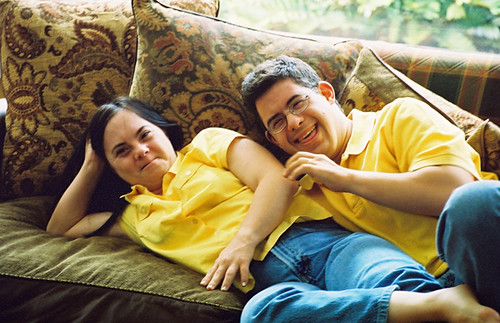
But the most moving film I saw was Monica and David, a film about two young people with Downs syndrome who get married. As in any case where the social conventions are stripped away and you are confronted with strong emotions, this is captivating.

But in this case, the emotion is love, and the two young people show enormous courage in confronting their challenges -as do their mothers and other members of the family. I was very impressed by the quality of shooting, sound recording and editing in this first film by director Alexandra Codina. Great work !

ACodina2774
Director Alexandra Codina

I am leaving for a future post John Walker’s excellent film A Drummer’s Dream.

Thanks to Tobi Elliott for help with this post.

Lancement Les super-Mémés

Louise et Marg, lancement QC4
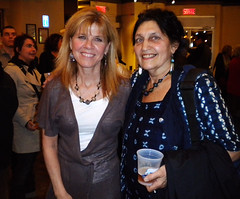
Louise-Édith Hébert et Marguerite Bilodeau. Photo Marie-Pierre Savard.

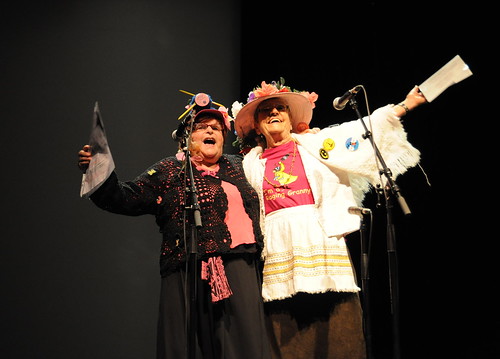
Au cours des dernières semaines, nous avons lancé mon film Les Super-mémés, sur le mouvement des Raging Grannies et des Mémés déchaînées. C’est un film produit par Isabelle Couture et Ian Boyd aux films de l’Isle, avec une license cruciale de Canal Vie, et distribué par Vidéo-Femmes. Le film a d’abord été le film de clôture du Festival des films sur les droits humains, et a ensuite été lancé au Musée de la civilisation à Québec. Après six ans de travail et beaucoup de difficultés de financement, j’étais très touché de voir la réception du film à la fois par les journalistes et par le public. Paul Houde de FM 98,5 disait: ‘un super film, qui donne envie de vieillir dans la délinquence.’ Et à Québec, une spectatrice m’a expliqué l’importance du message du film de façon tellement éloquente que je lui ai demandé de mettre ces commentaires par écrit. La parole est à Thérèse Voisard:

Thérèse Voisard.726 copy
Thérèse Voisard

C’était la première fois que j’entendais parler de ce mouvement, qui allie l’humour à l’engagement social. Il s’agit, à mon avis, d’un mouvement qui gagne à être connu autant des personnes âgées que des plus jeunes.

….Ces dames peuvent s’autoriser un certain niveau de “délinquance” ou de désobéissance civile, qui ne serait pas toléré chez les jeunes. On n’utilisera pas de bâtons, de pistolets” taeser” ou autres contre des femmes de cet âge, au cours d’une manifestation”. alors que l’on hésitera pas à s’en servir contre des jeunes. De même on ne les jettera pas en prison et on ne les bousculera pas; ce que l’on hésitera pas à faire lorsqu’il s’agit de personnes plus jeunes. De plus, si elles peuvent déjouer et narguer la police, comme on l’a vu dans l’incroyable scène de canotage sur la Rivière des Outaouais, c’est grâce à leur sens de l’humour souvent beaucoup plus efficace que la violence. De même, leurs costumes très voyants leur assurent une visibilité à nulle autre pareille tandis que leurs chansons remplacent efficacement les cris de colères et les slogans agressifs. Leur âge leur assure aussi une crédibilité quant à la défense des valeurs nécessaires à la vie bonne. Elles en ont vu d’autres et savent d’expérience distinguer l’essentiel de l’illusoire sans que l’on puisse mettre leurs opinions sur le compte de l’inexpérience ou de la fougue irréfléchie de la jeunesse.

Ces impressionnantes “mémés” établissent sans contredit que ces avantages offerts par l’âge peuvent, comme le film le démontre si bien, être mis au service de la communauté.
Peut-être s’agit-il là du véritable rôle social des aînés.

Tous nos remerciements, pour ce magnifique film.

Thérèse Voisard

Launching French Granny film

Louise et Marg, lancement QC4
Louise-Édith Hébert and Marguerite Bilodeau, photo Marie-Pierre Savard

Over the past two weeks, we launched my French-language film on the Raging Grannies and Mémés Déchaînées, Les super-mémés. It premiered on the 20th of March as closing film for the Human rights film festival in Montreal, at the Park Cinema, and we had another launch screening in Quebec City at the Musée de la Civilisation. The film was produced by Isabelle Couture at Films de l’Isle and is distributed by Vidéo-femmes, based in Quebec City. We were able to make the film thanks to the support of Canal Vie, and more precisely Line Richard, now at the French production branch at the NFB. For several years, Line was the only person in the television world who supported this project while it was turned down by numerous English-language broadcasters. It is very heartwarming, after all the difficulties we had finding the funding, to see that the film is very well received both by journalists and audiences. Radio Host Paul Houde at FM 98,5 said: ‘This is a super film which makes you feel like being more of a delinquent as you grow old.’

The Reboot Experience and the guinea pigs.

The_Guinea_pig_detectives_coverpage
Guinea pig detectives cover page. Illustration by Pierre Durand.

Together with my friend and colleague Patricia Bergeron I spent last week in intensive consultations about cross-platform documentaries – meaning documentaries which aren’t just a film or a TV program but also play themselves out on the web, including in the social networks. ( Cross-platform or transmedia is different from multi-platform in that the content actually varies from one platform to the other, making for complementary parts of a greater whole.) With our project Guineapig Detectives – about citizen investigations of new forms of advertising – Patricia and I were finalists in the Reboot competition organized by DOC Canada. I will tell you more about our project at a later date but the graphics will give you some hints. As finalists we had the privilege of several sessions with pioneers of multi-platform production and even ARG‘s – alternate reality games. Among the mentors were moderator and Reboot organizer Brett Gaylor ( the director of Rip! A Remix Manifesto), Evan Jones of Stich media, Katarina Cizek who made a Filmmaker-in-Residence at the National Film Board and Lance Wieler, a partner in Seize the Media. You can actually see presentations by these people on the DOC web site, along with the keynote by digital distribution pioneer Robert Greenwald. Since Patricia is herself a new media expert ( lots of good material on her blog about the subject !), I am sure I learned more than anyone else during this week which ended very well indeed, because Patricia and I actually won the coast-to-coast competition ! Thanks Jessica Berglund and Franck Le Coroller for research help with the project.

The_Guniea_pig_Detectives_plan
Guinea pig detectives cross-platform overview.

New directions 1: short film competitions on the web

Béth5
Béthièle when she was five.

A documentary filmmaker in Canada today might be forgiven for being discouraged. The combined impact of the crisis of television, the more general economic crisis, and the Conservative government’s policies are having a devastating impact on our traditional sources of funding. There is definitely a ‘paradigm shift’ underway. New models of production and financing will surely emerge, but the transition is in many ways painful and the future uncertain. One way or the other I strongly believe there will still be a place and a role for documenting what goes on in society, and for making films which will contribute to public debate. And I would say, observing my own decision-making process so to speak, that I am in the process of finding new directions. In addition to one more traditional film project, I am beginning to explore multi-platform production ( more on that another day) and filmmaking for the web. In this process, I am learning a lot from my younger colleagues and not the least my interns.

I meant to participate in the short film competition about public service, organized by the CSN – deadline a few days ago. But my plans fell through due to the absolutely exceptional circumstance of no substantial snow fall in Montreal for almost a month. ( Last year we had four meters of snow !) Nonetheless, I extend my heartfelt thanks to the Société de Transport de Montréal and their employees who generously helped me prepare for a shoot which had to be put off to another year. On the other hand i will participate in the short film competition Roots, organized by RCI. This is a terrific idea, an initiative which will allow Canadian citizens from different background to tell their stories – or the stories of others, as you can already see on their web site. My contribution will be a video-letter to my daughter Béthièle who was born in Haiti and whose tenth birthday pretty much coincides with the competition deadline.

Thanks to Jessica Berglund for the help with this blog.

Projection-événement: ‘Enfants de Choeur’ à la cinémathèque

EC!  2 (horiz)

Mon film ‘Enfants de Choeur‘ sur la chorale des sans-abris de Montréal, terminé il y a dix ans, sera projeté à la Cinémathéque québecoise à Montréal ce samedi le 19 Décembre. Et ce sera une projection-événement puisque la nouvelle incarnation du groupe, la Chorale sous les étoiles – autrefois Chorele de l’Acceuil Bonneau – sera présente pour chanter. Je serai en Europe, mais le producteur Paul Lapointe y sera, ainsi que le Directeur de la chorale, Pierre Anthian. Le film était en nomination pour meilleur documentaire à Hot Docs (Toronto) et aux Jutras, et il s’est mérité le prix du meilleur moyen-métrage documentaire à Mumbai en 2000. Je suis reconnaissant au cinéaste Bernard Émond (son dernier film La Donation est à l’affiche dans plusieurs salles au Quebec actuellement) d’avoir écrit le petit texte qui suit sur Les Enfants de Choeur en vue de la projection à la cinémathèque. Et j’ajoute que Louise Côté qui a monté La donation et la plupart des autres films d’Émond a aussi assuré l’excellent montage de mon film. Bernard écrit:

‘Il y a deux films dans Enfants de choeur : en surface, un feel-good movie sur des marginaux qui retrouvent la dignité en chantant, et derrière, un film pénétrant sur la difficulté d’être et sur la difficulté d’aider. Il n’y a aucun angélisme dans ce film ; on est dans l’humain jusqu’au cou : les choristes sont poqués, égoïstes, et manipulateurs autant qu’ils sont généreux et attachants, et le désintéressement de leur directeur de chorale bénévole n’est pas exempte de prosélytisme et d’un certain goût du pouvoir et de la reconnaissance. La grande richesse du film tient justement à la tension entre ces éléments. On y comprend que le don n’existe pas sans une forme d’échange, et que dans l’échange, on se compromet toujours. Cela n’enlève rien à la générosité et au courage des protagonistes, sans lesquels la chorale n’aurait jamais existé ; seulement, le film ne cède ni aux simplifications, ni aux bons sentiments. Enfants de choeur rend la vie dans toute sa beauté et sa complexité.’

Merci à Jessica Berglund pour l’aide avec ce blogue.