A McLaren film for the 21st Century: Philippe Baylaucq’s 3D film ORA

The other day I went to see two exceptional films in 3D at the Festival du Nouveau Cinéma in Montreal. Millions of words have been written already about Wim Wenders’ film about the amazing choreographer Pina Bush, and I don’t have anything to add.

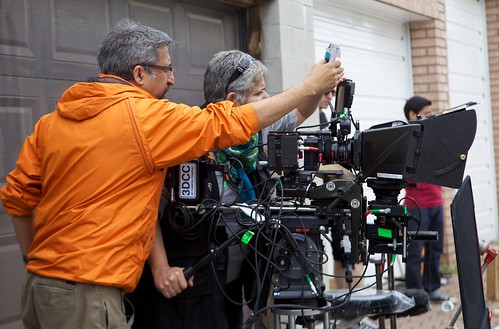
But that film was preceded by another extraordinary dance film, Philippe Baylaucq’s ORA. Shot with infrared cameras which capture only the heat of the bodies, with no light source whatsoever, it creates totally original images of translucent bodies dancing to a score by composer Robert Marcel Lepage. Philippe had chosen this project for his two-year residence in the National Film Board of Canada’s French program. I asked him what motivated this choice.

“The project started with the idea of marking the first century of abstract painting. I re-read Kandinsky and wanted to explore that period of painting and set design (Diaghilev, etc) when the human figure was still present in environments that were becoming increasingly abstract.

Initially I was interested in exploring the relationships between the human figure, dance, colour and space. I wished to work again with my friend and colleague dancer-choreographer José Navas and met up with him before applying to the NBF for one of their two year residencies. I was lucky, I got in and began to read up on my subjects. Soon I became aware of what was being done at the NFB StereoLab where I was blown away by what I saw, by what I was shown by Munro Ferguson. It became clear to me then that my two years spent at the Board would have to lead to a film that could be done there and nowhere else. Hence the 3D.

I had a full year of tests before opting for a world technological first: 3D thermal cinematography.

One does not really tell stories in the linear sense with dance. One does however have to be aware that most film spectators expect a storyline of some kind. I started with the title of one of Paul Gauguin’s most famous paintings: Where do we come from, who are we and where are we going? For optimal formal freedom, I wanted my dancers to evolve in a non-naturalistic setting, giving me the chance to be more audacious with gravity, depth, light, texture, movement.

From then on, I was interested in working in the “Norman McLaren” fashion which is to say that the filmmaker is led to his story-line through the interaction with the tools, materials and technologies that he is exploring. Our work with thermal imagery led us to discover very interesting phenomena that spoke of larger themes such as Darwinian evolutionary theory and classical myths such as Prometheus and Narcissus. Slowly, through the fundamental research with the technologies, a story immerged and eventually a film… It was fascinating.

2. A lot of the comments have been about the striking technical achievement, but the structure of the piece, with the music and choreography, must have been a considerable challenge. How did you work with composer, choreographer, dancers?

Working with me on this kind of subject is a trapeze act without a net. From the start, everyone becomes aware of the exploratory aspect of what we are doing. People are generally stimulated by uncharted ground, it gets them out of their routine and forces everyone to be ingenious, to extend further out and test their talents. Again I was blessed with many many inspired collaborators. I worked with people that also work in the documentary field and this is very important because it signifies that they know what it means to be open to chance and aware of what is there, in the world and not strictly on the pages of a script.

The film was loosely written, but my main collaborator José Navas, his magnificent dancers, my DOP Sebastien Gros, my musician Robert Marcel Lepage, my sound designer Benoît Dame, my editor Alain Baril, and many others, everyone was open to the idea that this piece was going to evolve until the very end of the very last stages of post production.

This requires a lot of patience and a very open minded producer. René Chénier did a remarkable job accompanying me through this open ended process. Despite the cutting edge, high-tech aspect of our novel technology, we tried to keep our feet on the ground and not get swept away by the myriad possibilities that both the camera and postproduction computer input might provide us. We tried to never lose sight of the organic, human aspects of our on screen subjects: the dancers. They are all that we see as they at once both the subjects and the light sources that define the subjects: they carry the light, they are the light.

The film is probably one of the very first films to have ever been shot without a single light source: no fire, no sun, no electricity; only heat, the heat of the body, biological light, the light of living things, the light of life itself.


Thanks to Tobi Elliott for her help with the blog.
 

Kazimi on 3D: part 1

Hazardous - production stills 4

Ali Kazimi is an award-winning filmmaker. Since 2008, he has been researching stereoscopic 3D digital cinema at York University, where he is an Associate Professor in the Department of Film.

Q. Why is there this sudden groundswell of interest in 3D?

The current stereoscopic 3D is propelled by the exponential rise in digital technology in film production, coupled with the phenomenal success of James Cameron’s Avatar. Really, much of the growth in S3D is due to Cameron’s championing and use of digital S3D. Cameron himself did not come to S3D overnight, he spent the decade before Avatar experimenting with making underwater docs with different degrees of success. In fact, his underwater experience reveals itself not only in the very comfortable 3D experience he was able to deliver, but also in the flora of the imagined world which looks and behaves very much like underwater plants do.

However, it is his S3D experimentation that is critical to acknowledge and it is instructive in many ways – or to put it differently, S3D has a steep learning curve. The biggest challenge I feel is getting a grasp on the fundamentals of perception, how we see depth. Stereo vision, or ‘stereopsis’ as it is known scientifically, is the process by which the brain takes in the 2D images from the left and right eye and fuses them together into a single 3D image. However, stereopsis is only one way in which in the human brain perceives depth. We also use a number of other visual cues, called monocular cues, such as perspective or the familiar size of objects to determine spatial relationships.

Technically, S3D camera systems mimic the way we see. We use two cameras each offset by a certain distance, called the inter-axial (IA) distance, to generate two identical from images from slightly different perspectives, similar to those between our two eyes. The images have to be in perfect sync with identical focus, depth of field, colour and contrast, this is easier said than done. The mechanism for shooting stereoscopic 3D, known simply as rigs, therefore consists of two cameras either side-by-side or at right angles to one another with a partially silvered mirror at 45 degrees in the middle.

In terms of both composition and pacing there is much that is still unknown, filmmakers have to learn how to see the world around us with the z-axis in mind.

A couple of months ago just I saw a screening of shorts, commercials and music videos screened at the TIFF Bell Lightbox. The program, called ‘Selected Package’, had a wide range, from those with high production values to lo-tech DIY retro-inspired music videos. The latter were screened with the Red/Blue, anaglyph format. I have rarely come out of a screening with such acute eyestrain and headache. Once again, these music videos painfully drove home the difference between bad 2D and bad 3D, in that poorly produced S3D can be uncomfortable and even painful. Filmmakers have to recognize that their S3D work can have an immediate physiological impact on the audience. In fact this is the very reason why filmmakers have to step way back and truly re-examine how we see.

On the other hand, Wim Wender’s film Pina is a real masterwork and a true landmark in S3D filmmaking. In my view, the first feature film made solely for S3D, one that explores its immense possibilities with such inspired grace and virtuosity.

Wenders’ keynote address at our Toronto International Stereoscopic 3D conference was one of the most amazing artist talks, and a truly inspirational speech on how he came to 3D and how filmmakers should engage with 3D (read the transcript here). Pina is exciting because it was designed solely as a 3D film, whereas I have long maintained the almost all other 3D content is designed to work in 2D as well. Consequently there can only be limited exploration of a new cinematic language. More on Pina a bit later.

What is it that you have to learn? Theory or hands-on?

On the technical side, digital projection has made it possible to deliver a pretty seamless 3D experience, it is another matter that many cinemas don’t have proper projectors resulting in relatively dimmer image. Of course this is the last but crucial stage in the entire digital workflow.

In some ways the ‘Avatar effect’, as I often refer to it, has been a mixed blessing. The studios and the television manufacturers all jumped on the bandwagon. S3D sets are now increasingly on the market and prices are coming down fast, the problem is the dearth of content. To create content one needs more than tech, training and accessibility is critical. As I have said earlier, S3D has a steep learning curve and there are no short cuts, it will take time to develop a critical mass of filmmakers and technicians.

The most critical position is that of the stereographer – a stereo expert who should ideally be at least consulted during pre-production, who is on the set during production working with the camera rig and who then again at least consults through post-production and during the final colour and stereo-grading. Stereographers are hard to find, in this new field many people claim to be one after doing a workshop or two, one has to be really careful. Errors made in production such as the depth of a shot are impossible to “fix in post”.

Thanks to Tobi Elliott for her help with the blog.

The Interrupters at Cinema Politica

Ameena Matthews in "The Interrupters" by Kartemquin Films

The other night I went to see The Interrupters at another full-house Cinema Politica screening at Concordia University in Montreal, with the filmmaker in attendance. Cinema Politica regularly gets hundreds of people out to see socially and politically relevant documentaries – in this case 650 people on a Monday night! Kudos to organizers Ezra Winton and Svetla Turnin.

The Interrupters is a terrific film by veteran filmmaker Steve James. Initiated thanks to an article by Alex Kotlowitz, it tells the story of three ‘violence interrupters’ who intervene in violence-ridden, mainly black neighbourhoods in Chicago – the ones which became a national symbol of urban violence in the U.S. a couple of years ago.

It’s a classical ‘vérité’ film, tracking the main characters in many tense and emotionally raw encounters with both victims and perpetrators. The director is also the DOP, and the film is beautifully shot – and has excellent sound recorded in often difficult situations. James’ views on documentary making and the relationship between filmmaker and subject are very close to my own. For example, he spoke about the impact of the camera on the subjects as being sometimes negative, sometimes positive.

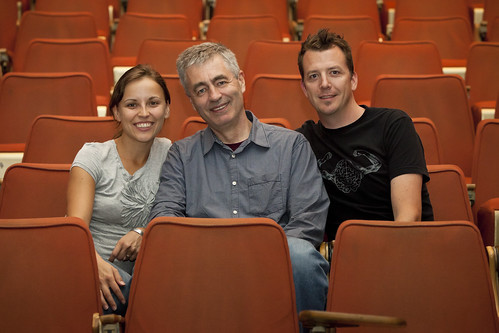
Svetla Turin, Steve James and Ezra Winton

Steve James directed Hoop Dreams, a truly impressive and inspiring film. There was a controversy about Hoop Dreams not being nominated for an Oscar, something it definitely deserved. Hopefully that mistake will be made up for by an Oscar nomination for Interrupters.

At IDFA in Amsterdam Steve was given a carte blanche to show his top list of documentaries, see here.

The Interrupters was produced by a truly excellent company called Kartemquin Films. Last year I met Gordon Quinn, one of the founders. I remember asking him whether he felt that the new digital environment had any negative implications for filmmaking ethics.

Quinn said: ‘It’s true that the context is changing, but I think the underlying sets of responsibilities are still there. You owe ethical consideration to your subject and to the intended viewer, and these things can be in contradiction. We spend months or years with our subjects, and so our concerns for them have to be greater than if we were just parachuted in for an hour, or worse just grabbed something from the net. I do worry that pieces of our films could be used out of context and portray our subjects in a dishonest light.”

Thanks to Tobi Elliott for her help with the blog.
Making soup on a nail

Jaxonw.hat.500KB.0001

For the last two years, I have been working on a film about a man who can be described as a footnote to history, Honoré Joseph Jaxon, alias William Henry Jackson.

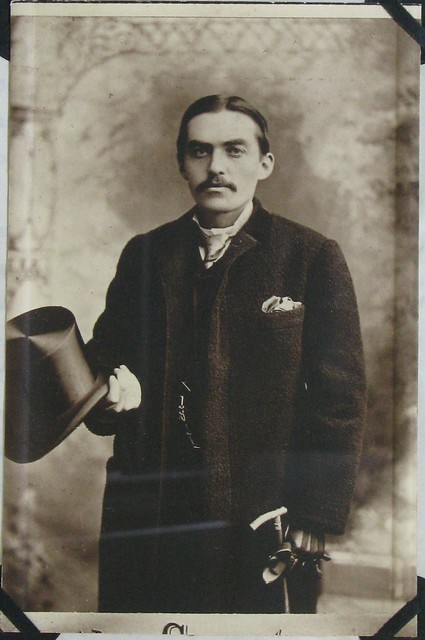
An enigmatic figure, his life was full of drama. He admired the Métis and participated in the Northwest Rebellion of 1885, acting as a secretary to Louis Riel. While Riel was hanged for treason, our man was declared insane and let go. He escaped the insane asylum and found himself – less than a year later – involved with the labour movement in Chicago, the fastest-growing industrial city in the U.S.

When anarchist leaders were accused of causing the Haymarket Riot of 1886 – the events which led to the choice of the 1st of May for the annual socialist labour march – he took their defence. Again, his associates were hanged.

Jaxon was an impostor, declaring himself to be a Métis when he was actually born William Henry Jackson of an Ontario methodist family. But he was a visionary, imagining and fighting for a just multicultural society. He ended his days in New York City, where he was evicted from a basement apartment with his huge collection of archives at age 91. He died only a few weeks later.

Jaxon’s story is little known, but Calgary historian Donald Smith has written a terrific book about him, published by Coteau books. Also, Quebec anthropologist and radio host Serge Bouchard did an excellent radio program about him. My own knowledge of Jaxon goes back to the seventies, when I made a series of radio programs about the U.S. labour movement, notably with the help of my friend Pat Quinn, then the Chief archivist at Northwestern University in Evanston/Chicago.

There are of course no moving images of Jaxon, and only a dozen photos. That’s why I say this project is like ‘making soup on a nail,’ recalling an old Scandinavian folk tale about a vagrant who gets himself invited to stay overnight at farm houses by offering to make soup with a nail. ‘If we can just add a little piece of potato, this will be even better….’ You get the idea.

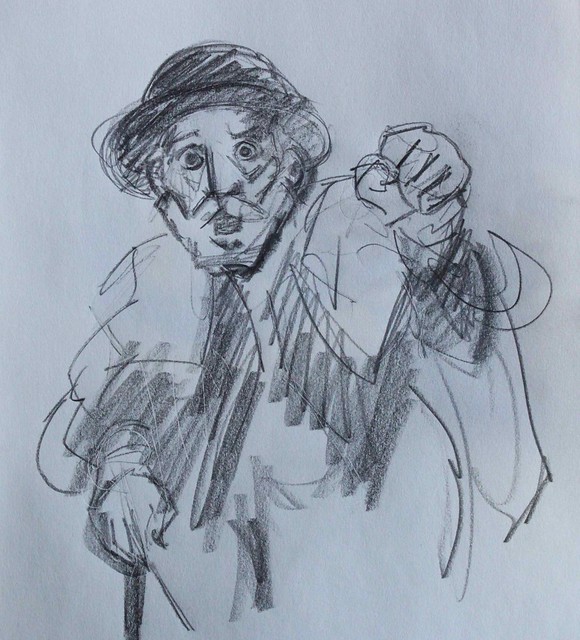
My partners in crime in this undertaking are, among others, scriptwriter Peter Haynes and animator Philippe Vaucher. Here is one of Philippe’s images.

Jaxon_Old.500KB.

Thanks to Tobi Elliott for her help with the blog.
Uncovering the hidden history of the Roma in the Holocaust

Ceija Stojka

Going to the Montreal World Film Festival is a hit-and miss kind of affair. One easily has the impression there is no serious programming effort, it seems like anything goes, and screening some of the films gives you a strong impression nothing would ever be turned down. But there are also some excellent films.

At the most recent edition went to see a couple of documentaries which had interesting subject matter but which seemed unfinished. But I also saw one really excellent doc, A People Uncounted, produced by a team of filmmakers which includes several children or grandchildren of Holocaust survivors, most of them Jewish, at Urbinder films.

Shot in eleven countries, it tells the horrific story of the Roma – often known as Gypsies – as little-known victims of the nazi death camps. I found it to be a very compelling and very unusual film, sort of a hybrid between an information-heavy current affairs doc and a very sophisticated beautifully shot film. Another peculiarity about this film is that it was made with – anonymous – private money.

One thing about the film really bothered me, as you’ll find out in my second question to the director Aaron Yeger, who had this to say:

About the style and structure of the film, I agree that it is not conventional. The film does have a dramatic story arch with three acts, however the arch doesn’t follow any particular person or event, but rather the experience of an entire people, the Roma. All the various people who appear in the film collectively represent that experience.

With that in mind, the structure is patterned more after a scripted drama than most documentaries, and it somewhat epic in scope. The first act lays out who the Roma are, both in terms of fact and fiction and shows how they are seen and represented. The second act jumps back in time to the Holocaust to explain by way of both the personal and historical/factual how they were murdered in that genocide. The third act takes us back to the recent past and to the present to explain how the present day situation for the Roma, which is rife with persecution, is a reflection of what happened during the Holocaust. The arch rises and falls with the level of drama and nature of the material, rather than the experience of one person or event in particular.

… We wanted to show what happened to the Romani people during the Holocaust, what’s happening to them in present day, the connection between the two, and what this says about humanity and racism in general. And to make matters more complicated, so little is known about the Roma in general audiences that we also needed to show who they are and what they are not.

So in the end it is a very diverse array of content with a lot of people and a lot of places and topics of exploration, but still with the goal of making the experience as cinematic as possible. It’s a film with one foot in education and the other in cinema and popular culture.

Director Aaron Yeger

Magnus: You go out of your way to be inclusive, to make links between the experience of Jews and Roma, to refer to other experiences of discrimination and genocide… and yet there (as far as I remember) not a single reference to the gays who were also targeted for extermination by the nazis and sent to the death camps. Given the extremely thought-through inclusiveness of the whole film, this cannot be an accident. (I did notice the little line in the end credits about people whose story was covered…)

Part of our goal was to make a film that elevates the Roma from a footnote in Holocaust history to a place of dignity. The point of the film was to focus on the Romani experience in the Holocaust and present day. Having said that, it’s impossible to show their experience in the Holocaust without drawing connections to the Jewish experience. This is partly because most people when they hear “Holocaust” think of the Jewish experience, so it’s pertinent to note the similarities in the style of the various acts of genocide and the Nazi rhetoric (such as that many Nazi policy statements referred to the [final solution of the Jewish and Gypsy question/problem] together in the same sentence.

The other reason is that organically, it came up time and time again in our travels and meeting lots of Roma that many of them feel a kinship and solidarity with Jews in the aftermath of the Holocaust.

We also chose to relate the present day civil rights struggles of the Roma to the African-American civil rights movement in the past, for the purpose of hoping to inspire people today to change things for the better. The similarities are startling. Roma in present day Europe often suffer from school segregation, lack of access to jobs and institutionalized racism, as well as openly pejorative rhetoric in the political and media mainstream. They are stereotyped as criminals who are unwilling to work. And they were slaves in the past, emancipated at approximately the same time as African Americans.

I agree that telling the story of the genocide of gays, as well as many other groups is very important, which is why there is that statement at the end of the film. But we didn’t want to make anyone into a footnote in this film. Gays and other groups murdered also deserve the dignity of a film dedicated to their suffering and I would like to see that film made.

Thanks to Tobi Elliott for her help with the blog.
Worthwhile articles on documentaries

Werner Herzog filming 'Into the Abyss' which screens at TIFF this week.

I can already imagine what my webmestre Kim Gjerstad might say about this post: “Magnus, I told you, only original material!”

But in my defense, these articles are very interesting, for different reasons. It’s disappointing however that the one about the abundance of docs at the Toronto International Film Festival doesn’t mention any Canadian docs, such as Surviving Progress. Maybe one reason is that TIFF programs very few Canadian docs?

Anyway, enjoy the reading.

  • A Bounty of Documentaries at Toronto Festival – focusing on the documentary offerings at TIFF, but in particular Werner Herzog’s film Into the Abyss, about the execution of death-row inmate Michael Perry. While editing, “Herzog said he was too shaken by his encounters with Mr. Perry, his associates, his pursuers and the family of his victims to work on the film for more than a few hours each day.”
  • Another NY Times article reviews a book by filmmaker Errol Morris, “Believing is Seeing” about the limitations of photographs. “Each of its six chapters originally appeared, in different form, in the Opinionator blog of The New York Times, and each centers on a photo or photo set: two slightly different pictures taken by Roger Fenton during the Crimean War; the infamous Abu Ghraib images, over two chapters; Depression-era photographs by Walker Evans and Arthur Rothstein; pictures of children’s toys lying in the rubble after Israeli airstrikes on southern Lebanon in 2006; and an ambrotype of three young children that was found clutched in the hand of a dead Union soldier at Gettysburg in 1863.”

Thanks to Tobi Elliott for her help with the blog.
Caravaggio, Kieslowski, Jarl: Inspiration

At a filmmaker lunch last year, my very creative friend Don McWilliams told this story. About fifteen years ago, the famous Polish filmmaker Kryzstof Kieslowsky gave a conference at Concordia University. After his presentation, a professor asked him what his greatest sources of cinematic inspiration had been.

His answer: Molière and Dostoyevsky. The professor found this very annoying, and came back to insist that this was a serious question. And Kieslowsky in turn explained that his was a serious answer. “You have to expose yourself to the arts and the world outside of the cinema,” is the way Don remembers his reply.

What brought this anecdote to mind was my visit to the terrific Caravaggio exhibition at the National Gallery in Ottawa. Caravaggio was a rebel, and the way he revolutionized the visual arts at the end of the 16th century has double relevance for documentary filmmakers. In times when the traditional treatment of religious motifs dominated the arts, he brought the turbulent realities of his contemporaries, ordinary folks included into his paintings: tax collectors, disaffected soldiers, prostitutes, street merchants… It was a breakthrough for realism, but a highly creative form of realism.

Caravaggio’s use of and depiction of light was equally revolutionary. One of the filmmakers who has most inspired me, the Swedish documentarian Stefan Jarl, has this to say about Caravaggio’s use of light:

‘Caravaggio is a master of light and shadow. There is a fantastic painting which describes how Jesus asks Matthew to follow him, in which the light from the window illuminates the characters in the shades. It’s one of the most vibrant paintings ever made. Everything he did during his tumultuous and much too short life was of the highest order when it came to lighting. Filmmakers have much to learn from him…’ (My translation, from a book by Cyril Hellman.)

If you have a chance to see the Caravaggio exhibition before it closes, you should!

Thanks to Tobi Elliott for her help with this blog.

Projections et télédiffusions, Les Super-Mémés

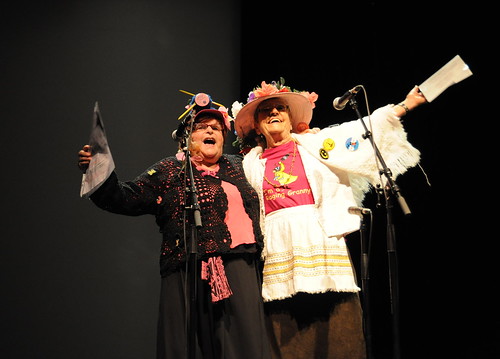
Louise et Marg, Les Super Mémés: lancement à Québec

« …un super film qui donne le goût de vieillir dans la délinquance! » Paul Houde (Montréal Maintenant, 98,5 FM)

Mon film LES SUPER-MÉMÉS, sur les Raging Grannies et les Mémés déchainées, a été lancé en tant de film de clôture du Festival de films sur les droits de la personne en mars 2010. Cet été, il y a plusieurs projections du film en plein air dans le cadre de Cinéma sous les étoiles, et la télédiffusion aura lieu la fin de semaine qui vient.

Cinéma sous les étoiles est une excellente initiative des Productions Funambule, la compagnie de mes jeunes collègues Santiago Bertolino et Steve Patry. Cet été, ils organisent une douzaine de projections dans des parcs dans différents quartiers à Montréal. Parmi les films montrés il y en a plusieurs dont j’ai déjà parlé sur ce blogue, sur Gérald Godin et Omar Khadr notamment.

Il y a quelques semaines, j’ai assisté à une projection des SUPER-MÉMÉS dans le Parc Laurier. Il y avait 80 personnes, et les Mémés étaient sur place pour chanter et discuter après le film.

Le film sera montré dans le cadre d’une autre soirée sous les étoiles, dans le Parc Aimé Léonard à Montréal-Nord le jeudi 1er Septembre à la brunante. J’y serai, ainsi que les Mémés.

Surtout, le film sera diffusé à Canal Vie le 28 Août à 19 heures. C’est en fait grâce à l’investissement de ce diffuseur que nous avons pu faire le film, produit par Les films de l’Isle et distribué par Vidéo-femmes.

Merci a Tobi Elliott pour son aide avec le blogue.

Rithy Panh

From Rithy Pahn's film Le Papier ne peut pas envelopper la braise

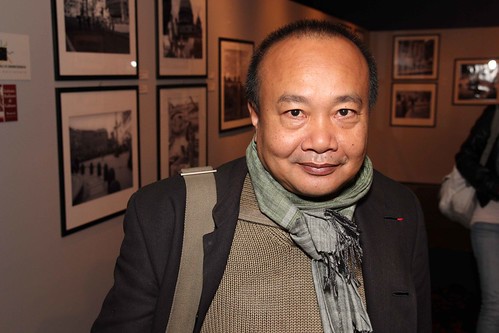
I recently had the opportunity to hear the French-educated Cambodian filmmaker Rithy Panh speak at the Cinemathèque Québecoise. The occasion was a retrospective of his very impressive work.

I first saw one of his films in 2000, when we both had films in competition at the Cinéma du Réel festival at Beaubourg in Paris. His film The Land of Wandering Souls, about the laying of optical cables through Cambodia, featured the encounter beteen modern globalized technology and medieval working conditions. It very deservedly took home the main award.

Unlike his own parents who died of starvation in a camp, Panh is a survivor of the Khmer Rouge genocide of the early ‘70’s. His entire oeuvre is marked by varying degrees of sadness and despair about the human condition.

Rithy Panh

The same goes for his own discourse: he speaks of ‘un travail de mémoire’ – not a duty to remember, but a choice – one could choose to forget. It’s just work to be done, if you choose to do it. He speaks as if there was nowhere to hide and no use pretending.

The filmmaker also needs to face up to his dilemmas: there is an obvious risk of voyeurism, of taking advantage of people. Like every other activity, it’s fragile and perilous.

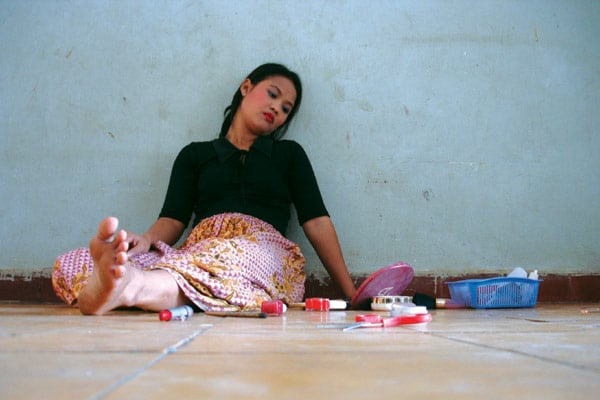
This time I was particularly struck by Panh’s 2007 film Le Papier ne peut pas envelopper la braise, about a group of young female prostitutes who share a house in Phnom Penh. The film is unbelievably sad, as the young women grapple with illness, unwanted pregnancies, violence and poverty.

The aesthetics of the film are striking: it’s all shot ‘verite’ in the sense that Panh just observes and captures moments of their life. But at the same time every image is carefully crafted, with just the right angle and framing.

How did he achieve this? I wondered. He explained that it was all a matter of patience. Being there for many months, shooting the same kinds of scenes many times over, and carefully selecting just the right shots – out of 300 hours of rushes – in the editing.

Thanks to Tobi Elliott for her help with this blog.

Wapikonimobile funding cancelled

A Wapikoni mobile production unit. Photo from http://wapikoni.tv

For the last eight years, an exceptional and pioneering media experience has given new means of expression and a sense of hope to aboriginal youth on reserves in Quebec.

The Wapikonimobile is a mobile video production unit – or rather three of them – travelling from community to community, providing video training and supervising the making of short films. For youngsters confronted with substance abuse, an epidemic of suicides and an almost complete lack of job prospects, this was an extraordinary opportunity, and they took advantage of it. Some 2000 of them learned production skills, and made some 450 films expressing their own realities. Some of those films had real cinematic qualities and were shown in festivals here and abroad.

But now, the federal Department of Human Resources has cancelled its half-million dollar grant, about half of the Wapikonimobile’s total budget– at a time when the production units should already have been on the road. Young people in numerous communities who have been looking forward to this experience for a whole year now find themselves without anything to do for the summer and without the means for expressing themselves. For what reason? Because, according to the minister, other projects offer better prospects for creating jobs and teaching skills.

Quebec’s excellent daily Le Devoir, which broke the Wapikonimobile story yesterday, has another story today (July 19th) revealing that the arts and the community and aboriginal sectors are hard hit by other little publicized Human Resources cutbacks as well. This is surely a sign of where things are going under the majority conservative government.

Could there be more urgent needs than those of aboriginal youth? Hardly. The founder and director of Wapikonimobile, filmmaker Manon Barbeau, is campaigning to have the department change its decision. I wish her the best of luck in this extremely worthwhile endeavour.

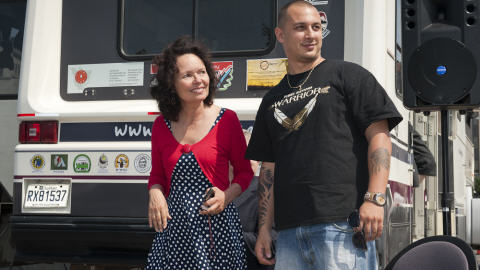
Manon Barbeau with well-known Attikamekw rapper Samian, whose career started with a Wapikonimobile training program. Photo: Luc Lavigne, Radio-Canada.ca

Thanks to Tobi Elliott for her help with this blog.