Winds of Heaven

Emily Carrs painting Cathedral Grove
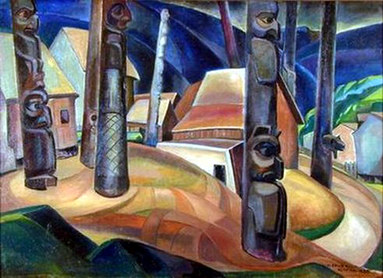
“Kispiox Village.” Painting by Emily Carr, 1929.

Montreal’s International Festival of Films on Art has a huge following. Most screening are full, great to see. The festival mostly programs films for the subject matter as opposed to the filmic qualities, but every year there are some really excellent films.

Of the films I saw this year I liked The Owl in Daylight by David Kleijwegt about Philip K. Dick for the way it used metaphorical images. (The sci-fi writer PKD’s stories have formed the basis for many fiction films, including Bladerunner, which came out just after he died, at an early age. Not to be confused with the Hollywood biopic with the same name starring Paul Giamatti as Dick!) And also my friend Jennifer Alleyn‘s excellent film about a German artist I really admire: Otto Dix. (Named Dix fois Dix, it’s made up of ten tableaus from different moments in Dix’s life.)

Another beautiful and insightful film at the festival was Winds of Heaven about Emily Carr, directed by Michael Ostroff, co-produced by Peter Raymont at White Pine Pictures and filmed by John Walker – who won the CSC award for best documentary cinematography for his work on the film. The most interesting thing about the film for me was the way it took a close look at Carr’s struggle to be recognized as an artist at a time when not many women were, and the ambivalent and not always ‘politically correct’ (especially with today’s standards) relationship with and views of the aboriginal peoples whose culture figured so prominently in her art.

Michael Ostroff explained to me how he constructed the story line:

Carr’s writings form the narrative basis of the film but I had to look at them from that of the perspective of an old sickly woman recalling her earlier times solely from memory. There were no notes or diaries that she relied on, at least so’s that anyone is aware of. So memory of events formed the basis of much of her writings which she began sometime after her first stroke in 1937. This is especially true of her stories about her travel among the First Nations peoples of NW BC. She declared herself to be a friend of the Indians but, as Marcia Crosby says in the film, her writings reflected not so much as friendship but a conceit, and a sense of the racism of her day.

John Walker and Michael Ostrof
Carr was not political – and we cannot judge her by the standards of our times. Her writings are problematic and to Marcia pose a real concern, because schools are still reading/teaching Carr’s stories.

However – the paintings show a great deal of respect. Carr went up the coast and brought back images of communities – active, working, living. This was at a time when the slogan “the only good indian is a dead indian” was often heard and approved of in white society. First nations people were seen by most whites as either barbaric savages or sad vestiges of the noble savage. Most of the the images created by whites portrayed one or the other of these two polarities (think about Curtis.) The solution presented by government was assimilation when it wasn’t outright extermination. Carr’s images however were respectful – and shocking to white society. (In addition to the fauve colours.)

Her diary entries of the 1930’s though suggest a more complex and troubled present. The sacrifices she had to make to remain true to herself as an artist were very hard.

The Harris quote I think should be on every artist’s wall. “… despair is part of every creative individual. It can’t be conquered. One rises out of it. I suppose we are only content when all our sails are up and full of the winds of heaven. I hope all your sails are up and full of the winds of heaven. There is only one way. Keep on.”

Much of the Carr industry is dedicated to the didactic exploration. WOH is not. Entertainment and visual flow were the guiding principles of my direction. And from that the film evolved. The logging sequences for example, became a metaphor for the first nations people. When first seen in the film’s prelude – there is barely enough room for the trees to fall. Each time we return to logging, the forest has been reduced until the very last exquisite camera pan of 25 seconds across the landscape of a 1925 clearcut. They are almost wiped out. Only a stick or two remains. So when we see – at the end – “Scorned as Timber” – a much loved Carr work – it can be a metaphor for Carr’s persistence and individuality, and it can be a metaphor for the First Nations people. “Yes – we’ve been beaten, but we are still here – reaching for the sky.” Striving. Living. I couldn’t feel comfortable ever writing – “they were almost exterminated/assimilated” – so I let the visuals say it.

Thanks to Tobi Elliott for the help with this blog post.

Labour’s New Frontier

McDuff & McDo
Young union organizers Maxime and Pascal from the film: 'Maxime, McDuff & McDo' (M.Isacsson)

Quebec has a higher percentage of union members (about 40%) than Canada as a whole (about 30%) or the United States (about 15%.) Perhaps this is why this province regularly sees pioneering efforts to extend unionization into new sectors. The most recent is the effort to sign up the workers at the Couche-Tard chain’s many convenience stores by the CSN, La confédération des syndicats nationaux.

The majority of employees in several locations have voted for the union. After threatening to close the stores where the workers voted for the union – in a video shown to the employees – management last week did just that, in one important store in Montreal. A choice location, at the corner of St. Denis and Beaubien, not one where the company can argue they were losing money. The union naturally accuses management of intimidation, and is maintaining the pressure.

This battle is reminiscent of one which touched Walmart in Quebec over the last couple of years, and saw that corporation close one major outlet in Jonquière.

This is all quite déjà vu for me, because I followed the attempts to unionize two McDonald’s franchises in Quebec for five years, from 1998 to 2003. I made two films, both produced by Virage and broadcast by Télé-Québec. The first one, Un Syndicat avec ça? (A Union with that?) saw a close-knit gang of experienced workers in Brossard bring in the union.

The second case was quite different. In Maxime, McDuff & McDo I followed two young men who signed up a majority of their very young co-workers in a downtown Montreal franchise on Peel street.

The result? The multinational closed down both restaurants, and there is still no unionized McDonald’s in Canada or the U.S.

The right to free association is a democratic right. How many stores is Couche-Tard willing to close before they accept the union?

Thanks to Tobi Elliott for her help with this blog.

Godin Doc: A Reminder of Heady Times

Gérald Godin and Pauline Julien
I have said this before: I often find myself writing about Quebec matters in English, because I feel like telling non-francophones about what goes on here.

Traditionally, St. Lawrence Boulevard – a few blocks from my house – has been thought of as the dividing line between English and French Montreal, with the francophones living mainly in the East. Although a huge simplification, this notion still bears some truth.

And well East of that line there is a fantastic neighbourhood cinema called the Beaubien that attracts people from many other parts of town. It usually mixes in documentaries with its mainstay of independent – or at least creatively interesting – fiction.

Screening right now at the Beaubien is Godin, a very good documentary by Simon Beaulieu about Quebec poet and politician Gérald Godin. It takes us back to the heady days when the independence movement in Quebec was on the march, winning a provincial election in 1976 and losing a referendum with a very close margin in 1995. The film seems to have struck a chord. The day I was there, the theatre was full for a 1.30 pm screening!

Godin was an irreverent poet who loved the good life. He lived for thirty years with one of my favourite singers, the passionate Pauline Julien – I was honoured that she accepted to narrate the French version of one of my films, Uranium. In 1988 Dorothy Todd-Hénault made a very good NFB film about the couple: Quebec… un peu… beaucoup… passionnément….

Godin was a tremendously open-minded and inspired politician who once famously defeated then premier Robert Bourassa in the riding of Mercier where I live. Although he was a Quebec nationalist who fought for independence, Godin was intensely interested in the cultural and linguistic minorities, and actually got a lot of immigrants to vote for the Parti Québecois.

He liked to de-dramatize the linguistic conflicts here. I remember him giving a bilingual TV interview in a local grocery store, saying, “Potato–patate, tomato-tomate, orange-orange – Quel est le problème? What’s the problem?” But of course he did support the protection and promotion of the French language.

Godin became Quebec’s Minister of Immigration and Cultural Communities under René Levesque, at a time when Pierre Trudeau was Prime Minister of Canada. As I left the screening, I heard a white-haired lady say: “Today’s politicians are sorry sight, compared to those days.”

The most touching part of the film deals with Godin’s illness – a brain tumour severely slowed him down and eventually killed him at age 56. We see him in archival footage still doing his best to represent his constituency during the last years, half his head shaven, and saying in essence, “When you’re seriously ill, you have to pack a lot in, because you know there isn’t much time left.”

Thanks to Tobi Elliott for help with this blog.

Disturbing realities: Annabel Soutar

Seeds - Alex propagating

I recently wrote about PorteParole theatre’s Montreal documentary theatre performance Sexy Béton (Sexy Concrete) created by artistic director Annabel Soutar. And I have seen other documentary plays she put on in the past – one of them was “Seeds,” about Saskatchewan farmer Percy Schmeizer’s fight against Monsanto and its genetically modified seeds. Just as interesting and thought-provoking.

This is the theatrical equivalent of creative non-fiction, a fascinating literary genre. And even among visual and installation artists and filmmakers there is a lot of talk about the relationship between documentary and fiction these days. I asked Annabel why she thinks this is so.

>> Annabel: I think that artists become obsessed with the boundary between fiction and reality when, in real life, we have lost touch with what is ‘really going on’. We have arrived at a point where we, unwittingly or not, accept a fictional narrative about the real world. Why? Partly because the truth is too hard to face. Why would I want to talk about my credit card debt when I could just go and enjoy another sushi dinner without really paying for it?

But also, people of my generation (who came of age in the 80s) have grown up on the idea that the news is not a description of reality, but a source of entertainment. Since the 80s we have been bombarded with mediated current-event stories: the advent of the 24-hour news cycle, the birth of ‘niche news’ (business news, weather news, celebrity news, etc…) and the evolution of instant and personalized news through the Internet.

Recently, it has dawned on us that we probably aren’t getting a true picture of reality from the news media. And most recently, with the Wikileaks cables, we have abruptly learned that we have been completely duped about a lot of things. Why have we trusted news media for so long? Why haven’t we noticed that what the media has been saying isn’t really going on in the world?

Well… partly because we’ve just been enjoying the stories so much. The news is entertaining. But also because we have accepted that our relationship with the world around us should be completely mediated. We are no longer going out into the world ourselves to learn and document reality because we are so busy consuming ‘stories’ about it.

You could say that the mediated world has replaced the real world for most of us. And in that mediated world, the search for truth is much less relevant than the ability to grab peoples’ attention and create another layer of buzz.

Annabel Soutar Jan 2011

>> MI: I am just reading a little book called ‘The Storyteller’ which my daughter Anna gave me. It’s about the ‘documentary turn’ taken by many artists. It says: “Faced with a reality fraught with global conflict, artists are increasingly seeking to respond to and come to terms with the world around them… events are re-imagined and thereby re-experienced through the artist’s personal encounter or the character’s narration.”

In your work, you have anchored your stories very solidly in a documented reality. Why? Will that strategy allow a closer relationship to a certain truth? Will that perceived relationship to the truth allow for a greater impact on the audience?

>> Annabel: I definitely feel like I NEED to research and write these documentary plays. Firstly because I can’t trust the version of the real word that is being presented to me by the media so I need to go out and experience the world first hand. But second, because if I don’t go out and encounter the real world in a concrete way, that world becomes an abstraction that is so easily misperceived, dismissed and neglected.

My theatre creation process is a process of engagement – engagement with ‘the other’, engagement between myself and experiences that were hitherto completely foreign to me, and ultimately engagement with the other artists I collaborate with to come to terms with what is really happening in the world.

Much of what “is happening” out there is invisible in our day-to-day lives, and much of what people are thinking and doing is unspeakable. The theatre brings concrete form to what we can’t see in the real world and gives the audience the courage and inspiration to speak about the unspeakable, and to recognize the invisible forces that are influencing their lives.

Thanks to Tobi Elliott for her help with this blog.

NFB film playlists

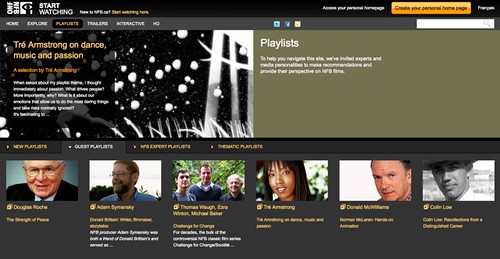
NFB playlists1

My young colleague Tobi Elliott who helps me with this blog has this to say:

I recently spent a morning browsing the NFB’s excellent resource of film playlists. The playlists have been a feature of the new www.nfb.ca website since it launched in January 2009. Invited guests and their own staff have grouped together films around themes ranging from the powerful to the whimsical, the obvious to the obscure.

I have one conclusion…. You can get lost in there! The only way I can justify spending hours watching ten of these films at a time, is by rationalizing that it’s the duty of every young filmmaker to see the work of filmmakers that have gone before them.

Thanks to the playlists, it becomes a delightful chore. They are a useful tool for whittling down the wonderful selection of films available on the website. They also provide insight into the making-of certain films and in some cases, the historical context that otherwise would be lost to someone of my generation.

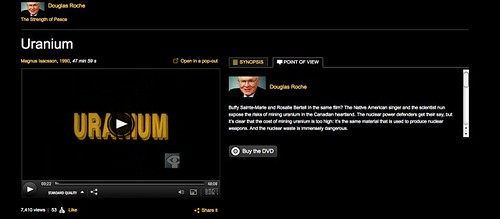
NFB Roche playlist

The NFB’s Guest Playlists include film groupings by the following people, some of whom are in-house producers and filmmakers:

  • Douglas Roche: The Strength of Peace (Magnus’ film Uranium, Terry Nash’s If You Love This Planet, and Martin Duckworth’s Return to Dresden are included in this list)
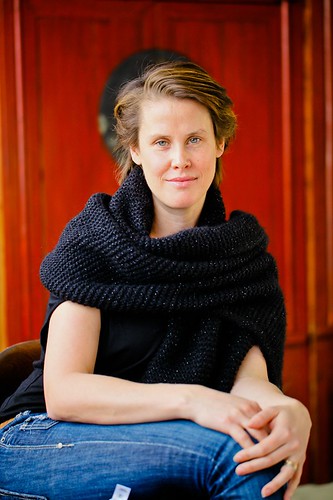
  • Tre Armstrong: Dance, Music and Passion
  • Donald McWilliams: Norman McLaren: Hands-on Animation
  • Colin Low: Recollections from a Distinguished Career
  • Alanis Obomsawin: a Retrospective
  • Gil Cardinal: The Aboriginal Voice
  • Katerina Cizek: Manifesto for interventionist Media
  • Thomas Waugh, Ezra Winton and Michael Baker: Challenge for Change
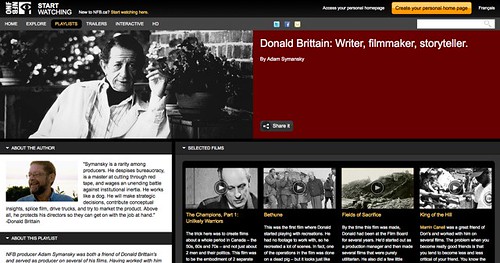
  • Adam Symansky: Donald Brittain

The guest authors of their collections take one of two approaches in their selections: either they focus on a theme or a particular filmmaker. Cizek’s playlist brings together 11 films on “the philosophy and practice of ‘Art as a Hammer’.” Her picks range from 1944’s short Democracy at Work to 2008’s RiP! A Remix Manifesto.

NFB symansky playlist

Symansky’s collection brings together eight Donald Brittain films, each written up with a personal recollection of Symansky’s about the “making of” of the film. The writing alone is an invaluable resource for younger filmmakers like myself.

In the NFB’s Expert Playlists, their resident collections expert, Albert Ohayon, put together six useful playlists:

  • 10 Great Films from the last decade you may not have seen
  • The 1960s: An Explosion of Creativity
  • The 1950s: Television and the Move to Montreal
  • Canada’s Diverse Cultures
  • Bill Mason: Beyond the wild, beyond the paddle

And finally, the Thematic Playlists comprise almost sixty collections of films and clips, intriguing because there’s such a huge variety. Where else can you access groupings ranging from ‘Winter Sports Movies” to “Canada’s got Treasures!”?

Treasures indeed.

Thanks to Tobi Elliott for this post.

Talkies in Toronto

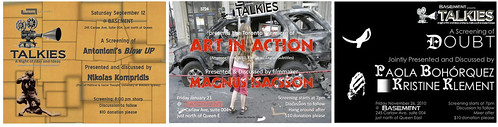
Talkies poster-3-1
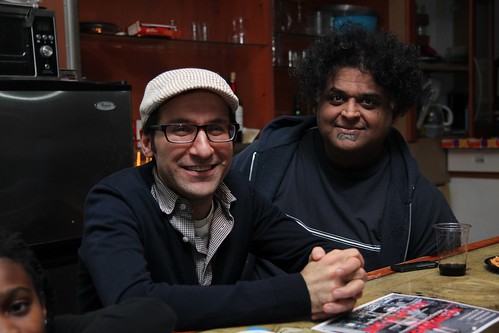
A few weeks ago, I was invited to present a film at an event called Talkies in Toronto. It was one event in a series of screenings and discussions, organized by York University humanities professor Mark Cauchi and his co-conspirator filmmaker Azed Majeed.

I thought about the choice of film for a while. In the end I suggested to Mark and Azed that I show either the controversial documentary Capturing the Friedmans, which would have allowed us to discuss many tricky issues of access and consent, or one of my own films. They decided to go for one of mine, because it would be their first documentary and the Toronto premiere of Art in Action.

Now, if you read this blog often, you’ve already heard enough about Art in Action (see previous post). So let’s talk about Talkies. The very congenial but intellectually intense event takes place in what would be a loft if it wasn’t a basement, in Toronto’s East End.

Mark explains it this way:

“The films are selected primarily by the speakers. We give them free reign to pick what they want. We figure that they’ll know best what film they can discuss in an interesting manner. This has resulted in wide variety of films being selected, from Antonioni and Godard to the 80s thriller Angel Heart to a recent film like Doubt.”

“When we conceived the series, one of the ideas was not to confine it strictly to “film studies.” So we’ve been selecting people who have expertise in certain fields or practices, who also like to work with and think about film, and who are engaging speakers. We don’t want a classroom. This means we’ve had speakers take philosophical, political, psychoanalytic, sociological, and anthropological approaches. Most have been academics, but that’s not by design as much as by circumstance. We want to get more film makers and other artists and non-academic writers to participate.”

Talkies in Toronto organizers Mark Cauchi and Azed Majeed.

Can you give an example or two of interesting discussions?

“Nikolas Kompridis (Professor at the Center for Citizenship & Public Policy, University of Western Sydney) gave a presentation on Antonioni’s classic, Blow-Up. He suggested that the film was challenging the modernist ethos of mastery and control (exemplified in taking pictures, technology, and swingin’ 60s consumption) by presenting its main character and its viewers with an enigma that no amount of control (exemplified in blowing up a picture) could resolve. The main character and viewer learns that instead of always attempting to control actively one’s environment, sometimes one must simply be receptive to what is beyond oneself.

“Kristine Klement (a graduate student in Social & Political Thought at York University) and Paola Bohorquez (Instructor of English, York University) gave a co-presentation on the recent film Doubt. They highlighted the fact that there is no evidence of crime in the film, and yet characters and viewers are compelled to regard the main character of the film as guilty. Leaving aside the question of whether or not he is guilty, they used psychoanalytic theory to explore the psychological processes that lead to such discrepancies.”

“Both discussions opened up the films in interesting and unexpected ways and generated a lot of discussion and response by our viewers.”

What’s coming up?

“The next Talkies will be on Saturday February 26.

We will be screening Bruno Dumont’s 1997 debut film, The Life of Jesus. Despite the title, this film does not depict the life of Jesus, a la Pasolini’s Gospel According to Saint Matthew or Mel Gibson’s The Passion of the Christ. The film will be in French, with English subtitles.

John Caruana (Professor of Philosophy, Ryerson University) will be discussing the film. As usual, the event takes place in the basement at 245 Carlaw Ave, suite 004 (just north of Queen East), and starts at 7 pm.

Thanks to Tobi Elliott for her help with this blog.

Sexy concrete – documentary theatre

SexyBeton2011
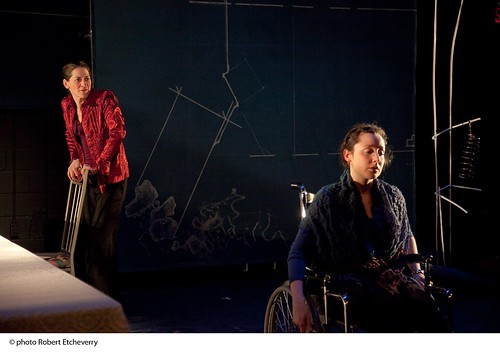
France Roland and Maude Laurendeau-Mondoux in 'Sexy béton'.

Last week I went to see a terrific documentary play called SEXY BÉTON, or “sexy concrete”. It was created by Annabel Soutar of the Porte Parole theatre company in Montreal – only the last in a series of documentary theatre performances.

And this truly is a documentary ‘démarche’ – to use this excellent French word which means a way of proceeding, an approach which involves a particular method. It’s an investigation of the cave-in of a concrete overpass that killed five people and seriously injured six others in Laval, just north of Montreal in 2006.

Annabel and her colleagues create a performance which is a hybrid of a documentary film shoot, a journalistic investigation and participatory research. They have a big advantage in that they don’t represent a media organization and they don’t have to bring a camera when they go to meet people. They record audio, and then use excerpts of people’s statements or dialogue to construct their play. People don’t have their guards up the way they would with a more elaborate or more journalistic setup.

What we learn from the play is revealing, shocking and thought-provoking. To sum it all up, this is a tragedy for which no one takes responsibility. The engineers, the construction companies, the sub-contractors, the civil servants working for the Department of Transport – no one wants to fess up to any wrongdoing or negligence.

To Annabel and her co-conspirators this case is a metaphor for the general state of affairs in our society. A lot is going wrong, catastrophically wrong, but no one is responsible. This is an important point.

And, in addition, the play seems incredibly timely in the present Québec context. The action takes place in Laval – Quebec’s second largest city – where municipal corruption is just now the subject of frequent scandals. And it deals with the construction industry, at a moment where a majority of Quebecers would like to see an official inquiry into corruption and wrongdoings in this sector. (Radio-Canada’s excellent investigative show Enquête should be credited with most of the revelations on these subjects.)

In creating this play, Annabel and her colleagues decided to do more than investigate. They attempted to convince the surviving victims to go for a lawsuit. Ignoring the advice from high-profile lawyer Julius Grey not to push the victims, they try hard but fail, and (though one might disagree with what they are doing) this is an important and interesting part of the story.

In watching the excellent crew of actors perform the interaction between the victims and with the documentarians, I felt like I was completely reliving my experience with the innocent victims of organized crime who were the subject of my film Hellbent for Justice (‘Pendant que court l’Assassin’.)

In both cases, the victims were completely unprepared for the complex physical, psychological and legal realities they suddenly had to deal with. And in both cases they have to confront bureaucratic machineries which don’t take their real-life situation into account.

The mise en scène (designed by Sophie Vajda and André Perrier) is great, the actors are fantastic, and completely bilingual. Watching this play is a truly Montreal experience of the best kind.

The play is still on until Feb 26. I am asking Annabel Soutar a few questions and will publish them in the coming weeks.

Thanks to Tobi Elliott for her help with this blog.

HD for Dummies

Philippe Lavallette - les réfugiés de la planète bleue
DOP Philippe Lavallette at work with an HD camera on Les réfugiés de la planète bleue.

These days, most documentaries are shot in HD, high definition. Seems to make sense, doesn’t it, since you can buy a high definition camera for just a thousand dollars! But does this mean that all HD is one and the same thing, and that you get as good an image with a thousand-dollar camera as with one that costs 50 times more? You guessed it, you don’t.

A few weeks ago I had the privilege of taking a course in HD workflow at PRIM, in Montreal, a resource centre for artists and filmmakers. (I am a member, we did the post-production for my most recent films there.) It was an opportunity to get an answer to my most pressing question: what does HD really mean, how do you know what quality you are really getting, and can you combine different kinds of HD formats without noticeable quality differences ?

So, in case you were asking the same question, here’s a short summary answer. The quality of a digital image is partly, but only partly, defined by the resolution, measured in lines of pixels. Standard Definition (SD) has 480 horizontal lines. The most common HD resolution is 1080 (horizontal) x 1920 (vertical) lines for a 16:9 image, but can be lower (720 for the vertical count is common) or higher (up to 4000 for a camera like the RED).

However, the actual quality of the image doesn’t depend only on the resolution. It also is a direct function of the compression, the size and nature of the image sensor, and the quality of the lens.

Compression is a way to encode the information to save space on whatever support the image is recorded on. It is expressed in three-part a formula as in 4:4:4 (uncompressed) or 4:2:2 (a $5,000 prosumer camera like the EX-1 which I use.) The inevitable cost of compression is a loss of definition and detail, and reduced margins for colour correction and visual effects in post production.

And the sensor. The smaller the sensor, the less detail you will get, and– counter-intuitively– the more depth of field you will get. More depth of field might sound like a good thing to the neophyte, but actually film makers tend to want the opposite, to achieve more of a ‘film look.’ (Main subject in focus, background out of focus, for ex.) Both Sony and Panasonic are just coming out with cameras that will make it possible to shoot video with a very limited depth of field, that will be another small revolution in video production.

With the help of PRIM’s excellent staff, we did some tests with the different cameras I use. To summarize the conclusion: the small and cheap HD cameras give a surprisingly good result, but you don’t get the same quality image as with a more expensive one. If you want to combine to two, the smaller/cheaper cameras should be used in good lighting conditions.

Thanks to Tobi Elliott for help with this post.

‘Inside Disaster’: the Interactive Experience

Inside disaster screenshot-12

Last week I wrote about the terrific Inside Disaster series. And here, as promised, is my colleague Tobi Elliott’s assessment of the interactive game on the Inside Disaster web site, where you can choose to be a survivor, a relief worker, or a journalist. (Tobi, as you may have noticed, regularly helps with this blog.)

Greeted by a grim, ashy looking scene of destruction, I begin the “Inside the Haiti Earthquake” experience with a small amount of dread. The disclaimer reads: “Please note that this simulation contains graphic and disturbing imagery.”

Many of the images ARE disturbing. Graphic and heartwrenching. Bodies lying in heaps on the ground. Rioting for food, people getting trampled. Fires and tears and brokenness. Some clips are more vivid than others, but the grainy film texture sometimes adds to the chaos the experience is supposed to replicate. Music underscores many of the clips.

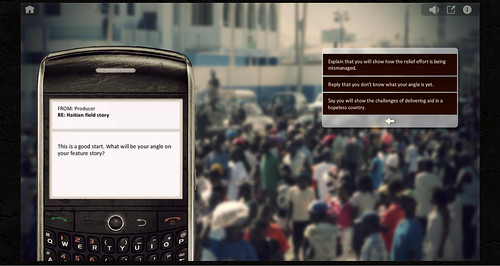
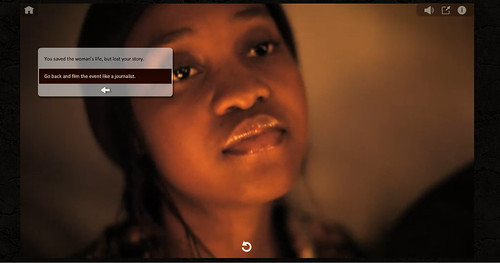
I chose to enter the experience as a journalist, of course, and my job was to create a two-minute feature story on the earthquake for a major network. After arriving in Haiti and travelling to Port-au-Prince, I was given the choice to go out into the streets and film, or stay in the safety of the Canadian Embassy. I chose to go out and get a story.

Following most segments, the player is presented with options to select from, choices that affect the outcome of your story. Some of the introductions/transitions to the next segment are almost hilarious, like a vibrating Blackberry cellphone with a text message from your producer after you file your first story.

Inside disaster screenshot-7
Your choices can lead to harsh, seemingly realistic outcomes, as I discovered when I lost my job after making a poor choice as a journalist! (I decided on a story angle too soon and couldn’t deliver… hmm…)

Generally, I found the experience quite moving because it brought me right into the reality of chaotic post-earthquake Haiti. I forgot sometimes that I was playing “a game.” What was onscreen could believably become what you might see with your own eyes. It became real. Your choices do seem to matter, even if just for a split second, “inside disaster.”

This simulation would probably appeal to almost any age, except for young children, and seems more designed to rouse empathy than to educate. The choices you make can lead to good and bad consequences, but that doesn’t seem to be the point of the experience. Instead, it’s about experiencing the chaos and trauma in a situation like the aftermath of Haiti’s earthquake… where every decision isn’t necessarily a good one, just the best one that could be made at the time.

Check it out here and see for yourself: www.insidedisaster.com/experience.

Inside disaster screenshot-5

Thanks to Tobi Elliott for her help with this blog. You can find her at her new website here.

More on Inspiration: my mother Kerstin

Kerstin - In MemoriumKerstin - In Memorium 2Kerstin - In Memorium 3

I find it interesting that I sometimes get very positive response to blog items which are more personal. A while back I wrote about the visual artists in my family as a source of inspiration: my father Arne, who died a few months ago, my uncle Torsten, my sister Eva.

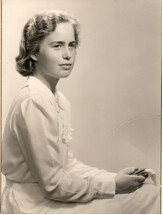
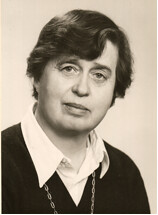
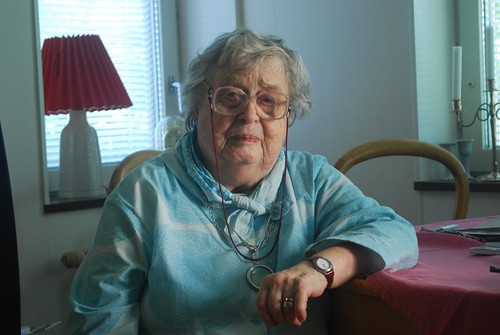
But another big influence was undoubtedly my mother Kerstin, who passed away a year ago. This is an excerpt from a short text I wrote about her for the funeral. For those of you who have seen my films – or who read my blog – the connections to my work are pretty obvious.

Kerstin - In Memorium 4

Kerstin was a renaissance person, and a citizen of the world. The former in the sense that she was intensely interested in everything: family and society, nature and culture; cooking just as much as history and philosophy; the trees outside the window as much as religion and literature.

To her everyday life she gave a sense of style and elegance, but that was only part of her reality, because culture was her life. Sometimes she reminded me of my experiences with some Native Americans who don’t make a hard distinction between reality and myth – for them, the two merge into one universe where the mythological creatures are just as real as the neighbours in the village.

Kerstin’s world was largely populated by artists and authors, composers and actors – some of whom she had actually met and known personally – but actually the others seemed just as real, and her relationship to them was just as meaningful. Faced with some day-to-day problem she was just as content to discuss it with Herman Hesse or Susan Sontag, as with a friend or family member.

She also had very vivid memories of people she had met, and kept them alive in her memory. In this way, she was never alone, although of course she lived by herself since we were children. And we must not forget the music: it was an important part of her world. That she should have chosen the music for her funeral is perfectly logical, and when you listen to it, Bach and psalms, folk and popular music, it reminds you of the range of her interests.

She was a citizen of the world in at least two ways. Her cultural interests knew no borders. She had vivid memories from her many trips abroad. She read in English and French, and until her last months she was still looking up words and learning new expressions. She read other literature in translation. It was always fun to talk to her when the Royal Swedish Academy had made its decision for the Nobel Prize. It was rare that they would decide on an author with whose work Kerstin was not familiar, and she always had her opinion about their choice.

She also followed world politics, not just with interest but with a constant concern for the best ways to solve problems and resolve issues. I was amazed that she never tired of this or gave up. Until her last weeks, even in the hospital, she wanted her daily paper. It was important for her to keep track of new developments and to make up her mind about them. Every conversation with Kerstin, even on the phone, moved quickly from family matters to culture and world politics.

Kerstin’s profession involved working with children, usually children with learning difficulties. In her archives, many folders and binders with course plans, certificates and childrens’ drawings attest to the quality of her work in this domain. Other teachers who worked with her saw her as an example.

As adults, many of her former students have spoken of her particular way of taking children seriously. Just one example: my older daughter Anna once said to me: “Can you believe this, Grandma just asked me if hip hop music is progressive. How old is she anyway?” Well, she was in her mid-seventies at the time, and even at that age she could make the rest of us feel intellectually lazy.

I will always think of Kerstin with gratitude and admiration.

Thanks to Tobi Elliott for her help with this blog.