Si vous lisez mon bloque régulièrement, vous avez probablement remarqué que je ne critique que très rarement le travail d’autres documentaristes. Mais j’ai été invité récemment à participer à une discussion à l’émission Premières Vues, diffusé sur Canal Vox, la télévision communautaire de Vidéotron/Québecor.
Après avoir parlé de ma propre démarche, j’ai discuté du film ‘Chercher le Courant’ avec les deux réalisateurs Nicolas Boisclair et Alexis de Gheldère. Le film est construit autour de leur descente de la rivière La Romaine en 2008, l’année avant que commençait le harnachement de celle-ci par Hydro-Québec.
Le voyage est entrecoupé de scènes d’une enquête systématique sur les alternatives énergétiques plus vertes qui ne détruisent pas des rivières et qui ne créent pas ou peu de gaz à effet de serre – menée d’ailleurs par le comédien Roy Dupuis. Et comme le but de l’exercice était de discuter du film, j’ai du exprimer mon point de vue.
D’abord, j’ai tenu à féliciter les deux cinéastes pour leur sens de l’initiative et leur courage. Non seulement ils ont entrepris une expédition de 700 km en canot sur une rivière difficile – de sa source au Labrador jusqu’à l’embouchure dans le St. Laurent. Ils ont en plus réussi à réaliser un film très ambitieux et substantiel malgré un contexte très difficile et un financement nettement insuffisant. Étant moi-même kayakiste de rivières et documentariste, je suis en mesure d’apprécier l’ampleur des défis qu’ils ont relevé. Comme premier film, c’est impressionnant.
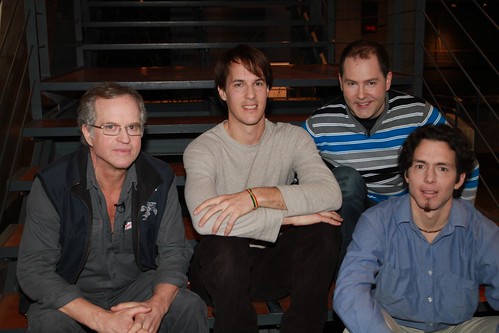
MI, Nicolas Boisclair, Frédéric Corbet et Alexis de Gheldère.
Par contre, dans l’émission – qui sera diffusée cette semaine – j’exprime aussi des critiques par rapport au film. Pour moi, l’histoire dramatique qui aurait pu être bien plus développée était justement la descente de la rivière, avec ses multiples embûches et rebondissements. Il fallait juste le dire pour que les deux cinéastes se mettent à raconter plein de dimensions de cette aventure qui ne sont pas dans le film. Ils ont voulu faire un film plus didactique, parce que leur mission en était une d’éducation populaire sur les choix énergétiques. A mon sens la qualité du film en tant que film se trouve à en souffrir.
C’est un choix très différent de celui que j’avais fait en réalisant Power (Tension) sur la campagne des Cris pour sauver la Rivière Grande Baleine au début des années 1990. Pour moi, il faut avant tout raconter une histoire captivante de manière cinématographique, plutôt que d’inclure toutes les informations et analyses dans le film. Ceci dit, j’ai déjà fait des films plus didactiques et dénonciateurs moi-même.
Et…. ‘Chercher le Courant’ est un excellent outil d’éducation, certainement un film à voir pour mieux comprendre nos options énergétiques.
L’émission Premières vues est animé de façon très dynamique par Fréderic Corbet. Elle sera diffusée jeudi à 19.30 avec de multiples reprises au cours des jours suivants.
Last week I wrote about the terrific Inside Disaster series. And here, as promised, is my colleague Tobi Elliott’s assessment of the interactive game on the Inside Disaster web site, where you can choose to be a survivor, a relief worker, or a journalist. (Tobi, as you may have noticed, regularly helps with this blog.)
Greeted by a grim, ashy looking scene of destruction, I begin the “Inside the Haiti Earthquake” experience with a small amount of dread. The disclaimer reads: “Please note that this simulation contains graphic and disturbing imagery.”
Many of the images ARE disturbing. Graphic and heartwrenching. Bodies lying in heaps on the ground. Rioting for food, people getting trampled. Fires and tears and brokenness. Some clips are more vivid than others, but the grainy film texture sometimes adds to the chaos the experience is supposed to replicate. Music underscores many of the clips.
I chose to enter the experience as a journalist, of course, and my job was to create a two-minute feature story on the earthquake for a major network. After arriving in Haiti and travelling to Port-au-Prince, I was given the choice to go out into the streets and film, or stay in the safety of the Canadian Embassy. I chose to go out and get a story.
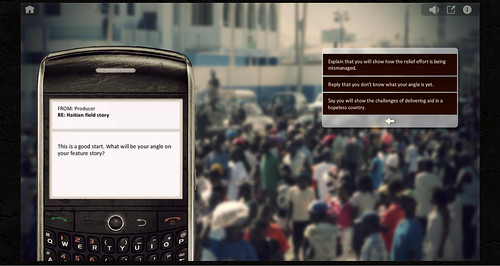
Following most segments, the player is presented with options to select from, choices that affect the outcome of your story. Some of the introductions/transitions to the next segment are almost hilarious, like a vibrating Blackberry cellphone with a text message from your producer after you file your first story.
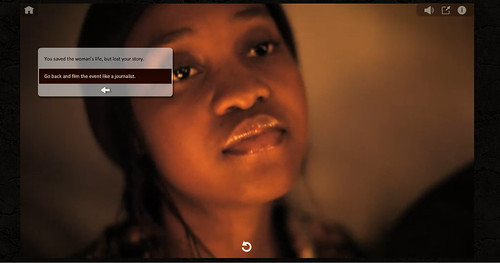
Your choices can lead to harsh, seemingly realistic outcomes,as I discovered when I lost my job after making a poor choice as a journalist! (I decided on a story angle too soon and couldn’t deliver… hmm…)
Generally, I found the experience quite moving because it brought me right into the reality of chaotic post-earthquake Haiti. I forgot sometimes that I was playing “a game.” What was onscreen could believably become what you might see with your own eyes. It became real. Your choices do seem to matter, even if just for a split second, “inside disaster.”
This simulation would probably appeal to almost any age, except for young children, and seems more designed to rouse empathy than to educate. The choices you make can lead to good and bad consequences, but that doesn’t seem to be the point of the experience. Instead, it’s about experiencing the chaos and trauma in a situation like the aftermath of Haiti’s earthquake… where every decision isn’t necessarily a good one, just the best one that could be made at the time.
It is a year since the devastating earthquake in Haiti, and just about every generalist television network has been broadcasting special programming. I found most of it to be competently done and well-meaning, but extremely predictable and pretty superficial.
This is the curse of television. Just wait till the 10th anniversary of September 11th later this year. Millions of dollars will be spent on reporters and television crews lining up to broadcast from Ground Zero, and I could tell you already what they will say. Meanwhile, how much coverage is there of the millions of people who have perished in Congo over the last five years?
Fortunately, for this earthquake anniversary, there were a few exceptions from the run-of-the-mill. Radio-Canada’s news channel RDI broadcast a documentary by Réal Barnabé and Dominique Morisette who had gone back to meet the people and places featured in Radio-Canada’s first ever reportage from Haiti (done by the grand dame of Quebec télévision journalism, Judith Jasmin). Pourquoi Haiti? became Pourquoi pas Haiti? (Why Not Haiti?) and it was interesting to see that some of today’s key players on the country’s political scene were already active back then.
Frontline (PBS) showed an interesting look at the policing situation in Port-au-Prince, where the criminals who escaped the crumbling prisons in the aftermath of the quake have taken refuge in the emergency tent camps where they are rebuilding their gangs and taking control.
Butthe best programs are broadcast on TVO: the series Inside Disaster, directed by Nadine Pequenza and produced by Andrea Nemtin and Ian Dunbar at PTV productions in Toronto. I already congratulated them on their sense of initiative a year ago and I am very happy to see that they have really delivered. The authors of the series have also wisely decided to look beyond the disaster towards the long-term challenges of reconstruction – we haven’t seen that part yet.
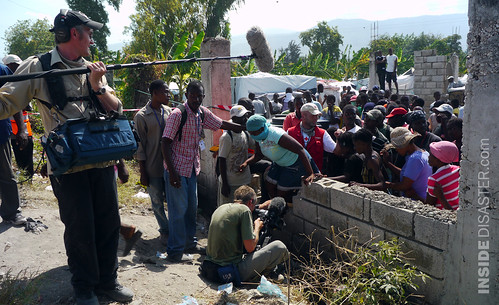
Shooting 'Inside Disaster'Dir. Nadine Pequenza
This is terrific documentary work, not just news reporting. We are truly inside the biggest humanitarian relief effort ever, focusing on the Red Cross and some really great characters – Jean-Pierre Taschereau who leads the huge team is just one of them – as they struggle against overwhelming odds to get water, food and medical help to the victims of the quake. You are really there with them, experiencing their challenges, difficulties and emotions.
The shooting and editing are excellent, and the website that accompanies the project is exemplary, giving you information about the earthquake, about ‘humanitarianism’ and emergency relief efforts, and about the film. The companion blog Haiti-today goes in depth into the reconstruction effort, and there is also an interactive component to the site, where you can play the role of a victim, a journalist or a relief worker. I asked Tobi Elliott who helps me with this blog to try it out. Her comments in a few days.
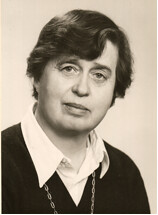
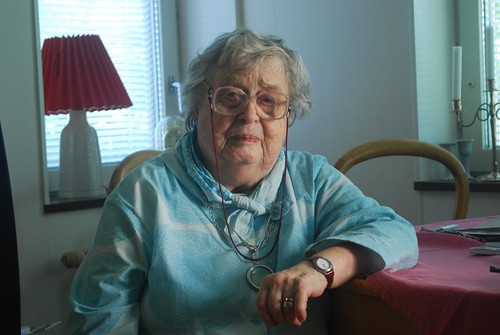
But another big influence was undoubtedly my mother Kerstin, who passed away a year ago. This is an excerpt from a short text I wrote about her for the funeral. For those of you who have seen my films – or who read my blog – the connections to my work are pretty obvious.
Kerstin was a renaissance person, and a citizen of the world. The former in the sense that she was intensely interested in everything: family and society, nature and culture; cooking just as much as history and philosophy; the trees outside the window as much as religion and literature.
To her everyday life she gave a sense of style and elegance, but that was only part of her reality, because culture was her life. Sometimes she reminded me of my experiences with some Native Americans who don’t make a hard distinction between reality and myth – for them, the two merge into one universe where the mythological creatures are just as real as the neighbours in the village.
Kerstin’s world was largely populated by artists and authors, composers and actors – some of whom she had actually met and known personally – but actually the others seemed just as real, and her relationship to them was just as meaningful. Faced with some day-to-day problem she was just as content to discuss it with Herman Hesse or Susan Sontag, as with a friend or family member.
She also had very vivid memories of people she had met, and kept them alive in her memory. In this way, she was never alone, although of course she lived by herself since we were children. And we must not forget the music: it was an important part of her world. That she should have chosen the music for her funeral is perfectly logical, and when you listen to it, Bach and psalms, folk and popular music, it reminds you of the range of her interests.
She was a citizen of the world in at least two ways. Her cultural interests knew no borders. She had vivid memories from her many trips abroad. She read in English and French, and until her last months she was still looking up words and learning new expressions. She read other literature in translation. It was always fun to talk to her when the Royal Swedish Academy had made its decision for the Nobel Prize. It was rare that they would decide on an author with whose work Kerstin was not familiar, and she always had her opinion about their choice.
She also followed world politics, not just with interest but with a constant concern for the best ways to solve problems and resolve issues. I was amazed that she never tired of this or gave up. Until her last weeks, even in the hospital, she wanted her daily paper. It was important for her to keep track of new developments and to make up her mind about them. Every conversation with Kerstin, even on the phone, moved quickly from family matters to culture and world politics.
Kerstin’s profession involved working with children, usually children with learning difficulties. In her archives, many folders and binders with course plans, certificates and childrens’ drawings attest to the quality of her work in this domain. Other teachers who worked with her saw her as an example.
As adults, many of her former students have spoken of her particular way of taking children seriously. Just one example: my older daughter Anna once said to me: “Can you believe this, Grandma just asked me if hip hop music is progressive. How old is she anyway?” Well, she was in her mid-seventies at the time, and even at that age she could make the rest of us feel intellectually lazy.
I will always think of Kerstin with gratitude and admiration.
I just wrote a very serious blog post, but I decided to save it til after the holiday season. I can see that people are in a party mood, which is a good thing. Even though Christmas and New Year’s come in well after Halloween and Valentine’s in my own Holiday ratings, it is a good time to see family and friends.
What’s not so good is the shopping Frenzy out there. With Canadian’s personal indebtedness at an all-time high, do we need to spend a lot more money on a lot more stuff?And do we need the stress of near-impossible parking and shopping mall line-ups?
In my Swedish family, present-giving has always been important. My mother, for one, always made beautiful packages for carefully chosen books or home-made textiles, a tradition now kept up by my sister Eva.
I like giving presents too, but I can’t stand Christmas shopping, and I have a system to avoid it. It’s the Present Cupboard. (Comes in handy for birthdays too.) All year, as I travel – or even just walk around town – I keep my eyes open for good presents. Although I won’t turn down a good sale with reduced prices, I have a big preference for buying things directly from people who make them, so I know where the money is going.
Inexpensive presents: the wrecked-car key rings on the right are from ATSA - the subject of my film Art en Action. You can find other presents on their website.
It seems to me this is more important than ever these days when arts and crafts are under attack from governments. If you buy something from a local artist or artisan, you are helping them stay alive and keep doing what they do best. There are also the special stores which sell fair trade presents, a great way to support cooperatives in poor countries. Many NGOs also sell fair-trade presents on-line.
And then there are great ways to contribute to good causes around the world, and ear-marking your donation as a present for a friend. This is mostly what I’ll do this year, because this has been such a terrible year for the people of Haiti.
So I will buy most of my ‘presents’ from Doctors Without Borders – you can buy cholera medicine, or pay for a day’s salary for a nurse or doctor. And I’ll make a contribution to Democracy Now!, for its great alternative news coverage totally independent of the multinational corporations who own most of the other media. ATSA is another excellent (and local!) group of engaged artists and citizens.
Boring, too ‘politically correct,’ moralistic? Some commentators in the mainstream media think so. If you asked the doctors on the frontlines in areas stricken by disaster, I think there perspective would be different.
Joyeuses fêtes!
God Jul och Gott Nytt År!
Feliz Navidad!
Happy holidays to all!
Thanks to Tobi Elliott for her help with this blog.
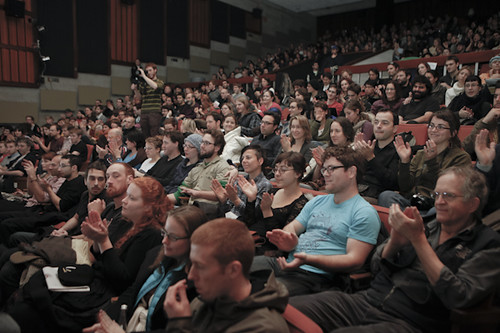
Cinema Politica is now, according to programmer Ezra Winton, the biggest community- and campus-based documentary screening network in the world! And Concordia, its home base and launching pad, continues to be the scene of weekly screenings often attended by more than 500 people – quite an achievement!
This time, after several years of efforts, Winton and CP Director Svetla Turnin had succeeded in bringing the Yes-Men to Montreal. Do you know who they are? They are surely the world’s leading impostors of the serious-humorous kind. They have pulled off some incredible hoaxes, and always at the expense of governments and corporations who should have reasons to be ashamed of their doings.
The Yes-Men modus operandi is to create false websites which lead people to invite them to conferences as representatives of the ‘bad guys.’ Once there, they push the envelope, taking corporate and government strategies to absurd levels, announcing outrageous schemes. The most incredible thing about their stunts is that people usually take them seriously, even when they propose, for example, human remains as a new energy source or human waste as a protein source for the poor.
Onbehalf of Dow chemicals, they apologized for the Union Carbide disaster in Bhopal and promised compensation for the victims. They got terrific coverage on BBC news around the globe, forcing DOW (the new owner of the UC assets) to strenuously deny that they had done something good! The Concordia crowd saw these feats in the film The Yes Men Fix the World, produced by Andy Bichlbaum and Mike Bonnano themselves, as a follow-up to the 2003 film The Yes Men.
I found the film a little uneven but full of brilliant ideas. For example, some arch-conservative U.S. climate-change deniers and free-market apostles are shot against a blue screen and are asked what they would like to see as a background for themselves. They then take the interviewees’ suggestions to heart, in their own humorous fashion, and use the backdrops as an ironic backdrop to their comments. Talk about giving people the rope to hang themselves. And most of all, the footage of the Yes Men’s stunts is priceless.
In the discussion afterward, Andy and Mike (actually Jacques Servin and Igor Vamos) explained that they are anti-capitalist, that they take advantage of opportunities to expose fraud and ill-doing, that they haven’t generally had problems with lawsuits, and that they encourage people everywhere to follow their example.
In response to the many activists who inevitably wanted to know if they had done something on their pet issue, they gave the sound advice: why don’t you do it yourselves!
Congrats to Cinema Politica for an exceptional last-screening-of-the-year!
With thanks to Tobi Elliott for her help with this blog. Photo credit: Thanh Pham
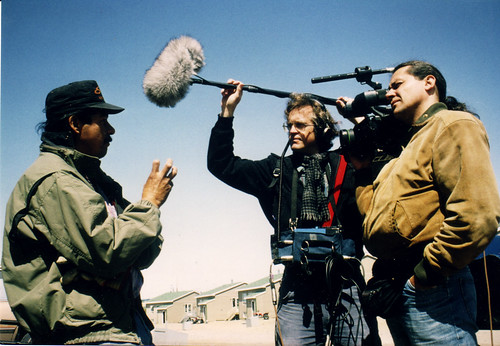
Myself and DOP René Sioui-Labelle shooting Power at Hudson’s Bay in the early 90s interviewing Cree chief Matthew Mukash.
Film students sometimes ask theoretical questions which, while not uninteresting, are not particularly important to a practitioner. But Tom Eden from the documentary program in Rivière du Loup asked me this: is it a good idea to direct and to do camera and sound at the same time?
This is a big question, and I could write a book about it. Some pioneers of cinéma vérité did their own camera work (Pennebaker) or sound (Wiseman). Some of my colleagues whose work I admire do their own camera work: John Walker, Martin Duckworth, Ali Kazimi… and I do my own sound – as did one filmmaker who really inspired me, Barbara Kopple.
I think some of us took this approach years ago because we wanted to have a small crew and also to maximize the number of shooting days (by spending less money per shooting day.) But the combination of reduced budgets and accessible digital technologies have really brought this way of working to the fore.
These days there are filmmakers who do everything themselves – one example is Montreal filmmaker Eve Lamont, who just released a film on prostitution (L’Imposture), which she directed while doing camera and sound herself. An impressive achievement, considering some of the situations involved several different characters, sometimes in uncontrolled environments.
The other day I saw a very good film, Gasland (shortlisted for the Oscars) shot by the filmmaker – but the shooting is pretty awful. What saves the film is the personal narrative tone, the investigation and the excellent editing. Imagine if it had been well shot as well!
For me, doing camera work would have come naturally, as I have a background in visual arts and photography. But I have chosen to do sound because I find that it allows me to have a better overview of what’s going on, looking around to see what else is going on outside of the frame.
So… doing creative tech work while directing has many advantages, primarily reducing the size of the crew and controlling costs. But here is a caution. Directing really requires your full attention. So does camera work and sound recording. So if you wear two of these hats at the same time, you are inevitably compromising.
If you are on a tight production schedule, something will get less attention. So one key issue is time. Doing camera or sound is great if you know how to do it, and you are not in a rush! Another key is really knowing your gear. (You don’t want to be struggling with tech issues at the crucial moment when you need to reassure your characters, negotiate access, ask a key question…) And your relationship and communications with whoever else is working with you needs to be really tight.
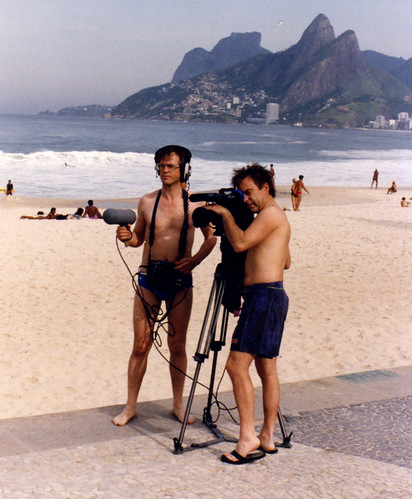
Here is an old photo to show that directing and doing tech work can be fun: myself and DOP James Grey on a beach in Rio during the 1992 Earth Summit in Rio de Janeiro.
Thanks to Tobi Elliott for her help with the blog.
The film has all the characteristics of a Longinotto documentary: it has amazing access to intimate situations, it deals with the rights of women, it’s tough and uncompromising, and doesn’t stay away from contradictions and difficulties. In this case, the main character is admirable, but Longinotto doesn’t idealize her, and at one point the film clearly shows her making a selfish and morally questionable choice which has serious consequences for a young woman who she has taken under her wing. The film is beautifully shot by the director herself.
Photo: Paul Galipeau
I went to hear Longinotto speak at a workshop at Hot Docslast spring. I was very impressed by her modest and unassuming presentation. What struck me the most was her combination of caring for her subjects but her incredible tough-mindedness. She is so close to the characters that they will, it seems, let her film just about anything, no matter how hard it is.
And she does – even when the scenes are almost unbearable to watch, as in a famous scene from a female genital mutilation in Africa. Life is often unbelievably hard for women in ‘Third world’ countries, and Longinotto is determined to show it – but always from the perspective of people who are working to change the situation. It’s an attitude which seems to be rooted in her own harsh childhood experience as a homeless orphan, and her feeling that filmmaking “saved her life.”
It’s film festival season in Montreal, and I have seen quite a few films.
I am often struck by how much it takes to make a really excellent doc. A good subject or a worthy cause are only the most basic starting points. A good story is one step better, but far from a guarantee of a good film, telling the story is the challenge. Great characters, good… but how will they be developed? what changes will they go through? will we really get to know them? And then there are all the questions of framing, movements, soundscape, texture, pacing…
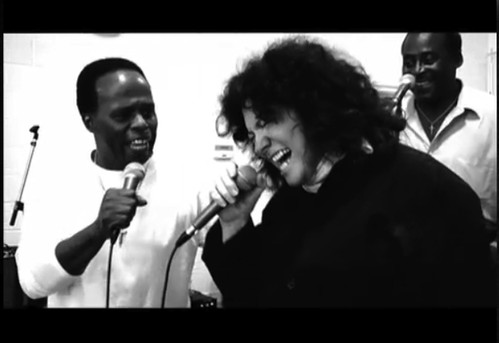
Two of the films I saw in the last few weeks really stand out (in addition to the one I wrote about in the last post.) At the Festival du Nouveau Cinéma I saw Music From the Big House, directed by Bruce McDonald (Hard Core Logo, Roadkill, Highway 61.) It’s the story of how Canadian blues singer Rita Chiarelli performs with several bands of inmates at Angola Prison, a U.S. maximum security penitentiary in Louisiana.
Ten years ago Chiarelli had been on a road trip in the American South, looking into the history of the blues, and happened upon the prison. It took years to develop the relationships needed to make this exceptional film, a story not just of prisoners and music but of redemption. Chiarelli was at the FNC screening and spoke in a totally honest and very touching way about her feelings about the inmates – murderers and rapists – she had gotten to know, and about her contradictory feelings about the question of forgiveness.
And the other day, at the Rencontres Internationales du Documentaire de Montréal, I saw an amazing Danish film about the war in Afghanistan, Armadillo. It follows young Danish soldiers to a forward base in Helmand where they patrol and eventually engage in combat with the Taliban.
The film is masterfully made, very close to the characters, beautifully shot, colorized in a way which strengthens a pervasive feeling of unreality. And this is the cinematic equivalent of the thousands of secret memos about the war released by Wikipedia.
Never has war seemed so confusing and futile. The young soldiers naively spout the official line about protecting civilians and fighting evil, even as the suffering civilians tell them that their presence carries a heavy price. The camera captures the confusion and fear they experience in a hostile environment far from home, accentuated when their comrades are killed or wounded.
And when they finally score a victory against the Taliban, killing five of them in a ditch – shooting wounded soldiers which is against the rules of war – their victory celebrations seem misplaced and even sinister. This must be the best war film I have ever seen.
Thanks to Tobi Elliott for her help with this blog.
“I know them well,” he said, “and I wouldn’t have cared if they had shown the film first. I just want them to give me an answer.” He then introduced the directors of the opening film of this year’s Focus Québec-Canada section, my friends Patricio Henriquez and Luc Côté.
Omar Khadr at age 15 (above) and 21.
The film is about the shocking case of the young Omar Khadr, the 24-year old accused of terrorism and killing an American soldier, who has been imprisoned for seven years, most of that time in Guantanamo. I will not summarize the case and describe this moving and incisive film in any detail, because I would not do as good a job as Cinema Politica’s Ezra Winton – read his article on the Art Threat blog.
Suffice it to say that the film is a deconstruction and analysis of the surveillance camera video of the seven-hour, truly revolting –Orwellian more than Kafkaesque– interrogation of Khadr by representatives of CSIS, the Canadian Security Intelligence Service.
Ezra is right in pointing out that we all have a share of responsibility for what the Canadian government is doing to this young man, a child soldier at the time of the events. You can only leave this film with a sense that something has to be done, even though Khadr’s lawyer explained at the launch that he is stuck between the devil and the deep blue sea.
Indeed, it seems – in the bargaining going on right now – that he will have to choose between pleading guilty to a crime he didn’t commit and continue serving time in prison, or rot in his cell in Guantanamo (the facility Obama promised to close!) forever. Amnesty petition here.
Since the film premiered, Patricio and Luc have been caught up in a whirlwind of activities, including a repeat screening of the film at the 700-seat Imperial Cinema where it premiered, and an upcoming screening on Parliament Hill in Ottawa. They nonetheless took the time to answer a couple of questions:
When we watch the film, the concept comes across so clearly and the structure seems so simple, so obvious. But during your process of creation…?
PATRICIO: The chronology in the shooting of a documentary doesn’t always provide an interesting dramatic structure. Often in the editing room you need to betray this chronology to give meaning to the images. Of course, in this case, we weren’t the ones who filmed the interrogation of Omar Khadr at Guantanamo by the Canadian secret police. Nevertheless, the seven hours of video recorded over four days in February 2003 (accessible to the public thanks to a decision by the Supreme Court of Canada in 2008) had a progression that we kept in our film.
Luc, our editor, Andrea and I, we watched these seven hours – of very poor technical quality – several times. We quickly discovered that each day had its own specific, separate nature. So we decided to identify each day as a journey: Day 1: Hope. Day 2: Fallout. Day 3: Blackmail, Day 4: Failure. Also, we understood we would need some context for these four days. So we directed our research toward eyewitnesses, people who had seen Omar, experts (scientific and legal), objective observers such as the Toronto Star reporter Michelle Shephard, and politicians. All these people had to help us better understand what played out during this four-day interrogation.
Andrea first edited together the interrogation in this order, and then we showed all the participants the passages they could appropriately illuminate for us in interviews. Then, we inserted these new elements into the structure of the interrogation. And voila, it wasn’t a very complex creative device.
Patricio Henriquez
Having followed this story for several years, how do you evaluate the media’s coverage of Khadr’s case?
PATRICIO: In Quebec, the coverage was particularly lacking. To my knowledge, the first print media to send a journalist to Guantanamo was Rue Frontenac, the website of the locked-out journalists of the Journal de Montreal. That’s totally to their credit.
Elsewhere, they trafficked in misinformation. One example: in a report aired Nov. 13, 2009, a Téléjournal correspondent in Washington said this of Omar Khadr: “He has already spent over seven years in Guantanamo, waiting for his trial for the murder of an American MILITARY DOCTOR.”
There are two grave errors in this communication. The 1st Class Sergeant Christopher Speer, in whose death Omar Khadr is allegedly implicated, had never been a military doctor. At the start of the proceedings against Khadr, the Pentagon stated (perhaps not innocently) that the victim had been a medic (‘un infirmier’ or ‘un brancardier’ in French.) The Radio-Canada reporter translated badly, calling him a “doctor.”
But even worse: Omar Khadr’s lawyers have proven since 2004 that the Pentagon has held back the fact that, in reality, Sergeant Speer was in Afghanistan as a member of the special forces known as Delta Force. And although he had been trained at one point as a medic, his primary role in Afghanistan was not to heal, but to kill.
This difference is doubly loaded with consequences for Khadr, because, according to the laws of war, killing a duly identified nurse or medic is a war crime. Therefore, probably more by negligence than in bad faith, Téléjournal reinforced all the same this idea that Omar had committed a war crime in killing a medical doctor. It’s not a shock then that public opinion, having fallen victim to similar misinformation, is still largely indifferent to the fate of Omar Khadr.
Then, we realized that practically every media in Quebec and in Canada has been content to merely reproduce the most emotional part of these seven hours of recorded video, the moment where, yielding to the psychological pressure of the Canadian secret agents, Omar cracks and falls into a depressed state, crying uncontrollably. No one seems to have taken pains to listen to the tapes in their entirety.
We do understand that journalists, working constantly under pressure, haven’t had the time to decode the material. This is where, sometimes, the documentary can be useful in supplementing, more calmly and later on, the picture of a certain reality.
How did you manage to finance the film?
Luc Cote
LUC: Financing this film hasn’t been very easy. After being refused by broadcasters and public institutions, we went to Jean-Pierre Laurendeau and Sylvie de Bellefeuille at Canal D. Without hesitation they agreed to give us a license. With this license, we had access to tax credits. But there still remained an immense hole in the budget of 50 per cent. One of my best friends, Kevin Kraus, who closely follows our work, offered to lend us money. So we went ahead by investing our salaries, our equipment, etc. For lack of resources, all of the filming – camera, sound and interviews – was done by Patricio and myself alone.
Thanks to Tobi Elliott for her help with this blog.