Happy (stress-free) holidays!

Bigger presents from Haiti
Items from my present cupboard

I just wrote a very serious blog post, but I decided to save it til after the holiday season. I can see that people are in a party mood, which is a good thing. Even though Christmas and New Year’s come in well after Halloween and Valentine’s in my own Holiday ratings, it is a good time to see family and friends.

What’s not so good is the shopping Frenzy out there. With Canadian’s personal indebtedness at an all-time high, do we need to spend a lot more money on a lot more stuff? And do we need the stress of near-impossible parking and shopping mall line-ups?

In my Swedish family, present-giving has always been important. My mother, for one, always made beautiful packages for carefully chosen books or home-made textiles, a tradition now kept up by my sister Eva.

I like giving presents too, but I can’t stand Christmas shopping, and I have a system to avoid it. It’s the Present Cupboard. (Comes in handy for birthdays too.) All year, as I travel – or even just walk around town – I keep my eyes open for good presents. Although I won’t turn down a good sale with reduced prices, I have a big preference for buying things directly from people who make them, so I know where the money is going.

Small presents from Haiti
Inexpensive presents: the wrecked-car key rings on the right are from ATSA - the subject of my film Art en Action. You can find other presents on their website.

It seems to me this is more important than ever these days when arts and crafts are under attack from governments. If you buy something from a local artist or artisan, you are helping them stay alive and keep doing what they do best. There are also the special stores which sell fair trade presents, a great way to support cooperatives in poor countries. Many NGOs also sell fair-trade presents on-line.

And then there are great ways to contribute to good causes around the world, and ear-marking your donation as a present for a friend. This is mostly what I’ll do this year, because this has been such a terrible year for the people of Haiti.

So I will buy most of my ‘presents’ from Doctors Without Borders – you can buy cholera medicine, or pay for a day’s salary for a nurse or doctor. And I’ll make a contribution to Democracy Now!, for its great alternative news coverage totally independent of the multinational corporations who own most of the other media. ATSA is another excellent (and local!) group of engaged artists and citizens.

Boring, too ‘politically correct,’ moralistic? Some commentators in the mainstream media think so. If you asked the doctors on the frontlines in areas stricken by disaster, I think there perspective would be different.

Joyeuses fêtes!

God Jul och Gott Nytt År!

Feliz Navidad!

Happy holidays to all!

Thanks to Tobi Elliott for her help with this blog.

The Yes Men bring the house down

This week I went to a sensational Cinema Politica screening at Concordia University here in Montreal.

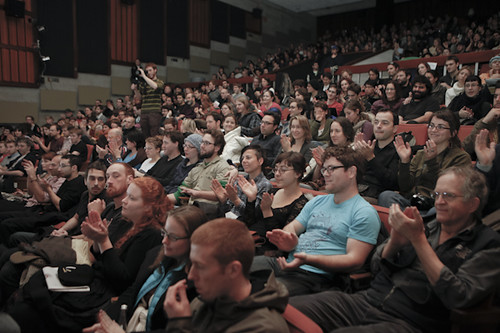
Cinema Politica is now, according to programmer Ezra Winton, the biggest community- and campus-based documentary screening network in the world! And Concordia, its home base and launching pad, continues to be the scene of weekly screenings often attended by more than 500 people – quite an achievement!

This time, after several years of efforts, Winton and CP Director Svetla Turnin had succeeded in bringing the Yes-Men to Montreal. Do you know who they are? They are surely the world’s leading impostors of the serious-humorous kind. They have pulled off some incredible hoaxes, and always at the expense of governments and corporations who should have reasons to be ashamed of their doings.

The Yes-Men modus operandi is to create false websites which lead people to invite them to conferences as representatives of the ‘bad guys.’ Once there, they push the envelope, taking corporate and government strategies to absurd levels, announcing outrageous schemes. The most incredible thing about their stunts is that people usually take them seriously, even when they propose, for example, human remains as a new energy source or human waste as a protein source for the poor.

On behalf of Dow chemicals, they apologized for the Union Carbide disaster in Bhopal and promised compensation for the victims. They got terrific coverage on BBC news around the globe, forcing DOW (the new owner of the UC assets) to strenuously deny that they had done something good! The Concordia crowd saw these feats in the film The Yes Men Fix the World, produced by Andy Bichlbaum and Mike Bonnano themselves, as a follow-up to the 2003 film The Yes Men.

I found the film a little uneven but full of brilliant ideas. For example, some arch-conservative U.S. climate-change deniers and free-market apostles are shot against a blue screen and are asked what they would like to see as a background for themselves. They then take the interviewees’ suggestions to heart, in their own humorous fashion, and use the backdrops as an ironic backdrop to their comments. Talk about giving people the rope to hang themselves. And most of all, the footage of the Yes Men’s stunts is priceless.

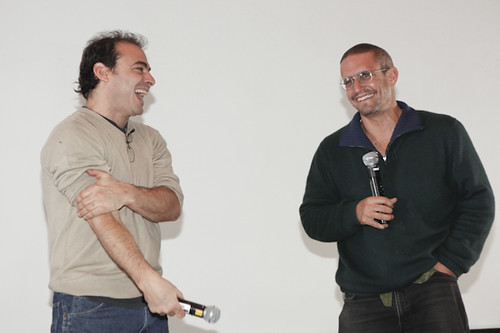
The Yes Men

In the discussion afterward, Andy and Mike (actually Jacques Servin and Igor Vamos) explained that they are anti-capitalist, that they take advantage of opportunities to expose fraud and ill-doing, that they haven’t generally had problems with lawsuits, and that they encourage people everywhere to follow their example.

In response to the many activists who inevitably wanted to know if they had done something on their pet issue, they gave the sound advice: why don’t you do it yourselves!

Congrats to Cinema Politica for an exceptional last-screening-of-the-year!

Cinema Politica crowd at Concordia

With thanks to Tobi Elliott for her help with this blog. Photo credit: Thanh Pham
Wearing two hats

Mukash, Isacsson & Sioui-Labelle
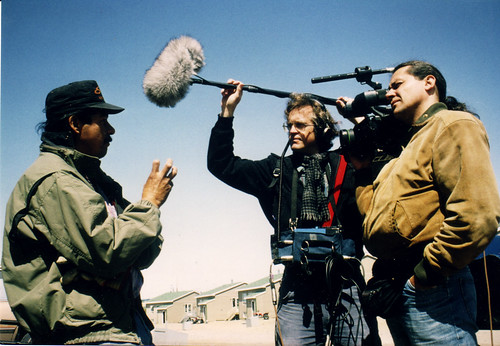
Myself and DOP René Sioui-Labelle shooting Power at Hudson’s Bay in the early 90s interviewing Cree chief Matthew Mukash.

Film students sometimes ask theoretical questions which, while not uninteresting, are not particularly important to a practitioner. But Tom Eden from the documentary program in Rivière du Loup asked me this: is it a good idea to direct and to do camera and sound at the same time?

This is a big question, and I could write a book about it. Some pioneers of cinéma vérité did their own camera work (Pennebaker) or sound (Wiseman). Some of my colleagues whose work I admire do their own camera work: John Walker, Martin Duckworth, Ali Kazimi… and I do my own sound – as did one filmmaker who really inspired me, Barbara Kopple.

I think some of us took this approach years ago because we wanted to have a small crew and also to maximize the number of shooting days (by spending less money per shooting day.) But the combination of reduced budgets and accessible digital technologies have really brought this way of working to the fore.

These days there are filmmakers who do everything themselves – one example is Montreal filmmaker Eve Lamont, who just released a film on prostitution (L’Imposture), which she directed while doing camera and sound herself. An impressive achievement, considering some of the situations involved several different characters, sometimes in uncontrolled environments.

The other day I saw a very good film, Gasland (shortlisted for the Oscars) shot by the filmmaker – but the shooting is pretty awful. What saves the film is the personal narrative tone, the investigation and the excellent editing. Imagine if it had been well shot as well!

For me, doing camera work would have come naturally, as I have a background in visual arts and photography. But I have chosen to do sound because I find that it allows me to have a better overview of what’s going on, looking around to see what else is going on outside of the frame.

So… doing creative tech work while directing has many advantages, primarily reducing the size of the crew and controlling costs. But here is a caution. Directing really requires your full attention. So does camera work and sound recording. So if you wear two of these hats at the same time, you are inevitably compromising.

If you are on a tight production schedule, something will get less attention. So one key issue is time. Doing camera or sound is great if you know how to do it, and you are not in a rush! Another key is really knowing your gear. (You don’t want to be struggling with tech issues at the crucial moment when you need to reassure your characters, negotiate access, ask a key question…) And your relationship and communications with whoever else is working with you needs to be really tight.

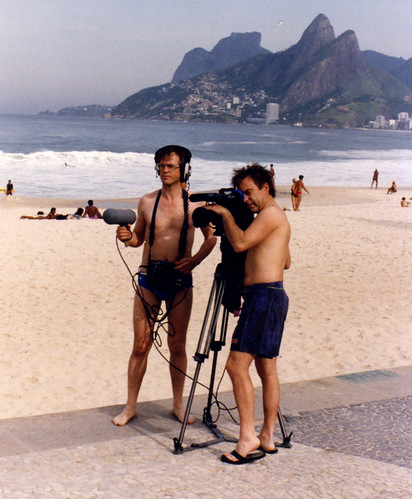
Here is an old photo to show that directing and doing tech work can be fun: myself and DOP James Grey on a beach in Rio during the 1992 Earth Summit in Rio de Janeiro.

Rio beach

Thanks to Tobi Elliott for her help with the blog.

Kim Longinotto and the Pink Saris

Pink Saris film by Kim Longinotto

Last week, at the Rencontres Internationales du Documentaire de Montréal, I had a chance to see the latest film by one of the world’s best documentarians, Kim Longinotto. In Pink Saris, she tells the story of the ‘Pink Gang’ of women in Uttar Pradesh, one of India’s poorest states. Led by a tough lady named Sampat Dal Devi, these “untouchables” (lowest caste) women take on violent or abusive husbands and corrupt officials.

The film has all the characteristics of a Longinotto documentary: it has amazing access to intimate situations, it deals with the rights of women, it’s tough and uncompromising, and doesn’t stay away from contradictions and difficulties. In this case, the main character is admirable, but Longinotto doesn’t idealize her, and at one point the film clearly shows her making a selfish and morally questionable choice which has serious consequences for a young woman who she has taken under her wing. The film is beautifully shot by the director herself.

Kim Longinotto @ Hot Docs
Photo: Paul Galipeau

I went to hear Longinotto speak at a workshop at Hot Docs last spring. I was very impressed by her modest and unassuming presentation. What struck me the most was her combination of caring for her subjects but her incredible tough-mindedness. She is so close to the characters that they will, it seems, let her film just about anything, no matter how hard it is.

And she does – even when the scenes are almost unbearable to watch, as in a famous scene from a female genital mutilation in Africa. Life is often unbelievably hard for women in ‘Third world’ countries, and Longinotto is determined to show it – but always from the perspective of people who are working to change the situation. It’s an attitude which seems to be rooted in her own harsh childhood experience as a homeless orphan, and her feeling that filmmaking “saved her life.”

Here is a list of some of Longinotto’s films:

Rough Aunties (2008)

Hold Me Tight, Let Me Go (2007)

Sisters in Law (2005)

The Day I Will Never Forget (2002)

Runaway (2001)

Gaea Girls (2000)

Divorce Iranian Style (1998)

Shinjuku Boys (1995)

Dream Girls (1994)

The Good Wife of Tokyo (1992)

Eat the Kimono (1989)

Underage (1982)

Thanks to Tobi Elliott for her help with this blog.
Super-Grannies – and two shorts

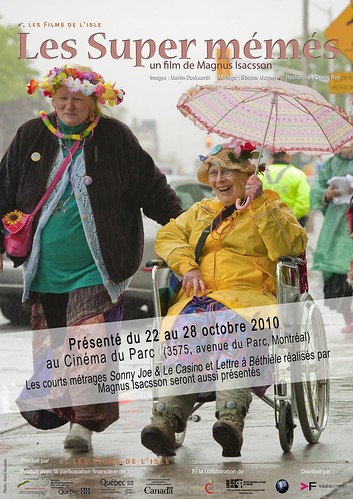
Les super mémés at Cinema du parc

The normal progression for a budding filmmaker has generally been from student films and shorty shorts towards longer shorts, and then medium-length films and finally feature length ones. Working on the short films, he or she would learn the ropes, learn how to use equipment and tell a story. Later on, with more resources, would come a bigger crew and competent technicians or co-creators.

Not so in my case. When I started making audiovisual stories for television, I already had many years of storytelling behind me as a radio producer. And as a television ‘producer’ (meaning actually director) at CBC and Radio-Canada television, I didn’t have the right to touch the equipment. I remember the editors saying to me, “You can screen the cut again while I’m on my break, but close the door and don’t tell anyone.” It was a co-conspiracy by the bosses and the union.

Things have changed a lot since then! Now, in the digital world, many television journalists and directors do their own shooting and editing.

And for my part, I am looking after the beginnings I never had as a filmmaker. Over the last couple of years, I have made my first short films. And they will be screening at the Park Cinema in Montreal, before my film Super-Grannies (subtitled version of ‘Les Super-Mémés’) from Oct. 18th to 22nd.

Here is a brief description of the three films – with apologies for the PR language!

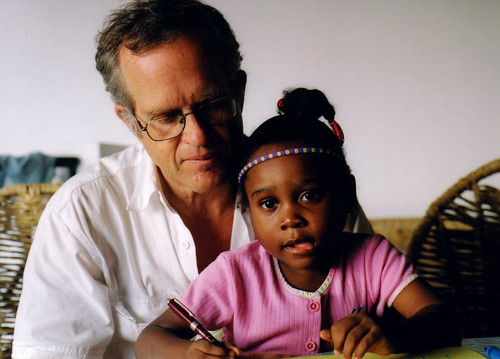
Béthièle & Magnus

Letter to Béthièle. (8 min. 2010) In French with English sub-titles.

In a touching visual letter to his adoptive daughter Béthièle on her 10th birthday, Montreal filmmaker Magnus Isacsson reflects on her roots in Haiti and his own in Sweden, drawing some surprising conclusions.

Sonny Joe & the Casino

Sonny Joe & the casino. (22 min. 2004)

Sonny Joe Cross collects used clothes from the residents of the Mohawk territory of Kahnawake. He sells some in his store and gives the rest to the homeless and poor in nearby Montreal. A former hard-drinking gambler, Sonny Joe leads a suspense-filled campaign against a casino promoted by the band council.

Les super-mémés. (45 min. 2010.)

Decked out in gaudy shawls and outrageous hats brimming with a cacophony of colours, «Raging Grannies» defy the invisibility so often experienced by older women. They are a colourful presence at most demonstrations and grassroots meetings promoting peace, social justice and environment.

On the surface, they are amusing, even hilarious. But underneath that humorous veneer, they are deadly serious. The film does more than portray of the movement and its members. It raises universal issues very seldom addressed by the current media, such as the role of senior citizens in our society. “With this documentary film, I wanted to accomplish myself what these exceptional women do so well: entertain while forcing us to reflection,” says the filmmaker.

Production: Island Filmworks

Distribution: Vidéo Femmes

Thanks to Tobi Elliott for her help with the blog.

The Experimental Eskimos broadcast premiere

The Experimental Eskimos 1

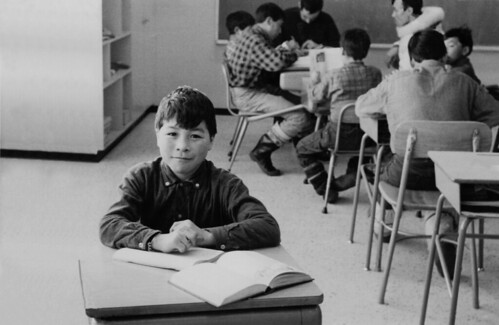
Barry Greenwald‘s terrific documentary The Experimental Eskimos reveals an extraordinary attempt at social engineering. The film follows three Inuit, Peter Ittinuar, Zebedee Nungak and Eric Tagoona, who, as 12-year-old boys, were shipped South in the early 1960s from their homes in the Canadian Arctic to attend white public schools in Ottawa. The consequences for their identity and culture were brushed aside.

In their twenties, they became a thorn in the government’s side and were instrumental in the establishment of aboriginal rights that led to the creation of the territory of Nunavut. The film is the untold story of how an experiment in assimilation not only changed the future of their people but the actual geo-political configuration of Canada.

My friend Barry’s previous documentaries include Taxi!, Who Gets In?, Between Two Worlds, The Negotiator, and High Risk Offender. Barry, Ali Kazimi and I share a website, and Barry’s complete bio can be found here.

The film will have its World Broadcast Premiere on Wednesday October 13 at 9 pm ET/MT on the Aboriginal Peoples Television Network‘s (APTN) Reel Insights strand across Canada.

Now, if I praised this film you might find that suspect, as Barry is a close friend of mine. So let me quote filmmaker Martin Duckworth – he copied me on a message to Barry after seeing the film:

What a brilliant and beautiful film, Barry. Such a great story, and so cleverly told. Relating personal tragedy and political triumph. Allowing the story to unfold at its own pace, with each chapter appearing as a surprise and a revelation. The film is a work of ingenuity and dedication. Chiseled to perfection. You have reached a pinnacle. It leaves one wondering, “What is there left for this guy to do?” My god, I must look at it again.

Eskimos received the “Allan King Award for Excellence in Documentary” at the recent Directors Guild of Canada Awards (Editor Nick Hector, Sound Editor Michael Bonini, Director Barry). The film has also received honours at the Winnipeg Aboriginal Film Festival (Best Feature Documentary) and the Yorkton Film Festival (NFB Kathleen Shannon Award).

Have a look at the trailer here.

Thanks to Tobi Elliott for her help with this blog.
Documentary and globalization: favouring understanding

Age of Stupid - Sydney
A still from the documentary "The Age of Stupid", directed by Franny Armstrong

I have just spent two weeks teaching at Whitman College in Walla Walla, Washington State. More on my course another day, but I also had the opportunity to speak to the students and faculty about Documentary in the Context of Globalization.

I talked about how the new digital technologies have democratized access to audio-visual production and how the web has made it possible to instantaneously distribute videos worldwide. This has opened up a two-way street, making local stories available to the world, and bringing the world (or stories from elsewhere in the world) to audiences just about everywhere.

To illustrate my points, I showed excerpts from three films. Burma VJ is one I wrote about on my blog earlier. The film documents the use of small digital cameras by courageous video journalists – VJ’s – to reveal what goes on inside the Burmese dictatorship. With digital cameras and satellite uploads they distribute images worldwide within hours. Their work made all the difference during the 2007 uprising led by Buddhist monks across the country.

Another example I used was the video of the killing of a young Iranian woman during the 2009 protests in that country. It graphically showed her dying moments, and really touched people emotionally. Thanks to the web and cell phone – Twitter was particularly instrumental – it spread like wildfire, and actually helped change the relationship of forces between the regime and the opposition.

As an example of how the new production and distribution context has allowed people who did not traditionally have access to the resources to express themselves audiovisually, I used the amazing Wapikoni mobile experience, which has been running for six years in Quebec. Young aboriginal people have been given training and access to production facilities, and the result is impressive. Many of their films have been presented at festivals and won awards.

For some filmmakers, the starting point is not local but global. That was the case with the 2009 film The Age of Stupid by Franny Armstrong. The premise, established with much aesthetic panache, is that while the world has gone to ruin, one man (played by Pete Postlethwaite) remains in the Global archive in 2055. His archives reveal the stupidity of the people of our era who knew the world was on the road to perdition but didn’t act – stories set, naturally, in our own time.

Finally, I spoke about the phenomenon of immigrant directors (or children of immigrant families) making films about their home countries in the ‘developing countries’. Having access to the funding mechanisms of the richer countries as well as an intimate knowledge – or at least personal connection – to their country of origin, these talented directors have made some great films. Ali Kazimi’s Narmada – A Valley Rises, Rithy Panh’s films about Cambodia are good examples, but I chose to show an excerpt of Up The Yangtze by Yung Chang (NFB & EyeSteel Films).

There are increasing numbers of excellent films coming out of the countries in the South. As a member of the board of the Alter-Cine Foundation, I am able to see the incredible diversity of projects from Asia, Africa and Latin America looking for funding every year. Just reading the proposals, one gets a sense of the many aspects of reality which are not adequately covered by our television networks.

Conclusion – it sound a little simplistic when summarized, but it’s true: by offering a more in-depth treatment of other realities, documentaries contribute to understanding and awareness between peoples.

Thanks to Tobi Elliott for her help with this blog.
Inspiration: The artists in my family, part 1

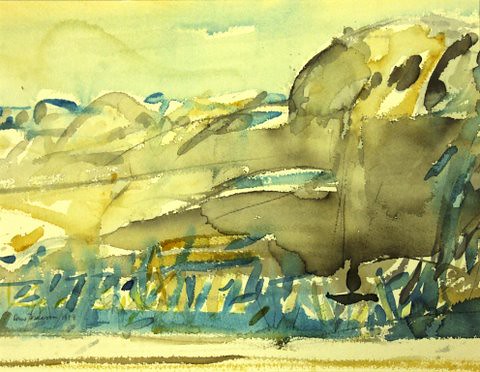
8-Båt-i-vinterfjord-1987
Båt i vinterfjord, 1987 ( Boat in fjord, winter, 1987)

I come from a family of teachers and the artists. From the former, in particular my mother Kerstin and her father Effe, I learned about the value of intellectual curiosity and learning. From the artists I feel I learned not just about aesthetics, but also about the value of a creative interpretation of the world around you.

And most of all an attitude: when you have something to do, do it. When you have something to say, say it. Even if it isn’t what’s popular at the moment, even if it isn’t easy, even if it costs you a lot.

I see myself more as an artisan than an artist, but that heritage is precious. I think of it when people look at my sometimes almost-impossible five- or six-year projects and tell me that in my place, they might have given up.

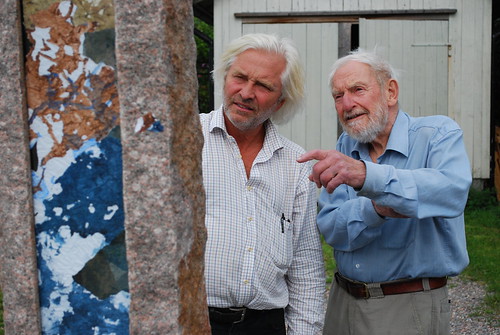
Pål Svensson and Arne Isacsson
Pål and Arne, with a scale model of their sculpture PålArne.

My father Arne Isacsson founded an art school, Gerlesborgsskolan, on the Swedish Atlantic coast in 1944. It soon operated summer courses in Provence and a division in Stockholm, and it soon grew to become the biggest private art school in Scandinavia.

When I was young my dad was mostly busy running the school, but since he retired some twenty years ago he has had more time to devote to his own art. Working mainly in aquarelle, he has pioneered new techniques, notably with laminates of watercolours, which make it possible to produce large-scale works for public installations.

Last year, he completed two “watercolour sculptures” together with the sculptor Pål Svensson. Totally original works, they stand several meters high and look out over the ocean. If I had lived in Sweden and not in Canada, I would have made a film about their joint creative process.

Still innovating, at the age of 93, my father really is an inspiration!

Arne’s wife Margareta Blomberg is also an artist, often they exhibit together. My sister Eva, also an artist on the Swedish west coast, combines the heritage of Arne and my uncle Torsten Renqvist in sensitive drawings and more conceptual collages.

Thanks to Tobi Elliott for her help with this post.

GDP/PIB: A conversation with Hélène Choquette

PIB/GDP: 'Une chance qu'il y a des mots'
Photo credit: Hélène Choquette

This week: following my previous post on the NFB‘s multi-platform project GDP: Measuring the Human Side of the Canadian Economic Crisis, here is an interview with Hélène Choquette, the project’s director and coordinator.

The above image is pulled from the excellent photo essay, Poetic Justice one of Hélène’s own compositions – featuring the young slam poet Marjolaine Beauchamp.

1. What was the most difficult part or challenge of making this project? The bilingual nature, traversing the “solitudes”, working from coast to coast, or something else?

Bringing together a group of documentarians and photographers from one end of the country to the other for a common year-long project was a challenge in itself. We spent a week together in June 2009: I presented the goals of the project and each and every one could share their own creative point of view.

Over and above bilingualism, GDP puts forth universal stories of humanity. When we look at the origin of the movies Quebecquers are viewing, we can see they are not only viewing movies from here, and it is the same thing is all the provinces. The resilience and demands that a human being must confront when faced with crisis situations are surely universal.

We also discovered that web users recognize themselves in the stories of those people who work in sectors or industries similar to theirs, without regard for geographic location. As a result, the fact that the site is bilingual permits us to counter this linguistic divide.

I also want to share with you the qualities of the Web that we’ve since discovered. We have no restrictions of length, or number of episodes, or the pacing of putting them on line. We are simply following the natural rhythm of our stories, which is frankly marvellous.

Hélène Choquette - PIB/GDP
Photo Crédit : Marc-André Grenier

2. I find the quality of the small films or reports very uneven. What do you think? Reasons?

GDP is a pilot project where trial and error have their place. When it’s a question of the creative process, this notion of trial and error is precious. It’s what challenged Fernand Dansereau when he discovered GDP last December. This possibility of playing outside a safe and secure box.

We are asking our directors to be one-man-orchestras. They accomplish all at the same time camerawork, sound recording and obviously, the directing. It’s extremely demanding. They are not all on the same level technically but despite some limitations, all end up delving into the universe of their protagonist.

Of course, some stories are stronger, but all have their relevance. Unequal quality is unfortunately often the lot of these group productions. However, because we’re on the Web, the user has the choice to watch only what interests them.

It’s astonishing to see that the most viewed films and essays are not always the best from a technical point or view, and even in terms of narration. That’s where we have a new gift from the Web. The user chooses what he or she pleases. As a documentarian, I would like to cause them to be interested in one story more than another, but I no longer have that privilege with this virtual audience.

3. There are some photographic essays that are particularly well done, do you agree? Reasons?

The photographic essays had as their first goal to document the impacts of the crisis in the far-flung regions. They are small, unique works, and so are a lot easier to watch as one-offs, while the narrative arc of the films evolved over one year, and take their meaning in time. They are a powerful artistic force.

The web effectively gives a new breath to certain mediums that have preceded it. Photography thus finds a new momentum, and the photographers have a chance to push their creativity more to the fore, and that is wonderful to me.

Thanks to Tobi Elliott for her help with this post.